Dwain Northey (Gen X)
The Strange Contradiction of Wanting to Belong
There is something about myself that I have been trying to understand, and quite honestly, I don’t know whether it is a personality trait, something psychological, or simply a collection of experiences that have accumulated over the years and changed the way I interact with people. I have a tendency to intentionally withdraw from gatherings, particularly those involving family, friends, or occasions where there is some expectation that I should be present. The strange part is that I don’t necessarily have a problem interacting with people. I can have perfectly pleasant conversations with complete strangers. I can exchange pleasantries, joke around, carry on a conversation, and generally function just fine in social situations. But put me in a room full of family, at a wedding, a holiday gathering, or some other occasion where I am supposed to belong, and something changes.
I withdraw.
Not necessarily because someone has said something offensive or because I dislike the people there. Sometimes I can’t even identify a specific reason. I simply develop this overwhelming feeling that I don’t belong in that particular environment. Almost as though everyone else has received an invitation to participate in something that I somehow missed. I become an observer rather than a participant, and eventually, my instinct is to remove myself from the situation altogether.
I’ve wondered whether there is some psychosocial explanation for this. Social anxiety? Avoidant behavior? Some form of rejection sensitivity? Perhaps something rooted in the way I perceive my relationships with other people. I genuinely don’t know. What I do know is that there is a distinction between being comfortable talking to someone and being comfortable belonging to a group of people.
And apparently, those are two very different things for me.
The more I think about it, the more I realize this isn’t necessarily a new development. Historically, I’ve never had a particularly large circle of friends. In fact, I’m not sure I’ve ever had that one consistent friend who has remained a part of my life from one chapter to the next. I’ve moved through different places, different stages of life, different relationships, and different circumstances without ever really developing that permanent social circle that so many people seem to have. There have been acquaintances, coworkers, people I’ve enjoyed spending time with, and relationships that were meaningful for a period of time. But that enduring connection, that person you can call after six months or six years and pick up exactly where you left off? I’ve never really had much of that.
Perhaps I’ve become accustomed to being independent because I’ve never had much experience being otherwise. Or perhaps I’ve developed a habit of keeping people at a comfortable distance because, somewhere along the way, I’ve learned that relationships are temporary.
But there is another piece to this puzzle that I recently started considering, and it goes back much further than my adult relationships. In fact, it goes all the way back to childhood.
I’ve never been particularly comfortable with gatherings centered around food.
That might sound like an odd thing to identify as a source of social discomfort, but when I look back, I realize it’s been a consistent pattern throughout my life. Family dinners, holiday meals, workplace functions involving dinner, and other occasions where the primary activity is sitting around a table and eating have always been situations I’ve tended to avoid or remove myself from.
Christmas. Thanksgiving. Family gatherings. Work dinners.
These are supposedly the occasions when people come together, share a meal, reconnect, and enjoy one another’s company. For me, they’ve often been occasions to find a reason not to participate.
I didn’t eat at my son’s wedding. I don’t generally participate in the food-centered portion of family holidays. Even work-related dinners have historically made me uncomfortable. I can attend an event, have a conversation with someone, and be perfectly comfortable for a while, but when the emphasis shifts to sitting down and eating, I tend to disengage.
What’s particularly interesting is that I can’t necessarily explain why. This behavior predates my MS diagnosis by decades, so I can’t simply attribute it to my medical condition.
Of course, MS has introduced another complication. I occasionally have difficulty swallowing, and sometimes food gets caught in my throat. That’s an uncomfortable experience under any circumstances, but it’s particularly something I don’t want to deal with in front of a room full of people. The thought of choking, struggling to swallow, or having to explain what’s happening while everyone else is enjoying dinner is enough to make me avoid the situation altogether.
That’s understandable on one level. But it doesn’t explain why I was doing essentially the same thing long before I had MS.
Perhaps the diagnosis has given an existing discomfort a more tangible explanation. Maybe something that was once simply an unexplained social aversion now has a medical component that reinforces it.
I find myself wondering whether there is something about the vulnerability of eating in front of other people that makes me uncomfortable. Eating is an unusually personal activity when you think about it. You are sitting there, engaged in something that requires your attention, following a social ritual that everyone else seems to navigate without giving it a second thought. Perhaps it’s the lack of control, the expectation to participate, or simply the feeling of being observed.
I don’t know. But I find it interesting that I can comfortably spend time talking to people while simultaneously avoiding one of the most fundamental ways human beings socialize.
Food is supposed to bring people together. Apparently, it has been one of the things I’ve spent much of my life finding ways to escape.
Then there is another consideration that I don’t think I can ignore: my diagnosis of multiple sclerosis.
A chronic medical condition changes the way you look at your future, even if you don’t necessarily talk about it with other people. It’s not simply the symptoms, the pain, the physical limitations, or the uncertainty of what tomorrow might bring. It’s the realization that the person you are today might not be the person you are five or ten years from now.
And that thought carries some considerable emotional baggage.
I’ve found myself thinking about the possibility of becoming increasingly dependent on other people as my condition progresses. I know what that could potentially mean, and one of the things I am particularly determined to avoid is becoming a burden to someone else. I don’t want someone to feel obligated to take care of me. I don’t want a friend, a family member, or someone who has become emotionally invested in my life to eventually find themselves responsible for managing the consequences of my declining health.
I realize that might sound like an unreasonable assumption about a future that hasn’t happened. It might even be an unfair assessment of the people who would willingly be there for me. But the thought exists nonetheless.
And it raises an uncomfortable question: Could I be intentionally preventing myself from developing closer relationships because I’m afraid of what those relationships might eventually demand of other people?
Perhaps keeping people at a distance is a way of protecting them from a future I cannot predict. If I never become particularly close to someone, I never have to worry about asking too much of them. If I don’t establish those deep emotional connections, I don’t have to contemplate the possibility of someone eventually having to make sacrifices because of my health.
There is a certain twisted logic to that kind of thinking. It also means I might be depriving myself of the very relationships that could make navigating that future a little less difficult.
I don’t know whether that fear is consciously driving my behavior, but I suspect it deserves more consideration than I’ve given it.
The most difficult part is that I recognize the contradiction in my own behavior. I’ll see photographs from a family gathering or some event and feel a genuine sadness that I wasn’t included in those moments. I’ll look at pictures from my son’s wedding and realize there are memories being made that I am not part of. Then I have to remind myself that I was there. I was invited. I had every opportunity to participate. But I spent much of that occasion feeling like an outsider, and I didn’t even participate in the meal. I allowed that feeling to dictate how much I involved myself.
It’s a peculiar form of self-inflicted exclusion. I want to be included, but I make myself unavailable for inclusion.
And perhaps that’s what bothers me most. I can’t entirely blame other people for not noticing my absence when I’ve become so remarkably good at removing myself from the equation.
There is another aspect of this that is considerably more painful, though. It’s one thing to see photographs of events you chose not to attend. It’s something entirely different to see photographs from periods of your life when you were actively involved, when you were part of the family, part of the relationship, part of the history, only to discover that you’ve seemingly been removed from those memories.
Those photographs carry a different kind of sadness.
They represent more than a social gathering or a moment in time. They represent a period when you believed you belonged somewhere. And seeing yourself absent from those images, particularly when you know you were once present in that chapter of someone’s life, can feel like an uncomfortable reminder that other people’s memories and your own memories don’t always overlap anymore.
I sometimes wonder whether experiences like that contribute to my tendency to withdraw. Does repeatedly feeling like an outsider eventually make you behave like one? Does being excluded, whether intentionally or through the natural progression of relationships, reinforce the idea that you don’t really belong? And does that eventually become a self-perpetuating cycle?
Perhaps it works something like this: I anticipate feeling uncomfortable, so I withdraw. Because I withdraw, people become accustomed to my absence. Eventually, invitations become less frequent, photographs are taken without me, and conversations happen without my participation. Then I see those things and feel excluded, which reinforces the original instinct to withdraw the next time an opportunity presents itself.
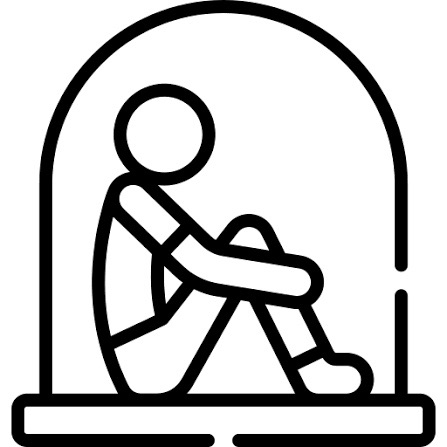
It’s a rather efficient little psychological trap. I construct the walls, complain about being on the outside, and then wonder why nobody is standing beside me.
But I don’t think the answer is quite that simple.
There are years of experiences behind these feelings. A marriage that ended, relationships that changed, a family dynamic that evolved, and the gradual realization that the people who once occupied the center of your everyday life have moved into different chapters of theirs. You can understand intellectually that life moves forward and that people establish new families, new traditions, and new routines. Understanding something intellectually doesn’t necessarily mean you’ve reconciled yourself to it emotionally.
And perhaps family gatherings make those changes particularly difficult because they are supposed to represent belonging. They are supposed to be the places where you don’t have to explain yourself, where your presence is assumed, where you can simply exist among people who know you.
Yet those are precisely the environments where I sometimes feel most uncomfortable.
I can sit in a car with a complete stranger, have a twenty-minute conversation, exchange a few laughs, and go about my day without giving it another thought. But put me around a table with people who have known me for years, and I can find myself wondering where I fit into the conversation, whether I’m intruding, or whether my presence is even particularly meaningful.
Maybe there’s a difference between being socially capable and feeling emotionally connected. I seem to manage the first reasonably well. The second is considerably more complicated.
And perhaps there is something else happening here. Maybe brief conversations are comfortable precisely because they don’t require anything beyond the moment. There is no expectation of a future relationship, no emotional investment, no obligation to explain my circumstances, and no possibility of becoming dependent on someone or having someone become dependent on me. When the conversation ends, it ends. Everyone goes about their business.
Relationships are different. They require continuity. They require allowing someone to know you, including the parts of yourself that aren’t particularly easy to explain. They require vulnerability, and vulnerability means accepting that someone might eventually see you at your least capable.
Maybe that’s what I’m avoiding.
I don’t want to casually diagnose myself with a disorder, because I recognize that social withdrawal can have several explanations, and feeling uncomfortable in groups doesn’t automatically mean something is clinically wrong. Social anxiety, depression, loneliness, unresolved grief, chronic illness-related anxiety, and avoidant coping patterns can all contribute to this kind of behavior. Sometimes several things overlap. It might be worth exploring with a therapist, particularly because the withdrawal seems to be causing me genuine sadness and interfering with relationships I would actually like to maintain.
I also wonder whether the discomfort around food deserves to be explored independently rather than automatically lumped into the same category as my social withdrawal. There may be a psychological explanation, a sensory component, a fear of being observed, or something else entirely. The fact that it began in childhood makes it worth examining on its own merits. And given my swallowing difficulties with MS, it’s something I should discuss with my neurologist or a swallowing specialist rather than simply accepting that avoiding meals in public is my only option.
But I also think there’s a question I need to ask myself that is considerably more difficult than identifying a psychological label.
Am I withdrawing because I don’t feel like I belong, or have I withdrawn so consistently that I’ve forgotten how to feel like I belong?
And perhaps an equally uncomfortable question:
Am I keeping people at a distance because I genuinely prefer solitude, or because I’m afraid that someday my health might require more from them than I’m willing to ask?
And one more:
Have I spent so much of my life avoiding situations that make me uncomfortable that I’ve inadvertently avoided some of the experiences that create lasting relationships in the first place?
Those are very different problems, even if they eventually produce the same result.
I don’t necessarily want to become the person who attends every gathering, works the room, sits through every dinner, and participates in every family photograph. That’s not particularly realistic, nor is it necessarily what I want. I value my solitude. I enjoy my own company. But there’s a difference between choosing to be alone because you enjoy it and finding yourself alone because you’ve gradually become uncomfortable being anywhere else.
I think I’ve occasionally confused the two.
And perhaps I need to reconsider this notion of being a burden. There is a difference between allowing someone to care about you and making them responsible for your existence. There is a difference between accepting someone’s friendship and expecting them to become your caretaker. I may be trying to protect people from a hypothetical future at the expense of allowing myself to experience meaningful relationships in the present.
That’s a rather significant price to pay for something that hasn’t happened.
I also don’t want to look back years from now and discover that I missed an entire collection of memories, not because I wasn’t wanted, but because I couldn’t convince myself that I belonged there. Or worse, because I decided that the possibility of needing someone someday was reason enough not to let anyone get close today.
I don’t have a tidy conclusion to this. I’m still trying to understand it. I still see photographs and feel that little pang of sadness. I still recognize my own fingerprints on the circumstances that produced that sadness. And I still have questions about how much of my withdrawal is a choice, how much is learned behavior, and how much might be rooted in the uncertainty of living with a progressive medical condition.
Maybe the first step isn’t forcing myself into every gathering or pretending these feelings don’t exist. Maybe it’s recognizing the difference between the instinct to withdraw and the actual desire to leave.
Because sometimes I suspect that the person who wants to leave the room isn’t necessarily the person who wants to be alone.
Sometimes he’s just the person who doesn’t know how to feel welcome anymore.
And perhaps he’s also someone who has become so concerned about being a burden to others that he’s forgotten he might have something to gain from allowing others into his life.
I don’t know.
But I am beginning to wonder whether the walls I’ve spent so much time building to protect myself, and perhaps everyone else, have become the very things keeping me from experiencing the connections I occasionally find myself missing.
Maybe those walls were built long before I understood why I needed them. Maybe some of them have nothing to do with the people standing outside them. And maybe it’s time I started figuring out which walls are protecting me and which ones are simply keeping me alone.
And that’s a considerably different kind of loneliness.

