Dwain Northey (Gen X)
https://www.cbsnews.com/news/naacp-travel-advisory-florida-says-state-hostile-to-black-americans/
Remember the good old days when there were only travel advisories and or ban for, what some would call, third word countries? Well now because of the vile vitriol of one Governor Ron DeSantis the state of Florida, a vacation destination, has received a travel advisory by the NAACP.
The wannabe future President has made the climate so venomous in Florida the anyone who is a part of any minority group does not feel safe in the state. Black, Brown, LGTBQ+, these are all groups that are under attack in the Sunshine State. The majority Republican legislature and their fearful leader has passed laws that make almost everything a jailable offence and the fact that the state has very loose gun laws and a stand your ground law makes it more dangerous than being a blonde female in central America.
Florida residents are able to carry concealed guns without a permit under a bill signed into law by Republican Gov. Ron DeSantis. The law, which goes into effect on July 1, means that anyone who can legally own a gun in Florida can carry a concealed gun in public without any training or background check. This with their ridiculous stand your ground law, ‘Florida’s “Stand-Your-Ground” law was passed in 2005. The law allows those who feel a reasonable threat of death or bodily injury to “meet force with force” rather than retreat. Similar “Castle Doctrine” laws assert that a person does not need to retreat if their home is attacked.’ Makes it really sketchy to go there.
This in top of the don’t say gay rule and the new trans ruling that just passed.
“Florida lawmakers have no shame. This discriminatory bill is extraordinarily desperate and extreme in a year full of extreme, discriminatory legislation. It is a cruel effort to stigmatize, marginalize and erase the LGBTQ+ community, particularly transgender youth. Let me be clear: gender-affirming care saves lives. Every mainstream American medical and mental health organization – representing millions of providers in the United States – call for age-appropriate, gender-affirming care for transgender and non-binary people.
“These politicians have no place inserting themselves in conversations between doctors, parents, and transgender youth about gender-affirming care. And at the same time that Florida lawmakers crow about protecting parental rights they make an extra-constitutional attempt to strip parents of – you guessed it! – their parental rights. The Human Rights Campaign strongly condemns this bill and will continue to fight for LGBTQ+ youth and their families who deserve better from their elected leaders.”
This law makes it possible for anyone to just accuse someone of gender affirming care to have their child taken from them this would include someone traveling from out of state. This alone justifies a travel ban to the Magic Kingdom for families.
Oh, and I haven’t even mentioned DeSantis holy war with Disney, the largest employer in the state. I really hope the Mouse eats this ass holes lunch.
Well that’s enough bitching, thanks again for suffering though my rant.
-
Photos by Michelle

-
In Defense of Smart People

Do you believe that highly intelligent people are socially stunted? If so, you certainly wouldn’t be alone in assuming this stereotype. Many people believe that those who are smart or who are highly intelligent tend to be lost at sea where it comes to social skills, believing they lack interpersonal sense and sensitivity. This belief has persisted for centuries, and I have even personally encountered the odd uninformed organizational psychologist – someone specializing in human thought, feeling, and behaviour as applied to the workplace – who still believes that smarts and social skills are at odds with one another. In fact, it’s the ubiquitousness of this stereotype and its intransigent nature that’s motivated me to write on this subject. Thankfully, you don’t have to take my word alone on this matter. Recent research has indicated that this belief is more likely a myth than an informative and explanatory stereotype. In this article, I want to give you all a little taste of the most compelling research dispelling this myth while letting you in on precisely why holding onto this debunked stereotype could be quite costly in the end.
Intelligence and Interpersonal Sensitivity
A meta-analysis conducted by Nora A. Murphy and Judith A. Hall investigated the association between general intelligence and interpersonal sensitivity. Interpersonal sensitivity refers to the ability to accurately decode social cues, such as facial expressions and tone of voice, and understand their intended meaning. It’s a landmark feature of emotional intelligence and can be incredibly helpful in helping you to understand and communicate with others. Nora and Judith’s review involved 38 independent samples with nearly 3,000 total participants. The study found a small-to-medium effect for intelligence measures to be positively correlated with decoding accuracy (r = .19, p < .001). In other words, smarter people tended to be better at accurately interpreting and responding to the social and emotional cues of others.
It is important to note that significant moderators were found to include the type of decoding judgment (emotion vs. intended meaning judgments), decoding channel (audio-only vs. audio-plus-video channel), and target gender (both male-and-female targets vs. female-only targets having their emotions evaluated). This means that the association between general intelligence and interpersonal sensitivity can vary depending on the specific context of the social interaction. Nevertheless, the study’s findings suggest that cognitive abilities comprising general intelligence are part of the social skillset required for decoding emotions accurately.
All of this is important in a business context in the sense that you want to be putting highly skilled people into roles that they’re likely to thrive within. If you hold the stereotyped belief that smart people are likely to be socially stunted, you’re likely to be passing over highly qualified candidates for roles they’re actually well suited to perform within. Ultimately this sort of thinking can result in losses grounded in bias and unfounded assumptive stereotypes. Although this is far from the only instance where bias and stereotypes can harm businesses and the individuals within them, it’s certainly something we can actively avoid through awareness and a dedicated effort to combat faulty cognitive shortcuts of thinking.
Take-aways for you and your practice
These research findings have practical implications for leaders, managers, and individuals looking to improve their interpersonal skills. Leaders and managers can take advantage of these research findings by creating an environment that encourages and rewards intelligence of all sorts and that recognizes and accepts people for their unique contributions. They can try to combat their own biases and ensure that they’re using objective indicators of fit to judge people a prospective candidate for available positions within their organization. They can also ensure that their followers have the necessary time, energy, and other resources to develop their social and cognitive abilities as it’s likely to help them to perform better within their role. General intelligence is found to increase with additional years of academic training and validated emotional intelligence training programs can be a great tool to develop social skills.
Organizations can take advantage of these research findings by ensuring that people are being evaluated and placed into roles that they’re likely to excel within. One way to avoid the impact of such biases as these is to simply measure people’s abilities and skills to ensure you actually have a good idea how they’d perform rather than by relying on presumptive assumptions. There are many reliable and valid emotional intelligence assessments that are able to provide you with evidence as to the knowledge, skills, and abilities one has relevant to social settings. Even if someone doesn’t happen to score highly in emotional intelligence, it doesn’t have to be a prohibiting factor so long as it doesn’t prevent them from performing effectively and so long as they aren’t willing to try to develop it. Organizations can invest in emotional intelligence training to fill these gaps.
Non-managing members of organizations can also benefit from these research findings by challenging their own biases. They may also reflect and recognize how their own intelligence (general and social) impacts their work and how they perform in their role. The bridge between people with differences of all sorts is often through effective communication. People who speak differently from one another often have to work more deliberately and a bit harder to work more effectively with one another. When they don’t work so hard or deliberately to promote such communication, misunderstandings and assumptions are often made and it may work to perpetuate stereotypes like these. Even if we have to meet people where they are in terms of social and general intelligence, everyone can still strive to be better at their deliberate communication and active listening to accommodate for the natural differences we encounter in our work communities.
The idea that smart people are socially stupid is a myth that’s not entirely supported by the available evidence. In fact, there’s good evidence to suggest that the cognitive abilities comprising general intelligence are related to interpersonal sensitivity, which is the ability to accurately interpret and respond to the social and emotional cues of others – a landmark feature of emotional intelligence. By using objective data, working to overcome biases, communicating better, and recognizing the importance of different forms of intelligence organizations and the people that comprise them stand a much better chance of success.
-
Simple Times
Tug-of-war used to be in the Olympic Games.
ARTS & CULTURE

Today, we associate tug-of-war with cookouts and schoolyard games, but for a brief period in the early 20th century, world-class competitors participated in tug-of-war matches on one of the most prestigious stages in athletics: the Olympic Games. Tug-of-war was an event at five Summer Games: in 1900, 1904, 1908, 1912, and 1920. The rules of Olympic tug-of-war were essentially a slightly more regulated version of the game commonly played today. Two teams of eight competitors (or five or six competitors in the 1900 and 1904 Games) grabbed hold of either side of a rope, and two lines were drawn in the middle of the field, 6 feet away from each team. The two sides then battled to pull the opposing team 6 feet over the line closest to their side — or to make the other team fall over. If this wasn’t accomplished within a five-minute time limit, the team that had pulled their opponent the greatest distance was declared the winner.
However, there were some unusual rules in Olympic tug-of-war that led to a few odd results. For instance, a country could enter multiple teams into the same competition, which resulted in the United States winning the gold, silver, and bronze medals in tug-of-war at the 1904 Olympics. A similar result occurred after a controversy in the 1908 Games: When the United States complained that the competitors from Great Britain had an unfair advantage from the heavy, spiked police boots they were wearing, the U.S. withdrew from the competition in protest, and all three medals went to Great Britain. After the 1920 Games, the International Olympic Committee removed around 30 sports from the Olympics, including tug-of-war, amid concerns that the event was getting too large.
-
Flintstones
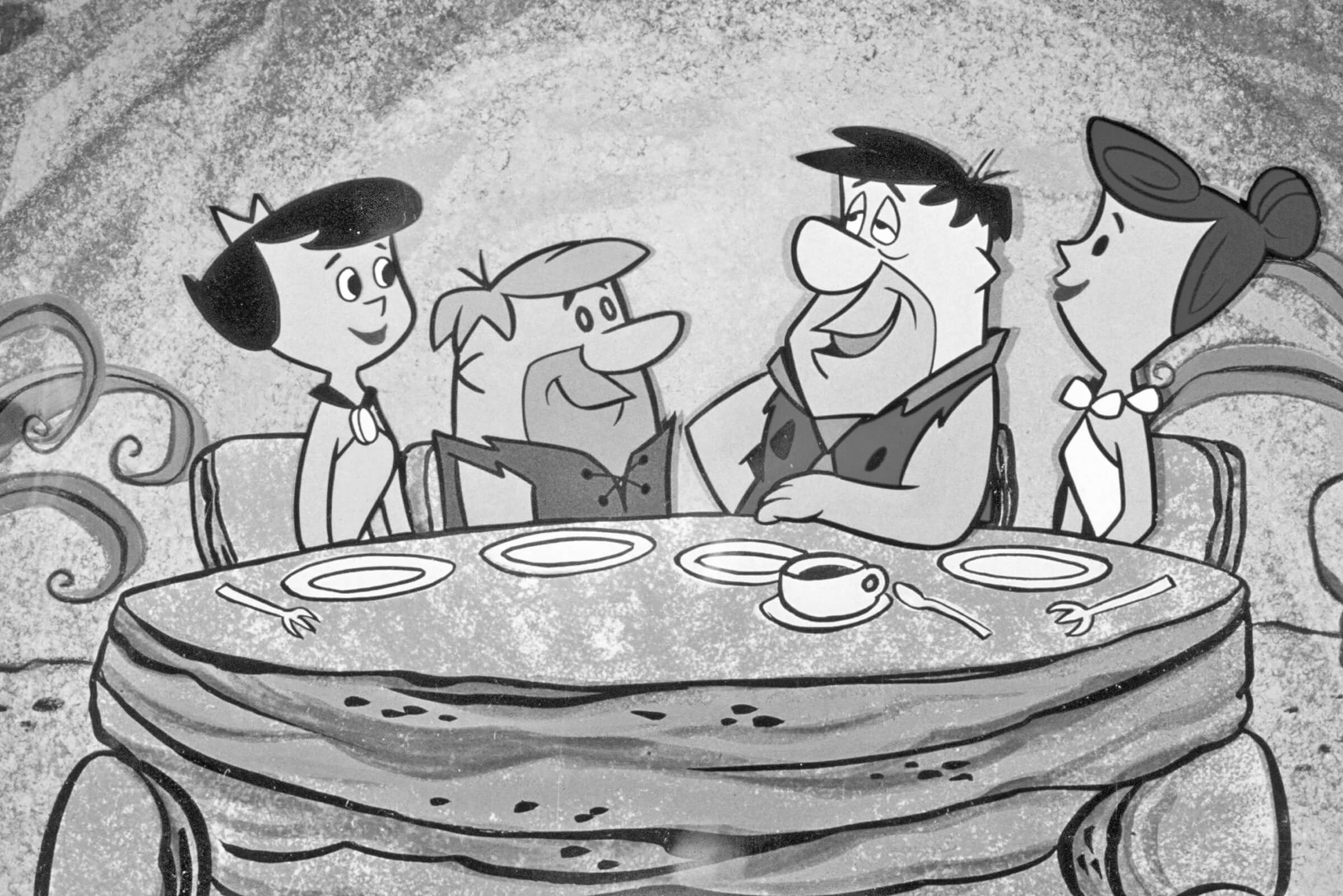
Credit: PictureLux / The Hollywood Archive/ Alamy Stock Photo A Lasting Cultural Impact
Over the course of six seasons and 166 episodes, The Flintstones carved out a formidable TV legacy. The show was the premiere 30-minute animated sitcom, as well as the first cartoon ever nominated for Outstanding Comedy Series at the Primetime Emmys — an honor The Simpsons has never even achieved.
Despite its laugh track, The Flintstones embarked on nuanced storylines in its middle seasons about routes to parenthood. After Fred and Wilma became U.S. television’s first animated couple to sleep in the same bed, nine episodes were devoted to Wilma’s pregnancy with their daughter, Pebbles. During the following season, with Barney and Betty, the series acknowledged the plight of infertility, a rarely addressed topic on screen or in society at the time. The Rubbles eventually adopted a son, Bamm-Bamm. The Flintstones proved that there was a grown-up audience for animation, emboldening future TV creators to tackle mature themes such as parental abandonment (The Simpsons), politics (South Park), mortality (Archer), and mental illness (Bojack Horseman) — to great critical acclaim.
Additionally, The Flintstones was an early satirist of TV tropes and celebrity culture that helped establish the practice of famous guest stars doing cameos as themselves. Ann-Margret, Ed Sullivan, Tony Curtis, Rock Hudson, and Cary Grant were among the prominent personalities that entered Bedrock. The show also gave rise to numerous TV spin-offs, two live-action films, and millions of brontosaurus cranes worth of merchandise sales, ranging from Fruity Pebbles cereal to Flintstones Vitamins. After a robust second life in syndication, The Flintstones recently found a new home on HBO Max.
-
The Supreme’s
Lyle Northey (Silent/Boomer)

Anti-Democratic Branch The Supreme Court has entirely too much power and some checks need to be established so that the decisions made in that body can be examined and approved before implementation. They are supposed to be the final word, but unfortunately this court is corrupt and not trustworthy enough to be trusted.
There are filmed interviews of the three most recent appointments lying during their confirmation interviews. That should be enough to cause at the very least, dismissal and disbarment. More severe punishment could include time in prison. The acceptance of favors or bribes should not go without consequence.
The overturning of Roe V Wade has had consequences in many states managed by right wing agenda representatives. There have been women that have died because of the laws passed by these representatives and signed into law by governors that are out of touch with common sense. The families of these women should be suing for wrongful death in each case and charging all that approved or signed those measures.
The suit should be sufficiently high enough to rob those persons of everything they own and all future income they hope to have, after all, they stole everything from those women. It is a sure bet that each will say something along the lines of, “I was just going along with the majority”. The point is that you put your approval on the measure and if you can hold someone accountable for the death in a bank robbery that drove the getaway vehicle then this is equal.
Why are all these legislators in those states so angry at women? Do they not have a spouse that cooks for them? Perhaps they are married to an iceberg that will not have sex. Maybe they had a mother and now have a wife that constantly bitches at them, or maybe they are all gay, who knows.
One of the other questions that must be asked of these people is what if the person that needs this assistance because of whatever reason, is a member of your own family? Do they just have to die because you have put laws in place that say help cannot be given? Do you have a way around these rules for your purposes? An additional question, how do you sleep at night?
Each and everyone of these states are reputed to be extremely religious and yet they all have put into law measures that show no compassion which is supposed to be a hallmark of the christian faith. Does it state in your book of faith that your savior held such views, or all of you just a bunch of mean bastards without consciences or caring?
If in fact at some point we must answer for all that we have done in this life, then it is hard to imagine the consequences of such blatant use of power to subjugate, humiliate and murder other representatives of the gender that brought you into this world.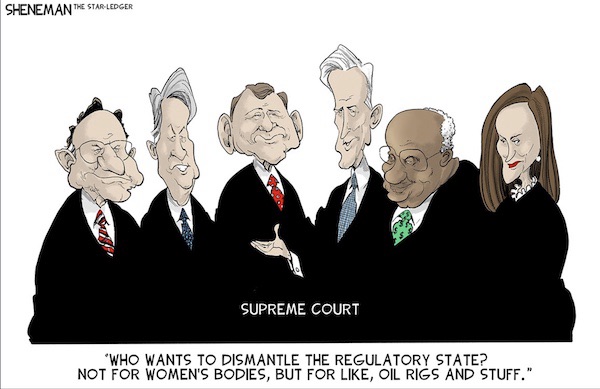
-
Grievance or Growth
Lyle Northey (Silent/Boomer)

Our nation is at a very decisive point in its history. There are basically two points of view being expressed as to what our future should become. One view is of a nation run by a dictator that has the power of life and death at his fingertips. If you have angered him for any reason he will take retribution. The campaign to become this omnipotent person is being conducted by a man that literally has one foot in a grave and the other on a banana peel.
His favorite tool in his war chest to greatness is division and hate. Make the future subjects to hate each other and divide them so that there is no trust or compassion one for another. When that has been done he will be able to do as he pleases and no one will challenge him. If he wishes to steal from the national treasury for personal gain, that is okay. If he wishes to put people in prison for failing to honor him in the manner he expects, that is okay. If he takes a fancy to your wife, or teenage daughter and wants to have them for his pleasure, that is okay as well.
There are some wealthy people that are pushing this program because they feel that they will be able to do pretty much the same things and get away with it. The other idea would be to be ready to step in when he checks out. They don’t mind that this course of events could lead to bloodshed and the collapse of society, they are not happy with the way things are so as long as they don’t have to suffer it matters not.
The other candidate in this time of distress is basing her campaign on hope, and inclusiveness, and caring. She is aware that everyone has aspirations and the ideal setting for most to reach their goal is in a society with promise and opportunity.
The gap between the visions is as epic as space between galaxies. The journey between the two is so vast that it appears to be beyond passage. Some will never make the change because they will not rise above the pettiness of their own prejudice over the things they feel divide us. Others have already realized that those differences are so very insignificant and the future is so much more important, not just for the here and now, but for as long as our nation stands for what it was founded for, that they must make the change.
So the question each of us has to ask ourselves is, “What do you want your future and that of your children to be?” Will it be the war torn streets of a battle ground where people are searching for food or water or a loved one, or will it be where all are equally respected and cared for?
We as a species have plenty of depictions of the aftermath of war, from antiquity till today, and that is not a positive image. The results of those wars have been graphically different depending on a number of factors. Some have ended with peace and nation building. Others have ended with entire societies being oppressed because of who came to power when the dust settled.
Will mankind ever get over this urge to fight? Do not have the answer to that question but hope that the energy wasted on fighting can somehow be put to a more productive use. -
Photos by Michelle

-
Ok What?

Astronauts say space smells like gunpowder and burnt steak.
It being a vacuum and all, space isn’t often thought of as having a scent of its own. And while no one has directly smelled outer space — exposure without a helmet would be fatal — many astronauts have reported that it smells like a mix of gunpowder and burnt steak. The odor is most noticeable after an astronaut returns to their spacecraft through the airlock and removes their helmet, at which point the lingering scent can be detected by both the astronaut who had been outside the ship and their crewmates who remained aboard.
It’s been theorized that the source of space’s scent is dying stars, which release molecules called polycyclic aromatic hydrocarbons — a chemical compound also found in coal, oil, and food — as they near the end of their existence. There’s even a colognenamed “Eau de Space” based on the smell, which was originally synthesized by biochemist Steve Pearce at NASA’s behest to better prepare astronauts for every aspect of the job. Based on his interviews with astronauts who had been to space, Pearce described the aroma as “hot metal, burnt meat, burnt cakes, spent gunpowder, and welding of metal.”
-
Irony
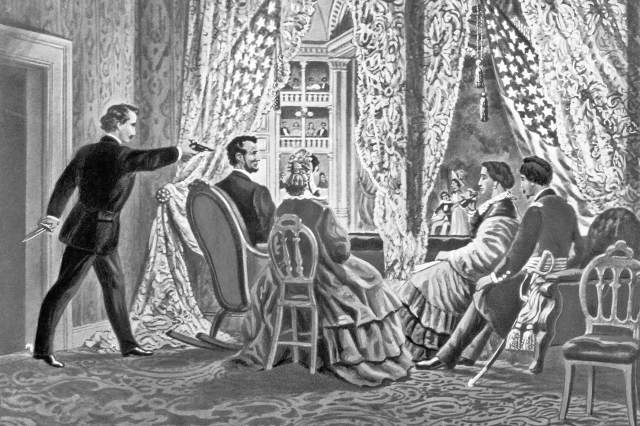
Photo credit: Heritage Images/ Hulton Archive via Getty Images Abraham Lincoln Created the Secret Service on the Day He Was Assassinated
On April 14, 1865, just hours before he was tragically shot by John Wilkes Booth at Ford’s Theatre in Washington, D.C., President Abraham Lincoln signed legislation creating the Secret Service. At the time, however, the new department’s purpose was not to provide presidential protection — it was to combat counterfeit currency.
By the end of the Civil War, nearly one-third of the U.S. currency in circulation was forged; the Secret Service was founded as a bureau within the Treasury Department to rehabilitate and safeguard the country’s monetary system. The night of Lincoln’s assassination, just one local police officer was assigned to escort the President from the White House to the theater, but the officer’s whereabouts at the time of the shooting are unknown. It was not until after the assassination of President William McKinley in 1901, when Vice President Theodore Roosevelt took over, that the Secret Service’s mandate was expanded to include the protection of the President. -
Photos by Michelle

Tranquility


You must be logged in to post a comment.