Dwain Northey (Gen X)
https://www.cbsnews.com/news/naacp-travel-advisory-florida-says-state-hostile-to-black-americans/
Remember the good old days when there were only travel advisories and or ban for, what some would call, third word countries? Well now because of the vile vitriol of one Governor Ron DeSantis the state of Florida, a vacation destination, has received a travel advisory by the NAACP.
The wannabe future President has made the climate so venomous in Florida the anyone who is a part of any minority group does not feel safe in the state. Black, Brown, LGTBQ+, these are all groups that are under attack in the Sunshine State. The majority Republican legislature and their fearful leader has passed laws that make almost everything a jailable offence and the fact that the state has very loose gun laws and a stand your ground law makes it more dangerous than being a blonde female in central America.
Florida residents are able to carry concealed guns without a permit under a bill signed into law by Republican Gov. Ron DeSantis. The law, which goes into effect on July 1, means that anyone who can legally own a gun in Florida can carry a concealed gun in public without any training or background check. This with their ridiculous stand your ground law, ‘Florida’s “Stand-Your-Ground” law was passed in 2005. The law allows those who feel a reasonable threat of death or bodily injury to “meet force with force” rather than retreat. Similar “Castle Doctrine” laws assert that a person does not need to retreat if their home is attacked.’ Makes it really sketchy to go there.
This in top of the don’t say gay rule and the new trans ruling that just passed.
“Florida lawmakers have no shame. This discriminatory bill is extraordinarily desperate and extreme in a year full of extreme, discriminatory legislation. It is a cruel effort to stigmatize, marginalize and erase the LGBTQ+ community, particularly transgender youth. Let me be clear: gender-affirming care saves lives. Every mainstream American medical and mental health organization – representing millions of providers in the United States – call for age-appropriate, gender-affirming care for transgender and non-binary people.
“These politicians have no place inserting themselves in conversations between doctors, parents, and transgender youth about gender-affirming care. And at the same time that Florida lawmakers crow about protecting parental rights they make an extra-constitutional attempt to strip parents of – you guessed it! – their parental rights. The Human Rights Campaign strongly condemns this bill and will continue to fight for LGBTQ+ youth and their families who deserve better from their elected leaders.”
This law makes it possible for anyone to just accuse someone of gender affirming care to have their child taken from them this would include someone traveling from out of state. This alone justifies a travel ban to the Magic Kingdom for families.
Oh, and I haven’t even mentioned DeSantis holy war with Disney, the largest employer in the state. I really hope the Mouse eats this ass holes lunch.
Well that’s enough bitching, thanks again for suffering though my rant.
-
57 days
Dwain Northey (Gen X)

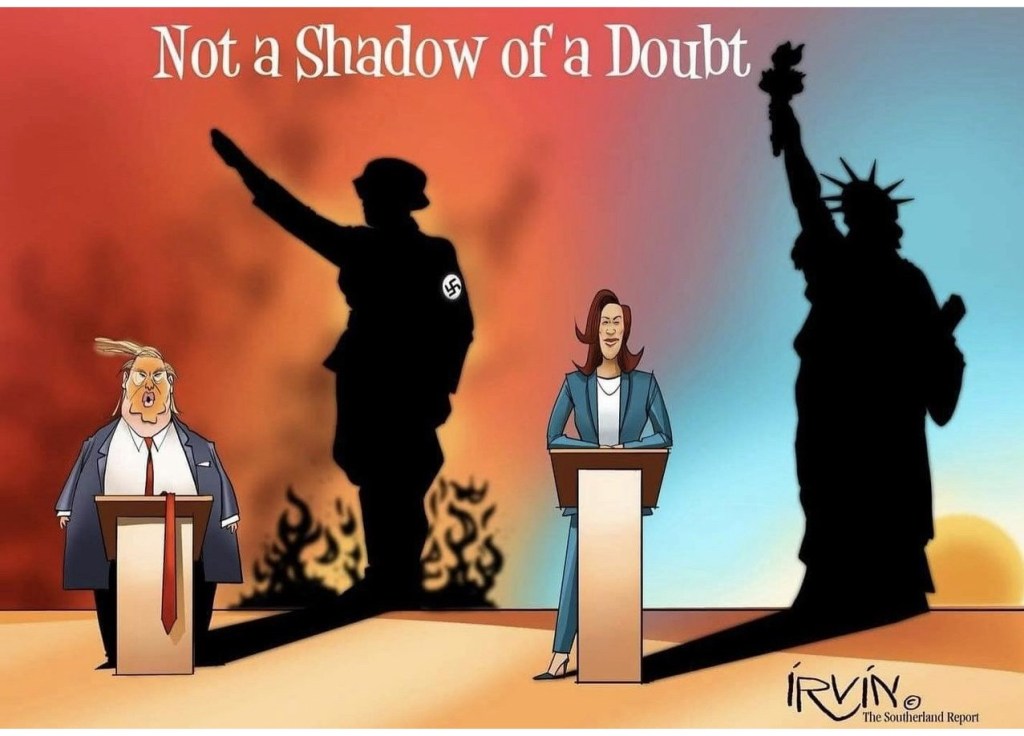
I know after last nights performance we are all enthusiastic about Harris but the race isn’t over yet. As poorly as the Mango Menace did his rabid base did not witness what we witnessed and his media mouthpieces are on their airways spouting a different version of what actually happened. In his camp there are 2 stories, one that Donald performance was masterful and the other that the debate itself was rigged, same old tale of two cities.
I am only saying this so that we don’t take our foot off the gas 57 till we vote and even then the fights isn’t over. In this moment we can be joyful but don’t get happy … Just under 2 months and and we can have our nations first woman President but in order for her to be successful we need the House and the Senate… We aren’t going back and we have the power to make sure we don’t.
-
Never Forget

-
Debate Night
Lyle Northey (Silent/Boomer)
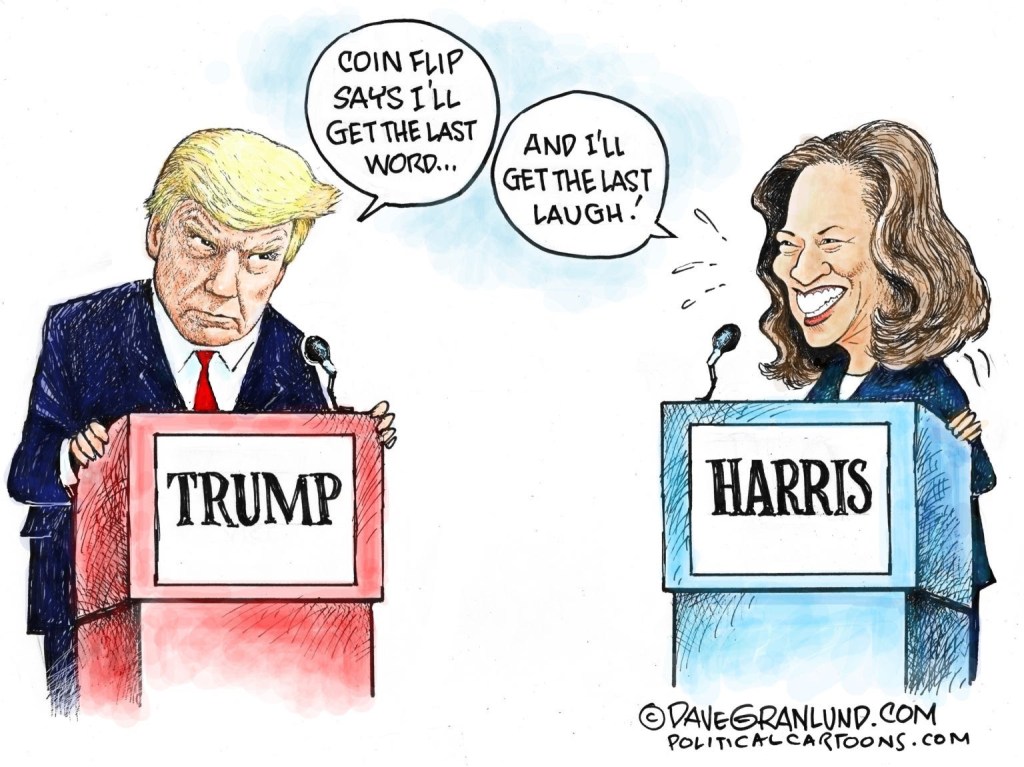
It is 9/10 and the epic debate is scheduled for tonight. Will both parties show up, one will for sure the other we can’t say will or won’t as he tends to not be good at confrontations. We know that no matter the result he will claim victory or have excuses as to why he lost.
With all the baggage he is carrying the question is why is he even allowed to be there? One comment that was made about that was that it is an insult to the Vice President, the office for which this race is being run and the nation that a convicted felon is standing on the same stage. It was also stated that if he should win this election, hopefully not, that according to the Constitution he will not be able to serve. Don’t know if that is true, but would bet that the Supreme Court would find a way to subvert that clause.
We have so much to lose if Trump gets back in office. No amount of honest evaluation of the situation can possibly make that a plus scenario. The popular vote and the electoral vote have to be a win win in order for this to be accepted by all.
The outcome is hoped to be that Harris wins hands down. Once she is in office along with all the other items on the agenda, clearing or balancing the Supreme Court should be on the list. There are 2 of the justices that have been named to be impeached, and there are 3 more that should be added for perjury during their confirmation interviews. It is normal for people to have views that do not agree with everyone else’s but the attitude that your personal view is more important than the national view is extreme.
Over and over the views that are being put forward are based on someone’s religious beliefs, and that is the problem. When you are in a position that supposedly represents the majority then an individual attitude or belief needs to be shelved for the greater good. This is a realistic attitude for some to accept, and in other cases it is impossible as they believe that their individual views are the answer and all should follow. That is the current view of some in our society, notably the very wealthy, the very religious, and those with little or no tolerance for others.
What will this debate prove? When all is said and done it will prove nothing as the results will be tempered by how each observer views each of the candidates. The stage is open even if the mics are turned off for the non speaker this provides the opportunity to make comments and attempt to be distracting while off mic. The set should be two sound proof booths so you can hear the speaker but can not interrupt. That is a suggestion for any future debates.
Another suggestion put forward is to have Kamala start her segments with the comment, “That’s a lie”. Since whatever Trump has to say is most likely going to be a lie as he has little or no ability to tell the truth.
If the effort results in a bigger win for Kamala then it is worth it. For the good of the nation, and very possibly the world there can only be one winner and that is Kamala Harris. -
Iconic Photo for History
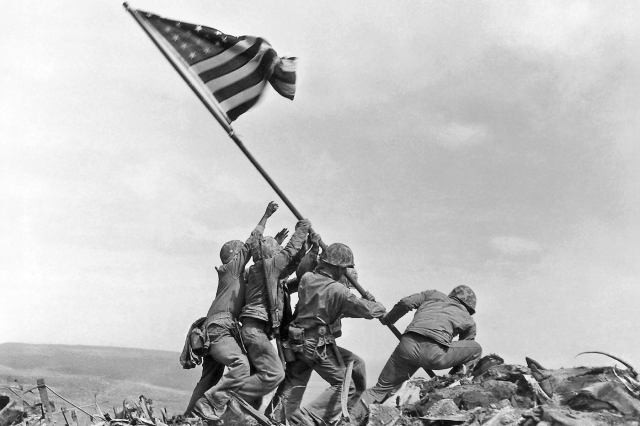
Credit: Bill Waterson/ Alamy Stock Photo “Raising the Flag on Iwo Jima” (1945)
Joe Rosenthal was a photographer for the Associated Press during World War II whose legacy was defined by the Pulitzer Prize-winning photo “Raising the Flag on Iwo Jima.” Rosenthal captured the iconic event on February 23, 1945, on the small Japanese island of Iwo Jima, roughly 750 miles south of Tokyo in the Pacific Ocean. The picture depicts six men triumphantly raising an American flag, and commemorates an important military victory — though there’s a good deal more to the story.
The island of Iwo Jima was a strategic stronghold occupied by the Japanese. On February 19, three U.S. Marine divisions landed on Iwo Jima and began a harrowing multiday battle with Japanese forces. On February 23, Americans took control of Mount Suribachi, a geographic landmark on the southern end of the island. In celebration of their conquest, troops raised up an American flag, though not the flag seen in the famous image. It was actually a smaller flag, captured by Sergeant Louis R. Lowery in a lesser-known photograph.
Hours later, troops were ordered to replace the first flag with a larger American flag that could be seen more easily from a far distance. This caught the attention of Rosenthal, who heard the plan from a nearby radioman. Rosenthal brought his camera to the mountain, where he photographed six men (five Marines and one Navy Corpsman) raising the larger flag in what has since become an iconic image. Tragically, it took another month for American forces to take the entire island of Iwo Jima, during which three of those men were killed: Sergeant Michael Strank, Corporal Harlon Block, and Private First Class Franklin Sousley. The three others who survived the battle, and the war, were Corporals Harold Keller, Harold Schultz, and 22-year-old Ira Hayes, a soldier of Pima Indian descent who went on to meet President Harry Truman at the White House.
-
Interesting History
“Mitochondrial Eve” is the common ancestor of all humans.

If you were to trace all our family trees as far into the past as possible, you’d find we’re all related — albeit extremely distantly. The common female ancestor from whom all humans are descended is Mitochondrial Eve, and scientists believe she lived in Africa some 200,000 years ago. Recent research may have narrowed down that location to an oasis in the Kalahari Desert, making it the “ancestral homeland of all humans alive today,” according to the researchers. Eve is technically known as Mitochondrial-Most Recent Common Ancestor, or mt-Eve and mt-MRCA for short, and her lesser-known male counterpart is known as Y-chromosomal Adam. He’s also believed to have lived in Africa, around 150,000 to 300,000 years ago.
Advertisement
The idea of a common ancestor has led to the misconception that Mitochondrial Eve was the first female human, which isn’t correct. Rather, she was the most recent common ancestor to whom every living person can trace their genealogy. Every human on the planet carries the Eve gene, including 147 people and fetuses from the original 1987 study. That study wasn’t the first to hypothesize a common ancestor, but the researchers behind it did coin the term Mitochondrial Eve.
-
Don’t be Intimidated
Lyle Northey (Silent/Boomer)
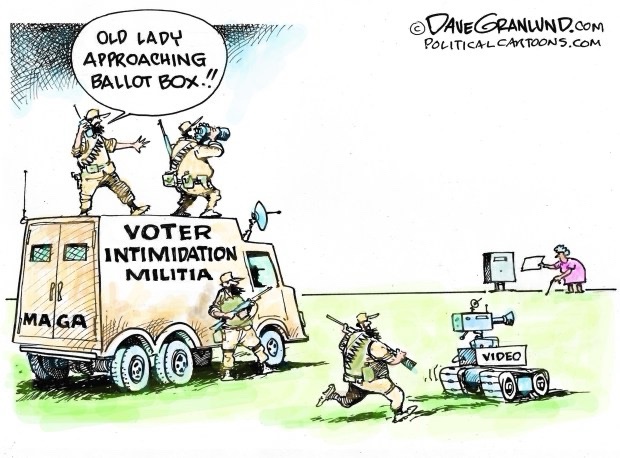
Voting as a right has been under attack by the republican party for 60 years. The methods used include verifying signatures. All sorts of things could cause your signature to look different from one time to the next, and they are too numerous to name. Another is that your ID does not match your birth record. This is true with married women when they take their husband’s name. Most women do not take the time to go to the state and have a legal name change; they feel that marriage should be sufficient. Unfortunately, in many states overlooking this step can be considered against the law and can end with legal action.
Having to show proof of citizenship is another. These are the sorts of things that will be looked for by the polling police and will be tasked with, Other duties that they may have is to make sure people stay separated. Have nothing to drink or eat, not sit down, no talking to one another, and have voter registration, ID, birth records, citizenship proof and anything else they can think of to ask for and if you don’t have it remove you from the line.
The real problem is that most of the people have no legal right to ask for anything and they should not be there, but if they can intimidate people and keep them from voting they have accomplished the mission. Ideally these people should have to be registered and someone should be there checking them before they are allowed to do anything, especially enforce rules.
It should not be happening. Mob tactics and fear are the methods of tyrants and nerdowells. This is a free country and voting is a right, a privilege and a duty and others should not be interfering in your right to do so.
Just like having the electoral college making the decision after the vote has been taken. That body has given the election to the losing party on more than one occasion which should indicate that they are corrupt or at least stupid. Time to rid our system of these fools as they have an agenda that does not follow the popular vote. This is why many people say, “What is the use, it doesn’t count anyway”?
The system has flaws and they need to be addressed and fixed. If the electors do not follow the popular vote, then nullify the electors choice and go with the popular vote. Other things that need to be used to put the nation back together is to punish those that don’t tell the truth.
The 3 most recent individuals added to the Supreme Court all said they would not overturn Roe V Wade, but the first thing they did was just that. They made the statements under oath so there are legal recourse for that. We need to use that path and take these people off the court. The fact that the high court has no ethics code to follow is another issue, and we need to tighten the codes for Congress and the President. When a sitting President uses the office to make money by directing people to use his hotel or requiring Secret Service agents to stay at his golf club in overpriced rooms that is a conflict with his duties.
Members of the military are held to higher standards than all our elected officials and somehow that does not seem right. Yes the military can do a lot of harm to others if the mission requires it, but our elected officials have access to the purse of the nation and no soldier does.
As has been pointed out numerous times, you can’t cure stupid. -
Money & Religion Ruin Everything
Lyle Northey (Silent/Boomer)

Hopefully this will not come off as paranoia or cause problems, just generate some action on the part of concerned capable people.
Our government, for the most part, at both national and state level, is being run by people that have money. Some have earned it, others have inherited it, but they have it and believe it gives them an advantage. One thing is certain, having money does not make you smart or improve your IQ. If it has any effect it is to give a sense of superiority that does not really exist except in the mind.
So the point is to get some intelligent people into the arena to help govern the country. At present we have one party that except for the fact that they call themselves christian are trying to enact rules that you would expect to see coming from muslim countries. The restrictions on women being the hallmark item on their agenda. Control everything women do, keep them in their place and make sure they do not have a say in anything.
Just like it was back when women could not own property, vote, get a loan in their name, or travel without a male escort. Domination is the name of the game and religion is the greatest advocate of the practice, no matter what the faith might be.
The effort to take over the world has been played out many times in history. The Romans, Alexandra the Great, Atilla the Hun, Adolph Hitler, (strange they all start with A). The Catholic Church put a bid in to do the same things and the religion that is trying today is the Muslim faith.
They have migrated to most everywhere and they take their faith with them. They are very active in the local political realm and get elected to city councils and then move up. As they move they tend to bring about changes that make their faith more acceptable. That is fine as long as it does not become mandatory as it is in current places.
With that, we currently have a political party that is oppressive and very restrictive. Put both those into place at the same time and it is more than possible to end up with one order and the domination by one religion.
One thing that is very real, and history has proven it, religion is not a good way to run a country. Most are not inclusive, they are very unforgiving, and quite rigid in what is or is not acceptable. None of that attitude makes for a good place to live. It might be fine for the wingnuts in charge but for the rest it is smothering.
Everyone in a society has to be respected as individuals regardless of race, religion, sex, gender or any other things you can come up with to identify as. When that disappears so does freedom and identity. Decisions are made by a very narrow group that is usually made up of very narrow minds and as has happened in the past, mother nature may decide that a complete purge is the best she can hope for, and start over.
Mankind should not put the future into terms like “In God We Trust” or “If Allah Wills”. Sorry, these beliefs are one way tickets to nowhere. It will take intelligence, common sense and compassion to keep mankind from destroying ourselves. We best hope we find those attributes in the people we elect and find it soon as world wide mankind seems to be in a self destructive mode. -
Pearl Clutching
Dwain Northey (Gen X)

The typical I have the right to have a gun, clutch their pearls over books they disagree with, drag queens, even teachers that aren’t parents them selves but it’s never the gun in a school shooting that is the problem.
A 14-year-old boy with mental problems reported when he was 13 was given an assault style rifle by his parents for gift which he used to shoot up his own school and killed classmates. The second amendment people want you to tell you that it’s not the gun that’s the problem, its the person wielding the gun. These are the same people that voted down any mental health that could help these people that decide to go shoot up a school or kill innocent people. My question is, how is the gun not the problem other countries have mental health issues. They have violent video games. They have all the same problems we have except one they don’t have easy access to firearms so again, I’ll ask the question. How is the gun not the problem?
-
1789 was a long time ago.
(Some parts of our Constitution need changed)
Lyle Northey (Silent/Boomer)

The absolute pathetic efforts that are put forth to protect school children from becoming victims of shootings was again demonstrated outside of Atlanta. There is all kinds of effort put forth to protect a former President while he stands and runs his mouth. Far more protection than needed. Ironic but true some of the children already have the scars from wounds from previous shootings.
There is so much being said about things being fair. College students don’t like a term or phrase and they make a big deal of how unfair it is that someone should use that word or phrase. The 2nd amendment jockeys think that restricting the types of gun they can have is unfair. Trump thinks it is unfair that he should be held accountable for crimes he has committed, or that he has competition running for office. The real unfair thing is our children and grandchildren having to go to school and endure live shooter exercises, or putting up with a live shooter in their school.
Now it is said that the electoral college is most likely going to side with Trump. Why are we holding elections? Why are we being asked to support causes or people when it seems we do not have a choice? A few very corrupt individuals hoping to be rewarded for being ass holes are going to decide what is going to happen on Nov 5. It is way past time to eliminate the electoral college. The college system might be fair if it were not for the Gerrymandering that goes on to give one party not just a chance to win but rather, a no way to lose position.
Should this election turn out with that sort of outcome and a huge loss in the popular vote. Then Biden should call for marshal law and remain in office until all the little corrupt bigots are ratted out and eliminated. Then have another election on a level field. Use the tactics of Trump against him and flush him down the toilet.
Another totally unjust thing that is being pulled is the removal of registered voters on bogus charges. I am not sure what the laws are in these various states that are doing this, but if a republican can remove a voting block with a single complaint, do the same and remove millions of the republican voters, especially MAGA republicans.
Normally it is better to remain in the boat and row than to try to sink it. This year, considering who is running again, we cannot remain on deck and play music, We need to take over the lifeboats and pull away from the sinking wreck. -
Same Ol’ Shit
Lyle Northey (Silent/Boomer)

There are so many reasons to be involved in the future of our nation and in order to be counted voting is a must. Then the question for each is who to vote for? Well think about what you want for yourself, in the context of personal freedom, self governance and general wellbeing.
Do you want your home or work place invaded to try and discover if you are loyal to the President, or are you monitoring your cycles to keep from having babies? Those are very different things to consider, but if we end up with a dictator we will have reason to be concerned with both.
The current stance of many in the republican party is that if you are not loyal to the leader then you are a threat to the nation. If you are not producing babies, as a woman, you are not fulfilling your duty to the nation. Women have a place to be of use, in the kitchen or the bedroom but not in the work force and not in government.
The manifesto that is called 2025 expresses some very radical ideas about keeping track of menstrual cycles, making sure that pregnancies are not terminated, even ones that occur because of incest or rape. The life of the baby is to be considered before the mother if problems arise. This topic has been addressed before and it is now a big point with the nominee for VP on the republican ticket.
The rhetoric on immigrants and how they are coming to steal jobs, and they are all criminals, etc is the kind of propaganda that was preached in Germany in the 1930’s. We know what that led to and the latest election there has put the extreme right back in power. Our political minefield hints at internal conflict where the effort to suppress everyone that is not of the chosen, i.e. white supermists.
We have managed to become the most powerful nation on earth in less than 300 years from founding till today. We have had some very rough patches in our development and everything is still not as rosy as it should be, however, we are making progress and we need to move forward not backward. The hate and division being preached by one party, which also seems to have a good deal of support from pulpits that should not be in politics, is defeating our independence and to the Constitution.
Our efforts need to be directed toward equality and inclusion not dominance and exclusion. For some reason it seems that even knowing life is short, the need to compete is stimulated more quickly than the need to relax and smell the roses. Mankind has developed a lot of games to compete, yet at the end of the day some can not accept that it is only a game. Winning is everything.
Question how do wars start, what is the catalyst for the conflict and who will gain the most for the conflict, and then find the leaders and let them fight it out. As it stands in the world today the effort to suppress others or take from others what is theirs, usually autonomy and freedom whether it is a battle between nations or between the sexes for respect and recognition.


You must be logged in to post a comment.