Dwain Northey (Gen X)
https://www.cbsnews.com/news/naacp-travel-advisory-florida-says-state-hostile-to-black-americans/
Remember the good old days when there were only travel advisories and or ban for, what some would call, third word countries? Well now because of the vile vitriol of one Governor Ron DeSantis the state of Florida, a vacation destination, has received a travel advisory by the NAACP.
The wannabe future President has made the climate so venomous in Florida the anyone who is a part of any minority group does not feel safe in the state. Black, Brown, LGTBQ+, these are all groups that are under attack in the Sunshine State. The majority Republican legislature and their fearful leader has passed laws that make almost everything a jailable offence and the fact that the state has very loose gun laws and a stand your ground law makes it more dangerous than being a blonde female in central America.
Florida residents are able to carry concealed guns without a permit under a bill signed into law by Republican Gov. Ron DeSantis. The law, which goes into effect on July 1, means that anyone who can legally own a gun in Florida can carry a concealed gun in public without any training or background check. This with their ridiculous stand your ground law, ‘Florida’s “Stand-Your-Ground” law was passed in 2005. The law allows those who feel a reasonable threat of death or bodily injury to “meet force with force” rather than retreat. Similar “Castle Doctrine” laws assert that a person does not need to retreat if their home is attacked.’ Makes it really sketchy to go there.
This in top of the don’t say gay rule and the new trans ruling that just passed.
“Florida lawmakers have no shame. This discriminatory bill is extraordinarily desperate and extreme in a year full of extreme, discriminatory legislation. It is a cruel effort to stigmatize, marginalize and erase the LGBTQ+ community, particularly transgender youth. Let me be clear: gender-affirming care saves lives. Every mainstream American medical and mental health organization – representing millions of providers in the United States – call for age-appropriate, gender-affirming care for transgender and non-binary people.
“These politicians have no place inserting themselves in conversations between doctors, parents, and transgender youth about gender-affirming care. And at the same time that Florida lawmakers crow about protecting parental rights they make an extra-constitutional attempt to strip parents of – you guessed it! – their parental rights. The Human Rights Campaign strongly condemns this bill and will continue to fight for LGBTQ+ youth and their families who deserve better from their elected leaders.”
This law makes it possible for anyone to just accuse someone of gender affirming care to have their child taken from them this would include someone traveling from out of state. This alone justifies a travel ban to the Magic Kingdom for families.
Oh, and I haven’t even mentioned DeSantis holy war with Disney, the largest employer in the state. I really hope the Mouse eats this ass holes lunch.
Well that’s enough bitching, thanks again for suffering though my rant.
-
Voter Suppression
Dwain Northey (Gen X)

There is a strange political philosophy taking shape in America, and it can be summed up rather simply: democracy is wonderful, provided too many people don’t participate in it.
At some point in the 1970s or ’80s, Paul Weyrich famously argued that conservatives did not need more people voting. The idea was brutally straightforward: when voter turnout goes up, Republicans don’t necessarily benefit, so why encourage more people to participate? It was one of those rare moments in politics when somebody apparently decided to skip the decorative wrapping and just say the quiet part out loud.
And here we are, decades later, watching that philosophy being dressed up in the respectable clothing of “election integrity.”
Because apparently the greatest threat facing American democracy isn’t foreign interference, political corruption, billionaires pouring money into elections, or candidates lying to voters. No, apparently it is some mythical army of millions of undocumented immigrants secretly voting, hordes of dead people casting ballots from beyond the grave, and women somehow becoming suspicious because they had the audacity to get married and change their names.
The evidence for these sweeping claims is remarkably difficult to locate.
If millions of undocumented immigrants were voting, you would think prosecutors would occasionally encounter one. If hundreds of thousands of dead people were voting, one might reasonably expect an army of election officials, investigators and prosecutors to have stumbled across the phenomenon. Yet the spectacular claims routinely seem to produce remarkably unspectacular evidence.
There have been isolated cases of voter fraud. There always will be. Humans commit fraud. Humans cheat. Humans occasionally do incredibly stupid things. But isolated examples are not evidence of a massive conspiracy.
And here’s the really fascinating part: when people have actually been caught attempting things like voting twice or casting a ballot on behalf of a deceased relative, the political affiliation of the accused hasn’t exactly supported the grand narrative that Democrats are secretly stuffing ballot boxes with corpses.
But never mind the evidence. We have a narrative to maintain.
Enter the increasingly creative machinery of voter restriction.
The proposed SAVE America Act and similar efforts are presented as efforts to “protect” elections. That sounds wonderful. Who could possibly oppose secure elections? The problem begins when “security” becomes a euphemism for creating enough bureaucratic obstacles that perfectly legitimate voters begin wondering whether exercising their constitutional rights is worth the hassle.
Because if you make voting complicated enough, you don’t actually have to tell anyone they can’t vote.
You simply make them prove who they are, prove where they live, prove what their name used to be, prove what their name is now, produce the correct documents, navigate increasingly restrictive registration requirements, and hope they haven’t recently gotten married, divorced, moved, lost a document, or otherwise participated in the inconvenient activity known as having a life.
And then there are the poll watchers.
Now, legitimate election observers have existed for generations. Transparency is not inherently authoritarian. Watching elections can be perfectly reasonable.
But there is a profound difference between observing an election and creating an atmosphere in which voters feel watched, challenged, questioned or intimidated.
Imagine being a perfectly legal American citizen walking into a polling place and wondering whether somebody is going to challenge your eligibility because of your name, your address, your appearance, or simply because you don’t look like what somebody has decided an American voter is supposed to look like.
You don’t actually have to prevent that person from voting.
You just have to make them uncomfortable enough to decide they would rather go home.
Congratulations. The suppression worked without anyone technically suppressing anything.
That is the clever part.
Authoritarianism doesn’t always arrive wearing jackboots. Sometimes it arrives carrying a clipboard and explaining that it is merely concerned about election integrity.
And then we get to the curious case of mail-in voting.
For years, Republicans have warned that voting by mail is somehow inherently suspicious, dangerous, fraudulent or practically an invitation for democracy to collapse into anarchy.
Except when Republicans vote by mail.
Donald Trump himself has used mail-in voting.
Apparently the ballot becomes suspicious only when the other guy is using it.
That’s the thing about democracy: it is supposed to belong to everybody.
The whole point of voting isn’t to create a system where one political party gets to decide who is sufficiently trustworthy, sufficiently documented, sufficiently recognizable, sufficiently stationary, or sufficiently enthusiastic to participate.
The point is that citizens vote.
Period.
If there is legitimate evidence of fraud, investigate it. If someone commits a crime, prosecute them. If an election system has a genuine vulnerability, fix it.
But don’t manufacture an imaginary epidemic of voter fraud and then use the fear of that imaginary epidemic to justify making voting harder for millions of people who have done absolutely nothing wrong.
Because eventually we have to ask the question that apparently nobody wants to ask:
If your political philosophy requires fewer people to vote in order to win, what exactly are you trying to protect?
The answer cannot honestly be “democracy.”
Democracy is not supposed to be a private club where the membership committee gets to decide who is allowed through the door.
It is supposed to be loud. Messy. Inconvenient. Occasionally infuriating.
It is supposed to include people you don’t like.
People who disagree with you.
People who don’t look like you.
People who speak differently.
People who vote against you.
And, most importantly, more people, not fewer.
Because if the solution to losing elections is to convince fewer Americans to participate in elections, perhaps the problem isn’t the voters.
Perhaps it’s the politics.
And maybe—just maybe—the answer isn’t to build a better mousetrap.
Maybe it’s to build a better argument.
-
Sunlight, pollution paradox
Dwain Northey (Gen X)

There is a little-known irony about living in a place like Phoenix, Arizona: sometimes the cleaner the sky looks, the easier it is to forget that the atmosphere is doing things you probably don’t want it doing.
Phoenix is famous for sunshine. We don’t merely have sunshine; we have industrial-strength sunshine. The kind of sunshine that makes you question whether the Sun has a personal vendetta against your windshield. And if you’re driving east in the morning, you already know the annual ritual: visor down, sunglasses on, squinting like you’re trying to read the fine print on a contract written by the Devil.
But here’s the part people don’t necessarily think about: a high-pollution day can actually make that glare worse.
It sounds counterintuitive. You would think pollution would block sunlight and make things darker. And technically, some particulate matter does reduce the amount of direct sunlight reaching the ground. But the atmosphere isn’t just a window. It’s more like a very dirty, poorly maintained lampshade.
Fine particulate matter—PM2.5, dust, smoke and other aerosols—scatters sunlight. Instead of all that sunlight traveling neatly from the Sun to your windshield, some of it gets bounced around the atmosphere and redirected toward your eyes. The result can be a bright, hazy field of scattered light surrounding the Sun.
So there you are, driving east at 7:30 in the morning, staring directly into the sunrise, thinking, Well, this is pleasant.
Except now the entire sky around the Sun can become a giant diffuser.
The problem isn’t necessarily that the Sun itself has gotten brighter. It’s that there is more stray light coming at you from the atmosphere, reducing contrast and making it harder for your eyes to adjust. The bright sky becomes a giant glowing backdrop, while everything you’re actually trying to see—the road, traffic lights, pedestrians, other cars—can become harder to distinguish.
And Phoenix has a particularly interesting relationship with this phenomenon because we already have plenty of ingredients for atmospheric haze: desert dust, vehicle emissions, industrial pollution, construction, and, depending on the season, smoke from regional wildfires. Add a nearly cloudless sky and a low morning Sun directly in front of you, and you’ve basically created nature’s worst possible lighting configuration for commuting.
It’s one of those things you don’t necessarily notice until you notice it.
You might think, Why is the glare so damn bad today?
Maybe the answer isn’t simply, “Because the Sun is in front of me.”
Maybe it’s because you’re looking through an atmosphere full of tiny particles that are scattering sunlight in every direction.
And that’s the strange little paradox of air pollution: sometimes pollution doesn’t make the day look darker. Sometimes it makes the world look brighter, hazier, flatter and harder to see.
So the next time you’re driving east through Phoenix in the morning, squinting through your windshield while wondering why the sunrise appears to have been upgraded to the world’s largest flashlight, remember:
It may not just be the Arizona sunshine.
It might be the atmosphere helping the Sun with the special effects.
Because apparently, in Phoenix, even the pollution wants to make sure you get the full Arizona experience.
-
Do over
If you could relive one day from your past, which day would it be and why?
The day in my recent past, I would like to do over is my son‘s wedding which was only four months ago. Reason is I would like to be a little more participative and stay longer. I was really tired work that day so I was there, but I wasn’t there and I feel bad about that.
-
Selective Memory
Dwain Northey (Gen X)

The Destroyer-in-Chief and the Republican Memory Hole
It is fascinating how quickly the Republican Party can develop a case of selective historical amnesia.
Remember George W. Bush?
Of course you do. Well, some of you do. Others apparently underwent the political equivalent of a factory reset.
There was a time when George W. Bush was the Republican president who could do no wrong. He was the strong leader, the cowboy, the guy who would stare down America’s enemies and protect the homeland. Then came Iraq. The weapons of mass destruction that somehow remained permanently invisible. The intelligence that turned out to be spectacularly wrong. The invasion. The occupation. The hundreds of thousands of dead. The trillions of dollars spent. The destabilization of an entire region.
And then, almost magically, Republicans discovered that George W. Bush was no longer their problem.
Funny how that works.
The party that once wrapped itself in the flag and defended every decision of the Bush administration eventually learned the ancient Washingtonian art of pretending that uncomfortable history happened to somebody else. Bush became the political equivalent of that embarrassing uncle everyone remembers fondly only after carefully removing the decade from the family photo album.
Which brings us to Donald Trump.
Because apparently the Republican Party has decided that if one president can eventually be memory-holed, why not another?
Trump has already accumulated a legacy large enough to require its own wing at the Smithsonian—or at least several dumpsters behind the National Archives. Yet his supporters continue to behave as though history is merely a suggestion and accountability is something that happens to Democrats.
He takes credit for successes that existed before he arrived, blames predecessors for failures that occur on his watch, declares victory whenever reality refuses to cooperate, and apparently believes that if he says something loudly enough, history will eventually update itself.
And Republicans applaud.
But here is the interesting question:
How long does the loyalty last?
Because eventually every political movement reaches the moment when the leader who was once considered indispensable becomes inconvenient.
It happened to Nixon.
It happened to Bush.
And eventually, whether Republicans like it or not, it will happen to Trump.
The question isn’t whether Trump’s legacy will eventually be reassessed. It will. History has a nasty habit of outliving political loyalty. The question is whether today’s Republicans will have the courage to acknowledge what they supported—or whether they’ll perform the traditional Washington ritual of suddenly discovering that they were never really that enthusiastic about the guy in the first place.
You can almost hear it now:
“Well, I always had concerns.”
“I wasn’t actually one of his biggest supporters.”
“I voted for him, but I didn’t agree with everything.”
“Let’s not rewrite history.”
Oh, absolutely.
Let’s not rewrite history.
That’s the problem.
History is already being written. The only question is whether we’re going to use permanent marker or the Republican Party’s preferred political medium: disappearing ink.
And perhaps that’s Trump’s ultimate contribution to the GOP. Not Make America Great Again, but Make Republicans Forget Again.
Because if George W. Bush can go from wartime president to awkward historical footnote, there is no reason Donald Trump can’t eventually make the same journey.
The only question is how many Republicans will still be standing around holding the Sharpie when the music stops.
And whether they’ll admit they helped draw the picture.
-
Tear jerker movies
What’s the last movie that made you cry?

Of all the movies I’ve seen that bring a tear to your eye. Anything were animals get hurt or children are injured or upset are the most heart wrenching and the scene from my girl Macaulay Culkin’s character is in the casket is probably the most heart wrenching scene from any movie I’ve seen, especially when the young little girl is completely losing her mind and she’s such a good actress that if that doesn’t make you cry, there’s something wrong with your heart.
-
Sharpie of Destiny
Dwain Northey (Gen X)

There was a time when a Sharpie was simply a writing instrument. You used one to label a box, sign a birthday card, or write “DO NOT EAT” on the leftovers in the refrigerator. Under Donald Trump, however, the Sharpie has apparently evolved into something considerably more powerful: a geopolitical weapon, a cartographic wand, and perhaps the most powerful instrument in the United States government.
Apparently, Donald Trump believes that if he draws something on a map with sufficient confidence, reality is legally obligated to comply.
We first witnessed the phenomenon during his first administration, when Hurricane Dorian was heading toward the United States and Trump famously presented an altered weather map showing Alabama inside the hurricane’s projected path. Because when the National Weather Service disagrees with you, apparently the appropriate response isn’t “perhaps I should reconsider.” It’s “Where’s my Sharpie?”
The lesson, apparently, was learned.
Why stop at hurricanes when there are entire continents and oceans just sitting there waiting to be renamed?
Greenland? Write USA across it.
Venezuela? Perhaps a little annotation in the margin: “Ours now.”
The Gulf of Mexico? Gone. With one presidential flourish, it becomes the Gulf of America, because apparently centuries of geographic convention can be defeated by the same technology normally used to write a phone number on a cardboard box.
And now we arrive at the latest masterpiece of cartographic statesmanship: the Strait of Hormuz.
Draw a circle around it.
There.
American.
See how easy that was?
This is the remarkable thing about Trump’s worldview: maps apparently aren’t representations of reality. They’re suggestions. And the president, armed with a Sharpie and an almost supernatural confidence in his own judgment, is apparently the editor-in-chief of reality itself.
If a hurricane is going somewhere he doesn’t like, draw a new line.
If a body of water has the wrong name, write a new one.
If another country possesses territory that looks interesting, write USA on it.
If a strategically important international waterway doesn’t appear sufficiently American, circle it.
Problem solved.
The only thing missing is a giant red crayon labeled “MAKE AMERICA BIGGER.”
Of course, the absurdity becomes considerably less funny when you remember that geography doesn’t actually work this way.
Hurricanes don’t care about presidential Sharpies. Atmospheric pressure, ocean temperatures, wind shear and atmospheric circulation determine where storms go. You cannot redraw a hurricane’s path any more than you can circle a tornado and tell it to make a left turn.
Likewise, countries do not become American because someone writes “USA” on a map. Oceans do not change names because someone with a presidential seal behind him decides the old name isn’t sufficiently patriotic. And international waterways don’t become American property because someone draws a circle around them.
Reality has this terribly inconvenient habit of refusing to acknowledge presidential stationery.
And that’s where the joke stops being merely funny.
There is something genuinely troubling about a worldview in which the distinction between claiming something and actually possessing something seems to disappear.
A map is not a magic spell.
A Sharpie is not a treaty.
A presidential proclamation is not a deed.
And drawing a circle around the Strait of Hormuz doesn’t suddenly cause the United States border patrol to materialize on the other side holding a sign that says, “Welcome to America.”
Unfortunately, the world doesn’t operate according to the rules of a kindergarten coloring book.
There are sovereign nations. There are international agreements. There are treaties. There are territorial waters. There are centuries of history, competing claims, military realities, diplomatic relationships and international law.
You can’t simply grab a marker and say, “Mine.”
Well, technically, you can.
You just can’t make everyone else agree with you.
And perhaps that’s the most Trumpian part of all.
He doesn’t seem to view the Sharpie as something that records reality.
He seems to view it as something that creates reality.
Draw the line, and the hurricane changes course.
Write the name, and the Gulf changes identity.
Write USA on Greenland, and Greenland presumably starts checking Zillow for American mortgage rates.
Circle a strategic waterway, and apparently the map itself is expected to salute.
It would be hilarious if the consequences of confusing personal declarations with actual geopolitical power weren’t so potentially serious.
Because nature doesn’t negotiate.
Maps don’t obey.
Borders aren’t suggestions.
And the rest of the world doesn’t necessarily recognize the authority of a Sharpie simply because the person holding it happens to be President of the United States.
There is, however, one thing Donald Trump may have genuinely accomplished.
He has elevated the humble Sharpie from office-supply-store merchandise to an instrument of presidential ambition.
NASA has rockets.
The military has aircraft carriers.
Diplomats have treaties.
Donald Trump has a marker.
And apparently, in his mind, that’s all the geopolitical infrastructure anyone really needs.
Somewhere, a cartographer is quietly staring at a map and whispering:
“Please, Mr. President. Put down the Sharpie.”
-
The Waiting Room of American Government
Dwain Northey (Gen X)
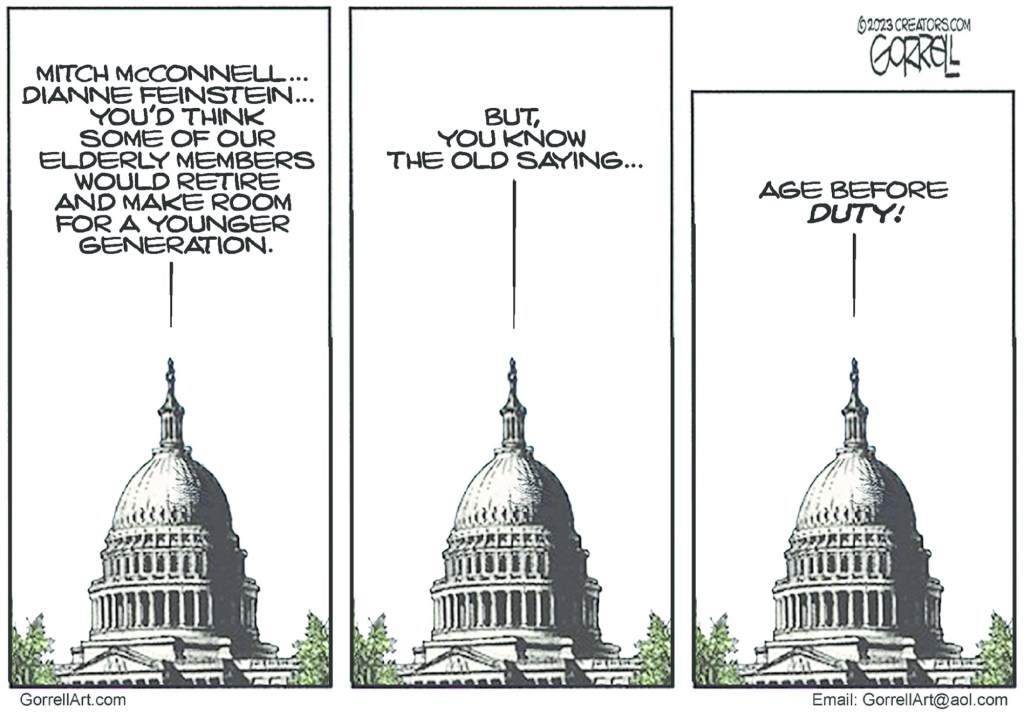
Apparently, America has discovered the secret to immortality.
You don’t need cryogenics. You don’t need experimental medicine. You don’t even need to drink from the Fountain of Youth.
You simply need to get elected to the United States Senate.
Because once you’re there, apparently, the expiration date is optional.
Look at the generational makeup of the Senate and you begin to understand why Washington can sometimes feel less like a representative democracy and more like a very exclusive retirement community with a nuclear launch code.
Approximately six out of every ten senators are Baby Boomers. Another handful belong to the Silent Generation. Gen X—which, depending on whom you ask, has been “next” for roughly 30 years—makes up only about three in ten senators. Millennials barely have a foothold.
And Gen Z?
Please.
They haven’t even been allowed into the building yet.
The Senate has become the political equivalent of a restaurant where the same people have been sitting at the best table since 1987, the waiter keeps bringing them bread, and every time somebody from the next generation asks, “Are you guys almost finished?” they respond:
“We’re just getting started.”
Welcome to the Eternal Internship
Gen X is particularly fascinating.
We are approaching 60.
We’ve spent our entire adult lives watching Baby Boomers occupy positions of political, corporate and cultural authority. We watched them become presidents, senators, governors, CEOs and media moguls. We watched them establish the rules.
And then we waited.
And waited.
And waited.
At some point you start wondering whether Gen X accidentally missed an email.
Because here we are, pushing 60, and we’re still standing outside the political revolving door holding a number that apparently says:
Now serving: 1946.
The irony is that Gen X was always supposed to be the generation that inherited the machinery.
Instead, we’re apparently inheriting the machinery after the previous owners have decided they’re never moving out.
It’s like buying a house where the previous owner says, “Sure, it’s yours now.”
Then you discover they’re still living in the master bedroom.
And they’re charging you rent.
The Senate: Where “Term Limits” Means Nothing You Can Measure
The Senate is especially absurd because there is no institutional requirement that politicians eventually say, “You know what? I’ve been doing this for several decades. Perhaps someone else should have a turn.”
Nope.
If the voters keep electing you, you can stay.
And politicians have become extraordinarily talented at getting reelected.
Some senators have served for decades. They accumulate seniority, relationships, donors, committee assignments and institutional power. By the time somebody from the next generation is finally old enough to realistically challenge them, the incumbent has been in Washington longer than the challenger has been alive.
And then Washington wonders why younger generations are frustrated with the government.
Imagine telling a 40-year-old:
“Don’t worry. Your generation will eventually have political influence.”
When?
After Social Security becomes a historical artifact?
After the last Boomer retires?
After someone finally removes the congressional office furniture from the Smithsonian?
The Great Generational Waiting Game
The strangest part isn’t that older Americans participate in politics.
They should.
Experience matters. Wisdom matters. Institutional knowledge matters.
But there is a difference between experience and permanent occupancy.
A democracy isn’t supposed to be a lifetime subscription.
The purpose of generational succession isn’t to throw older people into the political wilderness. It’s to make room for people who grew up under different circumstances, with different technologies, different economic realities and different social conditions.
The people governing America today came of age in a world before the internet, before smartphones, before social media, before artificial intelligence and before many of the economic realities younger Americans now face.
Meanwhile, Gen X grew up watching the world transform from rotary phones to smartphones.
We went from vinyl records to cassette tapes to CDs to MP3s to streaming.
We watched computers go from something that occupied an entire room to something sitting in our pockets.
We witnessed the birth of the internet.
And somehow Washington’s response was:
“That’s adorable. Now go sit over there.”
The Generation That Was Supposed to Be Next
Gen X has always had a peculiar relationship with history.
We were the generation sandwiched between two enormous demographic waves. We were smaller than the Boomers and smaller than the Millennials.
We learned early not to expect anyone to notice us.
So perhaps it’s fitting that we’re approaching 60 and still waiting for our turn.
But here’s the problem:
Eventually there isn’t supposed to be a turn.
There is supposed to be a transition.
That’s what succession is.
You don’t wait until the previous generation disappears before allowing the next generation to participate. You gradually hand over responsibility.
That’s how institutions survive.
That’s how families survive.
That’s how businesses survive.
That’s how civilizations survive.
But apparently the United States Senate has decided the best succession plan is:
“We’ll cross that bridge when we’re no longer physically capable of crossing bridges.”
And Then They Wonder Why We’re Cynical
Maybe this helps explain why so many Americans have become cynical about government.
People aren’t necessarily demanding that older politicians disappear.
They’re asking why the political system seems incapable of producing meaningful generational turnover.
Why does political experience increasingly mean how long you’ve managed to keep your job rather than what you’ve accomplished?
Why does seniority automatically translate into authority?
Why does somebody who entered politics when MTV was still playing music get to decide what the future of artificial intelligence, social media, cryptocurrency, climate technology and the modern workforce should look like?
Again, experience matters.
But experience isn’t the same thing as relevance.
And age isn’t the same thing as wisdom.
Sometimes age simply means you’ve had more opportunities to make mistakes.
The Punchline
So here we are.
The Silent Generation is still hanging around.
The Boomers dominate the Senate.
Gen X is approaching 60 and still waiting patiently in the hallway.
Millennials are finally getting a few chairs.
And Gen Z is standing outside wondering what the hell happened.
Meanwhile, the people currently holding the keys to the government keep telling everyone that America needs to prepare for the future.
Which is a little like having someone who has lived in the same house for 70 years tell you that the next generation needs to think about moving in someday.
Someday.
Just not today.
Today, they’re still using the good china.
And apparently, they’re not finished with it yet.
Maybe the real American dream isn’t passing the torch.
Maybe it’s simply refusing to let go of it until somebody pries it out of your cold, arthritic hands.
And Gen X?
Well, we’ll be over here.
Waiting.
We’re really good at waiting.
We’ve been doing it since 1980.
-
Historical edit
If you could erase one event from history, what would it be?
Erasing one event from history is kind of a loaded question because every event leads to many other things you know in the butterfly effect you know, of course you’d wanna get rid of 9/11 or Pearl Harbor or the Holocaust, the Crusades or any of those things but every one of those events as tragic as they were lead to something that good better in different has where we are in recent history I would like to erase the election results for 2024 for the White House that would be high on my list of things to get rid of
-
Skull & Bones
What’s a conspiracy theory you actually find believable?
Is for conspiracies go I’m pretty sure that there are actually groups that go back hundreds of years that have always been in power will continue to be in power because they have money and they can hide their agenda and you know the bushes being in Scullin bones and things like that are absolutely plausible
-
Service… Elected vs Volunteer
Dwain Northey (Gen X)

There is something almost beautifully absurd about the way our federal government has decided to define “service.”
Before diving in, it’s worth acknowledging an important reality that often gets lost in these comparisons: military service members and members of Congress operate in fundamentally different roles. One involves the possibility of physical danger, strict discipline, relocation, and legally binding orders that can place a person in harm’s way. The other involves legislative responsibility, policymaking, and governance in a civilian political system. Their responsibilities, risks, and compensation structures are not meant to be identical—and in many ways, they cannot be.
But here is where the comparison starts to bother me.
Take the typical young person who enlists in the Army, Navy, Air Force, Marines, or Space Force. They are often 18, 19, or 20 years old when they sign on the dotted line. Maybe they spend six years doing something absolutely essential but decidedly unglamorous—working behind a desk, processing paperwork, maintaining records, handling logistics, or doing any of the thousand administrative jobs required to keep the military functioning.
They may never fire a shot. They may never see combat. They may never come particularly close to a battlefield.
But they still signed a contract with the United States government.
They surrendered six years of their youth, accepted military discipline, gave up considerable personal freedom, and remained subject to being sent wherever the government decided they were needed.
They serve their six years.
Then what?
If they leave without a service-connected disability, congratulations! Here is your GI Bill. Maybe some education benefits. Maybe some other veterans’ benefits depending on the circumstances.
Thank you for your service.
Now let’s turn the telescope around.
Run for Congress.
Get elected to the House of Representatives.
Except there’s one little wrinkle in our comparison: the person running for Congress generally isn’t 18 years old.
They have to be at least 25 to serve in the House, and most members are considerably older than that when they first arrive. They have already had decades of life experience, education, careers, professional networks, and time to establish themselves.
So let’s make the comparison as fair as possible.
Imagine that young 18-year-old enlistee stays in the military for 20 years.
At 18, they put on a uniform.
At 20, they’re learning the job.
At 25, they’re a seasoned service member.
At 30, they’re an experienced noncommissioned officer.
At 35, they’re still serving.
And at 38?
They finally reach the point where they can say:
“I have given twenty years of my life to the United States military, and now I have earned my retirement.”
Twenty years.
Two decades.
Half the average American’s working lifetime.
Now take the other person.
Let’s say they don’t even get elected to Congress until they’re 32.
They serve six years.
At 38, they’re finished.
The military veteran has spent 20 years serving the government.
The politician has spent six.
Both are 38.
And yet their post-government trajectories can look remarkably different.
The military veteran walks away with a military retirement calculated from an enlisted pay scale.
The former member of Congress walks away with a congressional résumé that can open doors the enlisted veteran couldn’t even get through the lobby of.
That’s the part that makes me scratch my head.
The argument will inevitably be, “But Congress is a difficult job.”
Absolutely.
So is being a military member.
Congressional service carries enormous responsibility. Members deal with legislation, constituents, national policy, political pressure, public scrutiny, and the possibility of being voted out of office.
But here’s the absurdity:
The military doesn’t require you to be in danger for your service to count.
That administrative specialist sitting behind a desk is still subject to military law. They can be transferred. They can be deployed. They can be ordered into situations they didn’t choose. They don’t get to simply say, “You know what? I’m not really feeling Afghanistan this year.”
Their civilian counterparts can quit.
The enlisted member can’t just hand in a two-week notice.
And after six years, that 24-year-old veteran is suddenly expected to translate “military personnel specialist” into something a civilian corporation understands.
Meanwhile, the 38-year-old former congressman puts six years in Congress on the résumé and suddenly becomes an “experienced government affairs consultant.”
Funny how that works.
And let’s make the comparison even more uncomfortable.
The service member who joins at 18 and serves until 38 has given the government twenty years during the most formative decades of their adult life.
The person who gets elected at 32 and leaves at 38 has given the government six years.
Yet the six-year politician can potentially walk away with federal retirement benefits, continued access to federal healthcare programs, a substantial political network, and a résumé that can be worth a fortune in the private sector.
The military veteran has earned a pension through two decades of service.
The politician has acquired something arguably even more valuable:
connections.
The former congressman knows lobbyists.
Corporations know the former congressman.
Government agencies know the former congressman.
Other politicians know the former congressman.
And suddenly that six-year government employee is being offered a consulting contract worth more than the military retiree’s annual pension.
Again:
Funny how that works.
And this is where I think the conversation about “thanking veterans for their service” needs to become something more than a bumper sticker.
Because there is a profound difference between recognizing service and adequately rewarding sacrifice.
We have created a system where an 18-year-old can give the government twenty years of his life and still emerge financially behind someone who entered federal public service at 32, served six years, and left with a congressional résumé.
The young enlisted person gave the government their twenties.
Their thirties.
Their holidays.
Their weekends.
Their geographic freedom.
Their ability to make spontaneous decisions about where they wanted to live.
And potentially their physical health.
The politician gave the government six years.
Again, I’m not saying members of Congress don’t work hard.
I’m saying the scale of the commitment is wildly different.
And if we’re going to compare public servants, then let’s at least have the intellectual honesty to compare the entire package.
Not just the job.
The opportunity cost.
The years.
The restrictions.
The risk.
The retirement.
And most importantly, what happens after the government no longer needs you.
Because the military veteran gets a DD-214.
The congressman gets a résumé.
And in America, sometimes the résumé is worth considerably more.
Perhaps that’s the real irony.
We spend billions telling young people that military service is one of the noblest things they can do for their country.
And it is.
But maybe someday we should build a compensation system that reflects that nobility.
Because if an 18-year-old can give America twenty years and a 32-year-old politician can give America six, and the politician still walks away with the better long-term financial and professional deal, perhaps the problem isn’t that we’re failing to thank our veterans.
Perhaps we’re failing to value them.
There are two kinds of government service.
There is service to the government.
And there is service in government.
One gets you a DD-214.
The other can get you a pension, healthcare, a powerful résumé, a Rolodex full of influential people, and a second career explaining to corporations how government works.
And then we have the nerve to tell the kid who spent twenty years wearing the uniform:
“Thank you for your service.”
Maybe we should actually mean it.


You must be logged in to post a comment.