Dwain Northey (Gen X)
https://www.cbsnews.com/news/naacp-travel-advisory-florida-says-state-hostile-to-black-americans/
Remember the good old days when there were only travel advisories and or ban for, what some would call, third word countries? Well now because of the vile vitriol of one Governor Ron DeSantis the state of Florida, a vacation destination, has received a travel advisory by the NAACP.
The wannabe future President has made the climate so venomous in Florida the anyone who is a part of any minority group does not feel safe in the state. Black, Brown, LGTBQ+, these are all groups that are under attack in the Sunshine State. The majority Republican legislature and their fearful leader has passed laws that make almost everything a jailable offence and the fact that the state has very loose gun laws and a stand your ground law makes it more dangerous than being a blonde female in central America.
Florida residents are able to carry concealed guns without a permit under a bill signed into law by Republican Gov. Ron DeSantis. The law, which goes into effect on July 1, means that anyone who can legally own a gun in Florida can carry a concealed gun in public without any training or background check. This with their ridiculous stand your ground law, ‘Florida’s “Stand-Your-Ground” law was passed in 2005. The law allows those who feel a reasonable threat of death or bodily injury to “meet force with force” rather than retreat. Similar “Castle Doctrine” laws assert that a person does not need to retreat if their home is attacked.’ Makes it really sketchy to go there.
This in top of the don’t say gay rule and the new trans ruling that just passed.
“Florida lawmakers have no shame. This discriminatory bill is extraordinarily desperate and extreme in a year full of extreme, discriminatory legislation. It is a cruel effort to stigmatize, marginalize and erase the LGBTQ+ community, particularly transgender youth. Let me be clear: gender-affirming care saves lives. Every mainstream American medical and mental health organization – representing millions of providers in the United States – call for age-appropriate, gender-affirming care for transgender and non-binary people.
“These politicians have no place inserting themselves in conversations between doctors, parents, and transgender youth about gender-affirming care. And at the same time that Florida lawmakers crow about protecting parental rights they make an extra-constitutional attempt to strip parents of – you guessed it! – their parental rights. The Human Rights Campaign strongly condemns this bill and will continue to fight for LGBTQ+ youth and their families who deserve better from their elected leaders.”
This law makes it possible for anyone to just accuse someone of gender affirming care to have their child taken from them this would include someone traveling from out of state. This alone justifies a travel ban to the Magic Kingdom for families.
Oh, and I haven’t even mentioned DeSantis holy war with Disney, the largest employer in the state. I really hope the Mouse eats this ass holes lunch.
Well that’s enough bitching, thanks again for suffering though my rant.
-
Super Bowl or Misplaced Priorities
Dwain Northey (Gen X)

America’s Championship Priorities
Today is Super Bowl Sunday—our most sacred national observance, positioned neatly between Groundhog Day mysticism and Valentine’s Day consumer panic. It is the day we gather in solemn reflection to honor courage, sacrifice, and the heroic endurance required to finish a seven-layer dip before halftime.
This year’s ceremonial clash features the Seattle Seahawks and the New England Patriots, battling in Santa Clara for a trophy that will dramatically reshape…absolutely nothing about the daily lives of the 330 million people watching.
Meanwhile, in the quieter corners of reality, the 2026 Winter Olympics just opened in Italy—an event involving thousands of athletes who trained their entire lives for something that will receive roughly the same national attention as a weather report about Nebraska.
And somewhere in Washington, the federal government recently slipped into yet another partial shutdown, the political equivalent of putting the country on airplane mode and hoping no one notices until Monday.
But priorities are priorities.
Why concern ourselves with international competition or functioning governance when we can debate quarterback stats with the intensity normally reserved for constitutional amendments? Why follow policy negotiations when we can instead track the emotional arc of a halftime show and argue about commercials involving talking animals selling insurance?
The beauty of Super Bowl Sunday is its reassuring simplicity. No messy geopolitics. No budget negotiations. Just a perfectly contained universe where the most urgent national question is whether Seattle’s defense or New England’s legacy will prevail for three and a half glorious hours.
And when the final whistle blows, America will return to normal—remembering, perhaps briefly, that the Olympics are happening, the government still needs funding, and reality remains stubbornly unsponsored by beer companies.
But until then, pass the wings. Democracy can wait until after the commercials.
-
Prayer breakfast guess who wouldn’t be invited
Dwain Northey (Gen X)
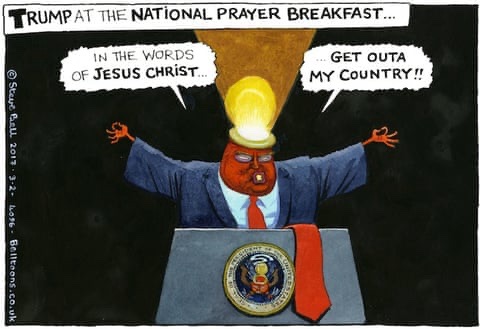
Ah yes, the sacred National Prayer Breakfast—America’s annual reminder that nothing says humble devotion quite like catered eggs, televised piety, and a guest list curated with the spiritual discernment of a campaign donor spreadsheet.
Enter Dear Donald, patron saint of the upside-down Bible photo op, now recast as a man of profound and deeply convenient faith. This is, of course, the same Donald whose first-term flirtation with Scripture involved gripping it like a rental prop outside a church he did not attend, holding it in a manner suggesting he believed the Beatitudes were printed on the back cover next to the barcode. Yet time, like public memory, is mercifully short. And so here we are again—watching a man who treats the Ten Commandments less as moral guidance and more as optional user settings suddenly draped in the warm glow of righteousness.
The honorees, we are told, are men of strength. Men of conviction. Men doing things that, if described in the New Testament, would almost certainly appear in the chapter right after “And Jesus said, please don’t do that.” But details, details. Christianity, in this ceremonial context, is less about loving one’s neighbor and more about ensuring the neighbor has proper documentation, quiet obedience, and preferably no legal representation.
One might imagine Christ at this breakfast—sandals dusty, sermon notes in hand—gently asking why the poor are missing, why the prisoners are mistreated, why mercy has been replaced with press releases. He would probably not be invited back. Seating is limited, and compassion does terrible things to the optics.
Still, Dear Donald seems comfortable in this new theological wardrobe. Not quite declaring himself divine—there are branding considerations—but certainly hovering in the general vicinity of sacred endorsement. If humility is the hallmark of faith, then he has achieved a remarkable innovation: humility without any visible trace of being humble. A kind of spiritual invisibility cloak, woven entirely from applause.
And of course, the message is clear. Welcoming the stranger is nice in theory—very poetic, very first-century Galilee—but in practice it is apparently a misguided thought, best replaced with something sturdier, like razor wire and a well-lit podium. After all, nothing captures the radical love of the Gospel quite like ensuring the least among us remain safely out of frame.
So the breakfast concludes as it always does: prayers offered, cameras satisfied, conscience gently postponed until next year’s menu is finalized. The kingdom of heaven may belong to the meek, but the ballroom, it seems, is reserved for the well-connected.
Amen—and please pass the hypocrisy.
-
The Wood-Be King and the Kingdom of Absolutely Not His Fault
Dwain Northey (Gen X)

There is, somewhere in the grand marble imagination of American politics, a man who believes history will remember him not as a president, but as a rescuer of civilization—a sort of budget monarch in a red tie. The crown is invisible, of course, but that only makes it more powerful. Anyone can see a real crown. Only the truly chosen can see an imaginary one.
Unfortunately for the wood-be king, the peasants in Minnesota have been behaving very poorly. Instead of applauding sweeping immigration crackdowns and thousands of federal agents descending on their neighborhoods, they’ve taken to marching in the streets, closing businesses, and chanting things like “ICE out.” Tens of thousands even joined a historic general strike after fatal shootings by federal agents intensified outrage.
This is awkward. Kings generally prefer parades for them, not protests about them.
The trouble began when aggressive enforcement operations—and the deaths of two U.S. citizens shot by federal agents—sparked nationwide demonstrations and deep fear in immigrant communities.
Naturally, in such moments of national soul-searching, a leader might ask:
Are my policies causing harm?
Should I reconsider?
Is governing slightly more complicated than yelling in all caps?
But that would require abandoning the most sacred principle of modern strong-man democracy:
Nothing is ever your fault.
So instead, the royal narrative adjusts. The shootings were tragic—but also self-defense. The protests are large—but also fake. The unrest is real—but caused by enemies, critics, mayors, judges, immigrants, weather patterns, and possibly windmills. The policies are unpopular—but secretly beloved by a silent majority that is very shy and lives mostly inside polling errors.
Even when federal officials quietly scale back enforcement or change leadership to calm tensions, skepticism lingers because the mission itself hasn’t changed.
In monarch-speak, this is known as “strategic compassion,” meaning you lower the volume without changing the song.
Meanwhile, judges restrict tactics against peaceful protesters, local leaders denounce federal overreach, and entire communities organize in resistance.
Which, from the palace balcony, looks less like democracy and more like terrible public relations.
So the question remains:
Will the wood-be king finally realize that when the streets fill with protest, the problem might not be the streets?
History suggests another outcome. The hot potato will be passed—perhaps to mayors, governors, immigrants, or the concept of reality itself. Credit will be claimed for successes, blame reassigned for failures, and the crown—still invisible—will remain perfectly polished.
Because in the kingdom of Never My Fault,
the ruler is always right,
the crowds are always wrong,
and accountability is something that only happens to other people.
Long live the king.
Please remain calm while the peasants keep marching.
-
Side Hustle
Dwain Northey (Gen X)
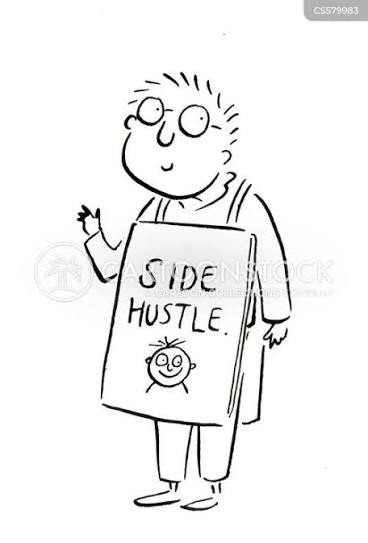
Somewhere along the way, we achieved the long-promised future of progress, efficiency, and limitless opportunity—only to discover that it mostly meant needing two or three jobs to afford toothpaste. Truly, the dream is alive and well. It’s just very, very tired.
We were once told that working hard at a single, honest job would provide stability, dignity, and maybe even the occasional vacation where you didn’t spend half the time checking your bank balance like it was a medical monitor. Now the modern definition of “stable employment” is having a full-time job, a side hustle, a backup side hustle in case the first side hustle collapses, and a vague plan to sell homemade candles online if everything else fails. Nothing says economic prosperity like a nation of exhausted entrepreneurs who never actually wanted to be entrepreneurs.
Of course, we’re encouraged to view this not as desperation, but as freedom. You’re not struggling—you’re diversifying income streams. You’re not overworked—you’re building your personal brand. You’re not collapsing from burnout—you’re grinding. It’s amazing what clever vocabulary can do. If medieval peasants had access to modern corporate language, they probably would’ve described serfdom as a “land-based subscription model with performance incentives.”
And let’s not forget the motivational speeches. Every corner of the internet is filled with cheerful billionaires explaining that success comes from waking up at 4 a.m., drinking something green, and believing in yourself. Strangely, none of these speeches mention needing three jobs just to pay rent, but I’m sure that’s an oversight. Perhaps the real problem is that millions of people simply haven’t optimized their morning routine enough. Clearly, the missing ingredient in economic survival is journaling.
Meanwhile, the cost of living continues its thrilling ascent into the stratosphere, bravely outpacing wages like an Olympic sprinter competing against someone wearing flip-flops. Rent rises. Groceries rise. Gas rises. Even the price of being broke seems to be increasing. But wages? Wages prefer a more meditative pace, choosing reflection over movement. We should respect that. Growth isn’t for everyone.
So here we are: a society where working all day is no longer sufficient to live, and living has become a sort of side activity squeezed between shifts. We work to afford housing we barely see, food we eat quickly, and streaming services we fall asleep in front of because we’re too exhausted to choose something to watch. Leisure has become a rumor passed down from previous generations, like pensions or affordable healthcare.
Naturally, we’re told this is temporary. Things will improve. Just keep pushing. Keep hustling. Keep believing. Keep pretending that this is normal and not a strange economic magic trick where productivity rises, wealth concentrates, and somehow everyone else is told to start driving for a delivery app at midnight. Progress, but with extra steps and less sleep.
And yet, the most impressive part of all this isn’t the exhaustion—it’s the quiet acceptance. Millions of people juggling jobs, schedules, and anxiety, still showing up every day, still paying bills, still hoping something might shift. Not because the system is fair, but because survival doesn’t offer many alternatives. Resilience is inspiring, but it’s also suspiciously convenient for anyone benefiting from the status quo.
So yes, we’ve come a long way. We have smartphones, artificial intelligence, same-day delivery, and the ability to summon dinner with a tap of a screen. We also have a workforce that needs a second job to afford the dinner. Progress is funny like that—technologically dazzling, economically confusing, and just sarcastic enough to feel intentional.
In the end, perhaps this is the true modern balance: we work just to live, and live mostly to keep working. A beautifully efficient loop. Almost elegant, really—if you ignore the exhaustion, the anxiety, and the lingering suspicion that somewhere, somehow, this wasn’t quite the future we were promised.
-
F… States Rights Nationalize Elections
Dwain Northey (Gen X)
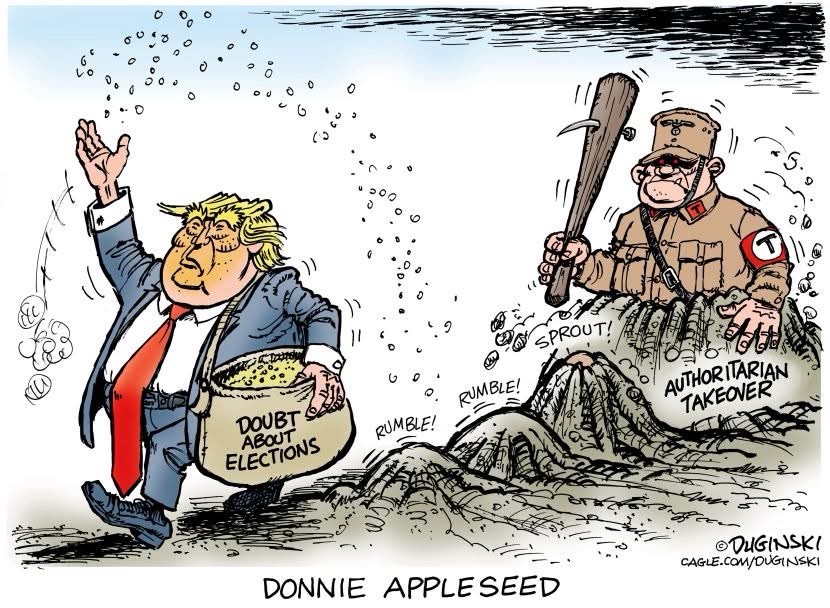
We’re now at the point in the national sleepwalking exercise where Donald, fresh off seizing voting records from Holt County, Georgia—because apparently “states’ rights” now means states’ stuff belongs to me—is openly floating the idea that elections should be nationalized. Not nationalized in the “uniform standards and equal access” way, mind you, but nationalized in the Republicans should run them so they’re fair way. Which is a sentence that should make the Constitution burst into flames out of sheer embarrassment.
Let’s be clear: this isn’t a slip of the tongue. This isn’t hyperbole. This is a guy standing on the hood of the American system, smashing the windshield, and yelling, “Relax, I’m fixing it.” The same Constitution Republicans wrap themselves in like a security blanket when someone mentions gun safety or student debt? That Constitution very deliberately put elections in the hands of the states, with decentralized control, precisely so no one party, no one man, could rig the entire system in their favor. You know—tyranny prevention, that boring old concept.
And yet here we are, being told with a straight face that the solution to losing elections is not better ideas, broader appeal, or maybe not nominating the same aggrieved reality-TV contestant again, but instead: take the elections. Just… take them. Federalize them. Party-ize them. Because nothing says “fair” like letting the people who keep losing decide the rules.
This is the political equivalent of a ref saying, “Actually, the team I like will now be in charge of keeping score.” And then half the country nodding along like, Seems reasonable.
What’s especially impressive is the audacity. For decades we were lectured that any federal involvement in elections was socialism, communism, Marxism, and possibly witchcraft. Now suddenly, central control is fine—as long as it’s red, loyal, and conveniently aligned with one man’s feelings about 2020. The Constitution didn’t change. The principles didn’t change. The only thing that changed is that he lost.
And instead of treating that loss like every other loser in American history—concede, sulk, maybe write a memoir—we’re doing this. Seizing records. Rewriting rules. Floating trial balloons about party control of democracy itself. All while insisting this is about “fairness,” the way a mugger insists this is about “redistribution.”
So again: when are we going to wake up? When the ballots are counted by party officials? When opposition voters are “reviewed”? When elections are only fair if one side wins? Because by then, congratulations—we won’t be arguing about democracy anymore. We’ll be reminiscing about it.
-
When will the files become trials?
Dwain Northey(Gen X)

The Epstein files are the political equivalent of a horror movie sequel nobody asked for and nobody can escape. Every time we think the story is finally dead, it sits up in bed, gasps for air, and whispers, “You thought.” Donald, of course, insists it’s all fake news—every word fabricated, every page forged—unless, by some cosmic coincidence, it mentions literally anyone other than him. Then suddenly it’s very real, very important, and probably needs a special press conference, three Truth Social posts, and a sharpie diagram.
Meanwhile, the DOJ is legally required to release the files, but they’re doing it with the urgency and efficiency of a 50-year-old man with an enlarged prostate trying to pee at 3 a.m. Lots of straining, awkward pauses, and assurances that something is happening, even though the rest of us are just standing there wondering why this is taking so long and whether we should call a doctor. Drip. Stop. Drip. Redaction. Stop.
And here’s the real punchline: I will be so happy when we finally have a House and Senate that stop treating the Epstein saga like a spooky campfire story and start treating it like what it should be—actual trials, actual subpoenas, actual consequences. Less breathless talk about “the files,” fewer selectively leaked pages, and more people sworn in under oath. Because I’m exhausted by the endless teasing of truth, the bureaucratic urinary hesitation, and the clown show in the Oval Office. At this point, justice doesn’t need another press release—it needs a courtroom.
-
Continued Search to Validate a Lie
Dwain Northey (Gen X)
Ballots, Dictators, and the Eternal Scream of “Stolen”
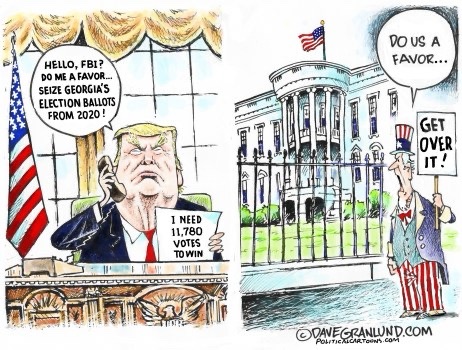
By now, the pattern should be familiar. Somewhere in the world, something dramatic happens—an arrest, a coup, a scandal—and within minutes Donald Trump is staring at ballots in Georgia like they’re connected by red string to a corkboard labeled VINDICATION.
This week’s entry in the ongoing saga: Nicolás Maduro, the longtime strongman president of Venezuela, is now in custody. And if that fact made you immediately think, Wait… wasn’t Venezuela one of the countries Trump accused of manipulating the 2020 U.S. election?—congratulations, you are paying attention.
Trump, of course, never stopped screaming that the 2020 election was stolen from him. Not paused. Not softened. Just full-volume grievance, four years running. Courts rejected it. Audits debunked it. Officials from both parties contradicted it. But facts, as we’ve learned, are no match for a man who treats losing like a clerical error that can be fixed if he just keeps yelling.
Now enter Maduro.
The Convenient Villain Returns
Back in the fever-dream days of post-2020 conspiracy theories, Venezuela was floated as one of the shadowy foreign actors that somehow—through vibes, algorithms, or mystical ballot sorcery—helped rig the U.S. election against Trump. These claims were repeatedly debunked, dismissed in court, and laughed out of serious conversation. But conspiracy theories don’t die; they just wait patiently for a new headline to climb into.
So now that Maduro is in custody, the question practically asks itself: will Trump finally get his long-awaited confession? Will there be a moment—perhaps televised, preferably dramatic—where Maduro sighs and says, “Yes, Donald, we did it. We manipulated the ballots in Georgia. Please forgive us.”
Because if that happens—never mind reality, evidence, or jurisdiction—Trump finally gets what he’s wanted all along: a foreign villain to justify his domestic obsession.
Ballots as Emotional Support Objects
Trump’s fixation on Georgia ballots has taken on an almost spiritual quality. These aren’t pieces of paper anymore; they’re sacred relics. Proof that the universe wronged him. Evidence that democracy malfunctioned, not because voters chose otherwise, but because something unnatural intervened.
And if Maduro can be cast as that unnatural force? Even better.
Never mind that elections are run by states. Never mind that there’s no mechanism—legal or constitutional—that allows a president to “seize ballots” years after the fact. Never mind that confessions extracted from foreign detainees are not admissible proof of anything other than desperation.
What matters is the narrative: I was right all along.
Authoritarian Logic, Imported and Domestic
Here’s where the connection really snaps into focus.
Authoritarians don’t lose elections. They are robbed of them. If the people vote against you, the people are wrong. If the math doesn’t work in your favor, the math is corrupt. If institutions contradict you, the institutions must be captured, purged, or ignored.
That’s not a Venezuelan problem. That’s a strongman problem.
We’re told to recoil in horror at sham elections abroad while casually entertaining the idea that maybe, just maybe, a foreign dictator secretly controlled American ballots—and that exposing this fantasy might somehow justify tighter control over future elections. Including, say, 2026.
Create the crime. Extract the story. Use the story to seize the system.
It’s not subtle. It’s not new. It’s just usually something we pretend only happens “over there.”
The Real Endgame
Let’s be honest. No confession from Maduro is coming that validates Trump’s claims. No evidence exists that Venezuela manipulated the 2020 election. And no amount of yelling at ballots will change that.
But that may not be the point.
The point is keeping the grievance alive. Keeping doubt in circulation. Keeping the idea floating that elections are only legitimate when he wins—and suspicious when he doesn’t. Because once enough people believe that, you don’t need proof anymore. You just need power.
So no, it’s not just you seeing the connection. The connection is the worldview. The belief that democracy is conditional, truth is negotiable, and losing is impossible unless someone else cheated.
Ballots in Georgia. A dictator in custody. A grievance that refuses to die.
Different headlines. Same story.
-
Groundhog Day
Dwain Northey (Gen X)

Every year on Groundhog Day, America gathers—some of us sincerely, most of us ironically—to consult a chubby rodent about the future of the climate. Not a meteorologist with decades of data. Not a climate scientist with models, satellites, and graphs that look like modern art. No. A groundhog. A dirt-loving mammal whose main qualifications include hibernation and an uncanny ability to panic at its own shadow.
This is the same country that scoffs at climate change because “weather changes all the time,” yet will confidently announce, “Welp, Phil saw his shadow—six more weeks of winter,” as if that sentence contains science instead of folklore and vibes. Ice caps melting? Debatable. A rodent blinking in Pennsylvania? Ironclad truth.
Groundhog Day is really a master class in selective belief. Climate data spanning centuries is dismissed as propaganda, but a creature dragged out of a hole at dawn, under camera lights, surrounded by men in top hats, is treated like the Oracle of Delphi. If Punxsutawney Phil had a PowerPoint, Congress might actually listen.
What makes it even better is that Phil is wrong roughly as often as flipping a coin, but no one storms the burrow yelling “fake weather.” There are no angry press conferences accusing the groundhog of having an agenda. We just shrug and say, “Well, that’s nature,” and go back to denying the rest of it.
So here we are: rejecting climate science while trusting a rodent to predict the seasons. Maybe that’s the real tradition—not Groundhog Day itself, but the annual reminder that evidence is optional, as long as the story is cute, familiar, and involves a fuzzy animal doing absolutely nothing.
-
February
Dwain Northey (Gen X)
February arrives like the calendar equivalent of an apology text. It’s short, awkward, and clearly wasn’t thought through. Here’s a month that’s supposed to hold love (Valentine’s Day), history (Black History Month), and somehow the emotional fallout of January—yet it only gets 28 days. Twenty-eight. Unless, every four years, we remember February exists and toss it a bonus day like a pity cookie. “You good now?”
There’s no real logic to it. Other months sprawl out with 30 or 31 days like they earned it, while February feels like the intern of the Gregorian calendar—overworked, underpaid, and constantly reminded it’s replaceable. We crammed romance, remembrance, and resistance into the shortest month and said, “You’ll make it work.”
And just to really underline how unserious we are about February, we kick it off with Groundhog Day. A holiday centered around a rodent making a meteorological guess that means absolutely nothing. Shadow? No shadow? Six more weeks of winter? Buddy, it was already going to be winter anyway. This isn’t forecasting; it’s vibes.
So here we are: a month that feels like an afterthought, pretending to be meaningful while running on borrowed time. Blink and it’s over. Which, honestly, might be the most February thing of all.
-
War in U.S cities
Dwain Northey (Gen X)
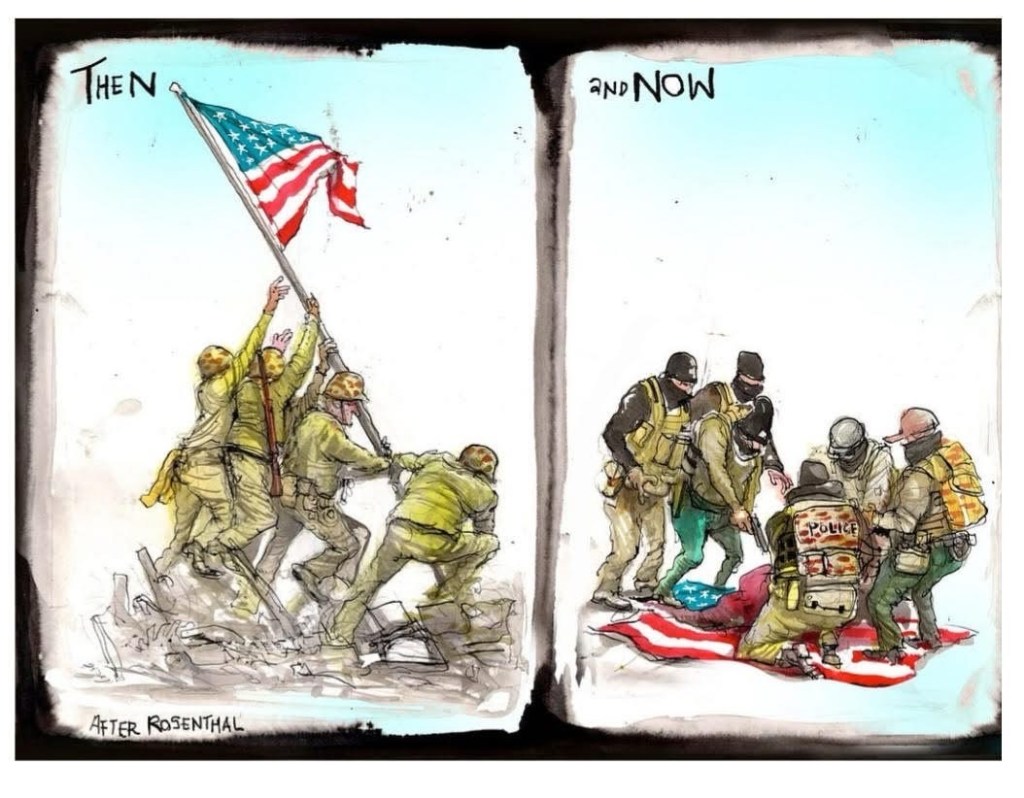
They keep insisting—very earnestly, with straight faces and carefully folded flags behind them—that they are absolutely not at war with America’s cities. Not at war at all. No, no. This is just a light domestic situation. A mild disagreement. A friendly disagreement that, for reasons no one can quite explain, requires “personnel in theater,” “operational zones,” and a “drawdown timetable.”
You know. Normal neighborhood stuff.
Apparently, when you’re not at war with your own country, the first thing you do is stop calling cities “cities” and start calling them “theater.” Chicago isn’t a place where people live, work, and pay taxes—it’s a “theater of operations.” Portland isn’t a city council problem—it’s an “active zone.” New York isn’t a municipality—it’s a “complex environment.” Funny how language works. Once you rename something, you can pretend it’s not what it obviously is.
And they are very clear about one thing: this is not an occupation. Occupations are bad. This is just a “temporary presence.” A presence with armored vehicles, federal forces, chain-of-command briefings, and press releases that sound like they were written in the Pentagon during the early stages of a foreign intervention. But relax—this isn’t war. War has uniforms everyone recognizes. War has enemies that don’t vote. War happens somewhere else.
This is different. This is just “maintaining stability.”
Of course, the cities receiving all this stability tend to share one suspicious characteristic: they’re blue. Very blue. Deep, terrifying shades of democratic blue. Somehow the red cities manage to survive without troops “embedded on the ground,” but the moment a city elects leadership the administration doesn’t like, suddenly it becomes a “hotspot” requiring “force posture adjustments.” Coincidence, surely. Pure coincidence, like rain always falling exactly where the roof is missing.
Listen carefully to the briefings and it’s impossible not to notice how much they sound like updates from an overseas conflict. “We have assets deployed.” “We’re evaluating threat levels.” “We’re drawing down operations once objectives are met.” Objectives like what, exactly? Civic harmony? Better vibes? Or maybe just reminding everyone who has the bigger toys?
And now, as if to really complete the foreign-war aesthetic, they’ve moved on to arresting journalists—for journalism. Not espionage. Not sabotage. Not incitement. Journalism. Standing there with a camera. Asking questions. Documenting what’s happening in these so-called “theaters.” Apparently, once an American city becomes a combat zone in the imagination of the administration, the First Amendment becomes optional—something to be “temporarily suspended for operational reasons.”
Because in a real war, journalists are inconvenient. They show the footage you’re not supposed to see. They record the names, the faces, the badges. They provide evidence. So naturally, the solution isn’t to stop behaving like an occupying force—it’s to treat reporters like enemy assets. Detain them. Handcuff them. Intimidate them. Then insist, with a perfectly calm tone, that the press is still free. Extremely free. Just not free to document this.
And, of course, we’re told not to worry. This isn’t oppression. It’s “crowd control.” It’s “scene security.” It’s “officer safety.” Funny how the language keeps doing the same job: sanding down reality until it fits into a press briefing. Arresting journalists sounds bad. “Neutralizing interference” sounds professional.
The strangest part isn’t even the militarized language—it’s the insistence that we’re imagining it. That we should ignore the jargon, ignore the posture, ignore the tactics, ignore the zip ties on reporters, and trust that this is all perfectly normal democratic governance. Because nothing says “healthy republic” like treating your own cities the way previous administrations treated Fallujah—and treating your own journalists like hostile embeds.
So no, they aren’t at war with America’s cities. They just talk like it. Act like it. Deploy like it. And silence the people documenting it.
But don’t worry. Once the “drawdown” is complete, I’m sure the cities will go back to being cities again—right after they’re done being theaters.


You must be logged in to post a comment.