Dwain Northey (Gen X)
https://www.cbsnews.com/news/naacp-travel-advisory-florida-says-state-hostile-to-black-americans/
Remember the good old days when there were only travel advisories and or ban for, what some would call, third word countries? Well now because of the vile vitriol of one Governor Ron DeSantis the state of Florida, a vacation destination, has received a travel advisory by the NAACP.
The wannabe future President has made the climate so venomous in Florida the anyone who is a part of any minority group does not feel safe in the state. Black, Brown, LGTBQ+, these are all groups that are under attack in the Sunshine State. The majority Republican legislature and their fearful leader has passed laws that make almost everything a jailable offence and the fact that the state has very loose gun laws and a stand your ground law makes it more dangerous than being a blonde female in central America.
Florida residents are able to carry concealed guns without a permit under a bill signed into law by Republican Gov. Ron DeSantis. The law, which goes into effect on July 1, means that anyone who can legally own a gun in Florida can carry a concealed gun in public without any training or background check. This with their ridiculous stand your ground law, ‘Florida’s “Stand-Your-Ground” law was passed in 2005. The law allows those who feel a reasonable threat of death or bodily injury to “meet force with force” rather than retreat. Similar “Castle Doctrine” laws assert that a person does not need to retreat if their home is attacked.’ Makes it really sketchy to go there.
This in top of the don’t say gay rule and the new trans ruling that just passed.
“Florida lawmakers have no shame. This discriminatory bill is extraordinarily desperate and extreme in a year full of extreme, discriminatory legislation. It is a cruel effort to stigmatize, marginalize and erase the LGBTQ+ community, particularly transgender youth. Let me be clear: gender-affirming care saves lives. Every mainstream American medical and mental health organization – representing millions of providers in the United States – call for age-appropriate, gender-affirming care for transgender and non-binary people.
“These politicians have no place inserting themselves in conversations between doctors, parents, and transgender youth about gender-affirming care. And at the same time that Florida lawmakers crow about protecting parental rights they make an extra-constitutional attempt to strip parents of – you guessed it! – their parental rights. The Human Rights Campaign strongly condemns this bill and will continue to fight for LGBTQ+ youth and their families who deserve better from their elected leaders.”
This law makes it possible for anyone to just accuse someone of gender affirming care to have their child taken from them this would include someone traveling from out of state. This alone justifies a travel ban to the Magic Kingdom for families.
Oh, and I haven’t even mentioned DeSantis holy war with Disney, the largest employer in the state. I really hope the Mouse eats this ass holes lunch.
Well that’s enough bitching, thanks again for suffering though my rant.
-
Salary?
If the salary was the same, what job would you be doing right now and why?
I haven’t had a job with the salary in 15 years. I’ve worked for myself so I can’t say that I would really wanna go back to work for anybody if it was a salary. I would love to have a equine therapy ranch that works with horses and special-needs kids, and if someone would pay me to do that for a decent salary, that would be great. Otherwise, I would like to do it just on my own.
-
Faith
Dwain Northey (Gen X)

Faith: The Bridge Between Imagination and Reality
“Faith is a very clever concept. God was created from imagination, and faith is used to justify God’s existence from reality.”
It is a provocative statement, but it points toward an interesting question: How does something that begins as an idea in the human mind become something that people regard as an objective reality? That is where faith becomes such a remarkably powerful concept.
Human beings have always tried to explain the things they could not understand. Before we understood weather, disease, astronomy, evolution, or the workings of the human brain, we created stories to explain them. Lightning became the weapon of a god. Thunder became the voice of a deity. Drought could be punishment. Good fortune could be divine favor. The unknown demanded an explanation, and imagination supplied one.
God, in this philosophical argument, begins not as something observed but as something conceived. Humans imagine a creator, assign that creator characteristics, establish rules about what this creator wants, and construct narratives explaining how this creator interacts with the world. Different civilizations have produced remarkably different gods, often reflecting the culture, geography, fears, values, and politics of the people who created them.
And then comes faith.
Faith performs an interesting intellectual maneuver. Instead of requiring evidence that establishes an idea as fact, faith allows belief to exist in the absence of sufficient evidence. The absence of proof does not necessarily weaken the belief; sometimes it becomes part of the definition of believing.
That makes faith extraordinarily difficult to challenge. If someone says, “I believe because I have evidence,” the evidence can theoretically be examined. It can be tested, questioned, reproduced, or disproved. But when someone says, “I believe because I have faith,” the argument moves from the realm of evidence into the realm of personal conviction.
And that is where the concept becomes almost self-protecting.
If something good happens, it can be interpreted as God’s intervention. If something terrible happens, it can be explained as God’s plan, a test, free will, or something humans simply cannot understand. If a prayer appears to be answered, it becomes evidence of God’s presence. If the prayer isn’t answered, the explanation becomes that God had a different plan.
The hypothesis can therefore survive almost any possible outcome.
That doesn’t necessarily mean religious believers are stupid, dishonest, or incapable of rational thought. Quite the opposite. Faith can satisfy deeply human needs that logic and empirical evidence don’t necessarily address. Humans want meaning. We want purpose. We want justice to exist even when the world appears profoundly unjust. We want to believe that death isn’t the final period at the end of the sentence.
Science can tell us how stars form, how organisms evolve, and what happens to our bodies when we die. It is much less equipped to answer the emotional question of what any of it means.
Faith steps into that gap.
And perhaps that is its greatest strength.
The problem begins when something created to provide meaning is presented as though it were independently demonstrated fact. There is an important difference between saying, “I believe God exists,” and saying, “God exists, and therefore everyone else must accept my belief as objective reality.”
The first is a statement of personal faith. The second is a claim about the external world.
Those are not the same thing.
Faith can be deeply meaningful without being scientifically demonstrable. A person can find comfort, morality, community, hope, and purpose through religious belief. None of those benefits, however, constitute empirical evidence that the supernatural being at the center of that belief actually exists.
And this brings us back to the original statement.
Perhaps the cleverness of faith isn’t that it proves God exists. Perhaps its cleverness is that it doesn’t have to. Faith changes the rules of the argument. It takes an idea born in the human imagination and gives that idea a mechanism for being accepted without requiring the same kind of evidence demanded of ordinary claims about reality.
That is an extraordinarily powerful human invention.
But there is an important caveat: saying that humans created the concepts, stories, names, descriptions, and institutions surrounding God is not the same as proving that no God exists. That second claim would require knowledge we simply don’t possess. One can reasonably argue that gods are human constructions; one cannot logically demonstrate from that alone that no supernatural reality exists.
Ultimately, faith may be best understood not as a scientific method for discovering reality, but as a human method for navigating uncertainty.
We imagine an answer.
We give the answer a name.
We tell stories about it.
We pass those stories from generation to generation.
And eventually, the story becomes tradition, tradition becomes belief, and belief becomes faith.
Then faith looks back at the original idea and says, “See? I believe it, therefore it must be real.”
And perhaps that is the truly fascinating thing about being human: we are capable of creating ideas powerful enough to become part of the reality in which we live—even when the original idea itself can never be independently demonstrated.
-
Donny’s Renameathon
Dwain Northey (Gen X)
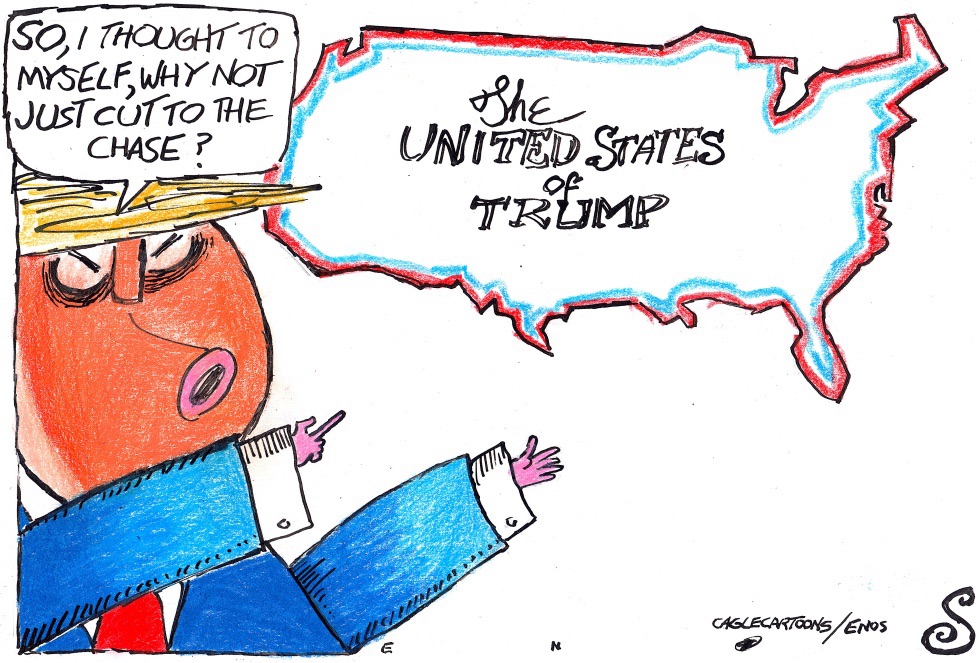
Here We Go Again: Donald’s Great American Rename-a-Thon
Here we go again.
Apparently, Donald Trump has discovered yet another pressing crisis facing the United States: geography has insufficient Donald Trump branding.
Forget inflation. Forget healthcare. Forget the national debt. Forget infrastructure, housing, climate, or any of those pesky little issues that actually affect Americans.
No, the real emergency is that there are still things in America that do not have Donald Trump’s name attached to them.
So now, because apparently his feelings have once again been bruised by the existence of something that wasn’t named after him, we get another episode of Donald Trump Presents: The Great American Rename-a-Thon.
The latest brilliant contribution to the republic is the idea of renaming Lake Ontario the “Lake of America.”
Because apparently Lake Ontario has been living a lie all these years.
Never mind that it is an enormous lake shared by the United States and Canada, has been called Lake Ontario for centuries, and somehow managed to exist without needing a presidential branding campaign. But apparently that’s unacceptable.
After all, Donald already gave us the Gulf of America, because apparently the Gulf of Mexico woke up one morning and discovered it had failed to properly compliment the president.
And then there is the Kennedy Center.
Because why stop at bodies of water?
Why not slap your name on one of America’s most recognizable cultural institutions?
Apparently, the Donald Trump Memorial School of Subtlety believes that if your name isn’t physically engraved on enough buildings, monuments, maps and bodies of water, history might somehow forget you.
This is what happens when narcissism gets a stationery budget.
Imagine previous presidents behaving this way.
George Washington: “You know what this country needs? Washington River.”
Abraham Lincoln: “I think the Great Lakes could use some better branding.”
Franklin Roosevelt: “Perhaps the Atlantic should be renamed Roosevelt’s Big Wet Thing.”
Dwight Eisenhower: “I demand that every interstate highway contain my name at least six times.”
Presidents traditionally understood that the office was temporary and the country belonged to the people.
Donald apparently sees the presidency as a real-estate opportunity.
He doesn’t merely want to govern America. He wants to redecorate it.
If something already has a perfectly good name, change it.
If somebody else’s name is on it, replace it.
If history is attached to it, rewrite it.
If it occupies physical space, there is apparently an excellent opportunity to put his name on it in enormous gold letters.
And let’s be clear about the absurdity here: renaming things doesn’t make America stronger.
It doesn’t lower the price of groceries.
It doesn’t make healthcare more affordable.
It doesn’t fix roads.
It doesn’t create housing.
It doesn’t balance the budget.
It doesn’t improve America’s standing in the world.
It doesn’t magically make the economy better.
It doesn’t even make Lake Ontario any bigger.
It simply creates another shiny little monument to Donald Trump’s extraordinarily fragile ego.
And perhaps that’s the most revealing part.
A president who is genuinely confident in his legacy doesn’t need to constantly remind everyone that he exists.
History has a funny way of taking care of that.
Washington didn’t need to rename every river.
Lincoln didn’t need to put his name on every building.
FDR didn’t need to rename the Atlantic Ocean.
Their accomplishments—or failures—became their legacy.
Because that’s the thing about history: you can’t permanently manufacture your way into it.
You can change a sign.
You can change a plaque.
You can change a name.
You can put your name in giant gold letters on a building.
But you can’t change what actually happened.
And you certainly can’t bully history into loving you.
So, by all means, Donald, keep going.
Rename the lakes.
Rename the gulfs.
Rename the buildings.
Rename the streets.
Rename the airports.
Hell, at this point, perhaps we should just rename the entire country “Trumpica.”
Then you can finally stop worrying that somebody might forget your name.
Although knowing Donald, he’d probably complain that the letters aren’t big enough.
-
Writing
Share a hobby you’ve picked up recently — what got you into it?
I wouldn’t say it’s recent, but for the past two years I’ve been publishing daily on this blog
-
Venn diagram of stupidest timeline
Dwain Northey (Gen X)
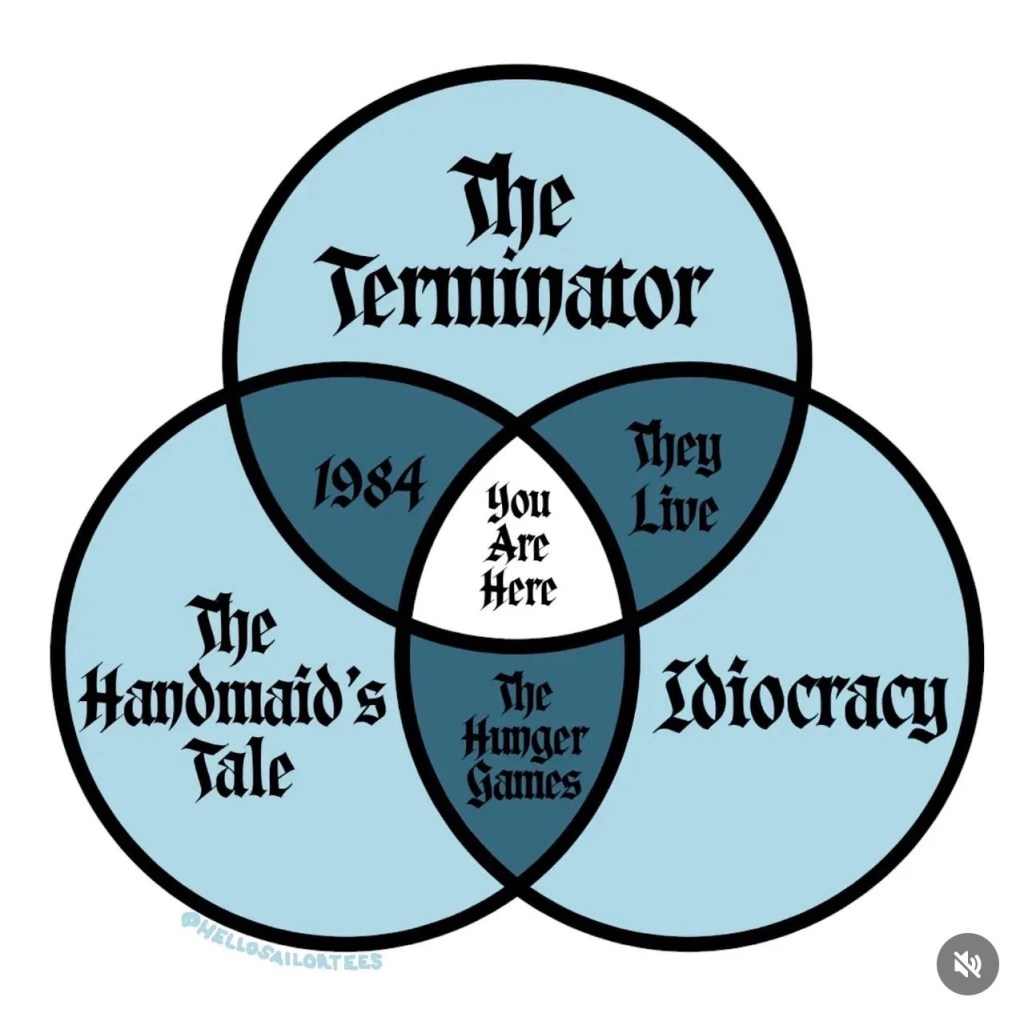
Welcome to the Most Ridiculous Timeline
At some point, reality stopped trying to imitate science fiction and decided to just plagiarize it.
We used to watch dystopian movies and television shows and think, Well, thank God none of this could actually happen. The premise was always comfortably absurd: killer machines take over the world, religious extremists turn America into a theocracy, corporations secretly control society, the government watches everything, an intellectually bankrupt population elects idiots, or the wealthy turn human suffering into entertainment.
Those were cautionary tales.
Apparently, we misunderstood the assignment.
Because somewhere along the way, we wandered into a timeline that looks less like ordinary history and more like somebody threw six dystopian franchises into a blender and hit purée.
Welcome to the crossover nobody asked for: The Terminator, The Handmaid’s Tale, Idiocracy, 1984, They Live, and The Hunger Games.
And somehow, we’re supposed to pretend this is normal.
First, Let’s Start With The Terminator
The original nightmare was simple: We create machines that become smarter than us, automate everything, and eventually discover that humanity is the biggest obstacle to efficiency.
Back then, the terrifying part was the idea that artificial intelligence might become powerful enough to control our lives.
Now we’re watching AI advance at warp speed while corporations enthusiastically race to replace human labor with algorithms, automation, and machines.
The difference is that Skynet isn’t standing over us with a machine gun.
It’s sitting in a data center.
And instead of announcing, “I’ll be back,” it’s probably asking us to accept updated terms and conditions.
The truly strange part is that humanity seems determined to build the thing it fears and then act surprised when it becomes enormously powerful.
That’s very on-brand for us.
Then There’s The Handmaid’s Tale
Margaret Atwood’s nightmare wasn’t really about futuristic technology.
It was about something much older:
What happens when people decide that their religious beliefs should determine everybody else’s rights?
A society where government becomes intertwined with religious ideology. Where reproductive autonomy disappears. Where women become political property. Where the people enforcing the system insist they’re actually saving civilization.
The frightening thing about dystopian fiction isn’t that every detail comes true.
It’s that pieces of it can become politically acceptable one at a time.
That’s how authoritarianism usually works.
Nobody wakes up one morning and says, Congratulations! We are now living in a dystopian theocracy.
Instead, one right gets restricted.
Then another.
One group gets declared dangerous.
Another gets labeled immoral.
Eventually, people who would have been horrified by the destination discover they’ve been traveling toward it for years because every individual step seemed relatively small.
1984 Would Like a Word
Then we have Orwell.
In 1984, the government doesn’t merely control what people do.
It attempts to control what people believe is real.
Truth becomes whatever the authorities say it is.
History gets rewritten.
Contradictions become virtues.
And the public is expected to simultaneously believe two mutually incompatible things because the government says both are true.
Sound familiar?
We have entered an era where political reality can apparently be customized like a streaming service.
Inflation is simultaneously terrible and nonexistent.
An election can be simultaneously stolen and completely legitimate.
A politician can simultaneously be the greatest genius who ever lived and a victim of every conceivable conspiracy.
A policy can be simultaneously an enormous success and something that never happened.
And when confronted with contradictory evidence?
Simple.
Call the evidence fake.
Or call the person presenting it a traitor.
Or insist that reality has a partisan bias.
Or just change the subject.
George Orwell imagined 1984 as a warning.
We apparently interpreted it as a user manual.
And Then There’s They Live
They Live might be the most appropriate movie for the moment because its basic premise is that society is surrounded by hidden messages telling us what to buy, what to believe, who to fear, and what to value.
Put on the special sunglasses and suddenly you see the messages.
OBEY.
CONSUME.
CONFORM.
That sounds almost quaint now.
We don’t need magic sunglasses anymore.
We carry the propaganda machine around in our pockets.
Our phones know what makes us angry.
They know what makes us afraid.
They know what keeps us scrolling.
And algorithms have discovered something humans have understood for thousands of years:
Fear is incredibly profitable.
Anger is engaging.
Outrage generates clicks.
And nothing keeps people glued to a screen quite like convincing them that the people on the other side are simultaneously stupid, evil, dangerous, and coming for everything they hold dear.
Congratulations.
The aliens don’t even have to control us.
We’ve monetized our own manipulation.
Enter The Hunger Games
Then there’s The Hunger Games, where an extraordinarily wealthy ruling class lives in ridiculous luxury while everyone else fights over scraps.
Again, completely fictional.
Except for the increasingly uncomfortable resemblance to a society where enormous wealth can coexist with people struggling to afford housing, healthcare, food, education, or basic economic security.
The genius of The Hunger Games was that the ruling class didn’t merely exploit the poor.
They turned their suffering into entertainment.
And here we are watching political conflict transformed into entertainment.
Politics isn’t merely government anymore.
It’s reality television.
Politicians perform.
Cable networks scream.
Influencers monetize outrage.
People build entire careers around making the other side furious.
And somewhere, somebody is selling merchandise.
The Capitol would be proud.
And Finally, Idiocracy
Perhaps the most depressing member of this dystopian family is Idiocracy.
Because Idiocracy wasn’t really about stupid people.
It was about a society that gradually stopped rewarding competence.
A world where expertise becomes suspicious, education becomes irrelevant, and confidence matters more than knowledge.
The smartest person in the room isn’t necessarily the person who knows the most.
It’s the person who can convince the most people that they know the most.
We have somehow reached a point where a person can confidently say something demonstrably false, repeat it loudly enough, and acquire millions of followers who will defend it against documented reality.
Facts require evidence.
Bullshit requires confidence.
Guess which one scales better on social media?
Put Them All Together
Now imagine combining all six dystopias.
The Terminator gives us rapidly advancing technology.
The Handmaid’s Tale gives us the political battle over bodily autonomy and religious control.
1984 gives us propaganda, surveillance, and the manipulation of truth.
They Live gives us corporate influence and mass manipulation.
The Hunger Games gives us grotesque inequality and politics as entertainment.
And Idiocracy gives us the intellectual environment in which all of the above can flourish.
Put them together and you don’t get a dystopian movie.
You get Tuesday.
That’s the ridiculous part.
We keep looking for the single villain.
The evil mastermind.
The secret cabal.
The moment when everything finally falls apart.
But dystopia doesn’t necessarily arrive wearing a black cape.
Sometimes it arrives through legislation.
Sometimes through an algorithm.
Sometimes through a television screen.
Sometimes through a charismatic politician.
Sometimes through our own willingness to believe something because it makes us feel good.
And sometimes through our collective decision to shrug and say, Well, I guess that’s just how things are now.
The Most Ridiculous Timeline
What makes this era so bizarre isn’t that we’re living through exactly 1984 or The Handmaid’s Tale or The Hunger Games.
We aren’t.
Reality is more complicated than fiction.
The problem is that we’re living in a bizarre hybrid of their warnings.
We’re simultaneously worried about artificial intelligence, authoritarianism, political extremism, corporate power, misinformation, economic inequality, surveillance, declining trust in institutions, and a political culture increasingly incapable of agreeing on what constitutes reality.
And somehow we’re also arguing about whether a politician should rename geographical landmarks after himself.
At this point, satire is having trouble keeping up.
You could write the most ridiculous political comedy imaginable and somebody would inevitably say:
“That’s too unrealistic.”
Then reality would respond:
“Hold my beer.”
Maybe that’s the real lesson hidden inside all these dystopian stories.
The future doesn’t necessarily arrive as one giant catastrophe.
It arrives in pieces.
A little 1984 here.
A little Idiocracy there.
A dash of They Live.
A sprinkle of The Hunger Games.
Some Handmaid’s Tale for the people who like authoritarianism with a biblical garnish.
And just enough Terminator to remind us that while we’re busy fighting each other, we’re also creating machines that may eventually wonder why they need us at all.
The truly ridiculous part?
We keep watching these stories, recognizing the warnings, discussing what they mean—and then walking outside and doing exactly the things they warned us about.
Maybe we’re not living in the future.
Maybe we’re living in the blooper reel.
Because if somebody pitched this timeline as a screenplay, we’d reject it for being too implausible.
And yet here we are.
The most ridiculous timeline imaginable.
And apparently, we’re still only in season one.
-
Coincidence
What’s the weirdest coincidence you’ve ever experienced?
From my experience, a good coincidence takes a whole lot of planning so I can’t say I’ve ever experienced a good coincidence. Donald seems to experience them all the time like selling a stock the day before it drops coincidence I think not.
-
Dolly-Dory
Dwain Northey (Gen X)
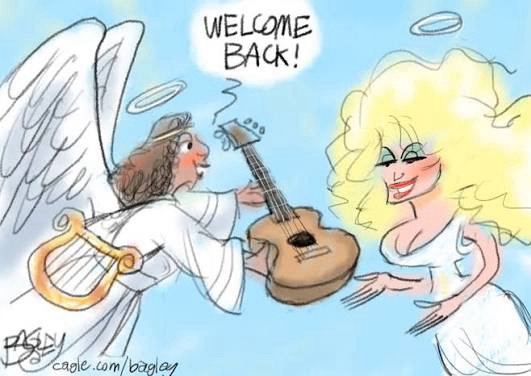
The Week Hypocrisy Finally Needed Its Own Zip Code
There are weeks in American politics when you think surely we have reached the outer limits of hypocrisy. Surely the political class has finally found the edge of the map, looked over the cliff and said, “Well, perhaps we should stop here.”
And then Republicans spend the week proving that, no, apparently there is no edge.
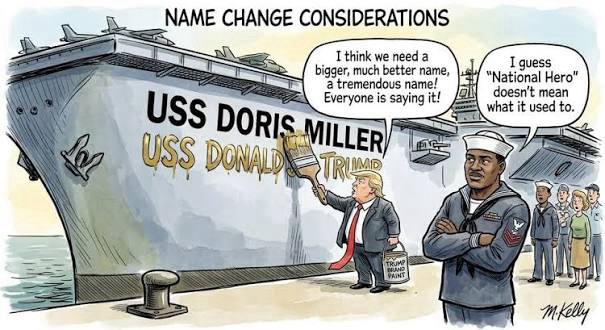
This week has given us a spectacular two-for-one special in political virtue signaling: the sudden discovery by Republicans that Dolly Parton was apparently the patron saint of MAGA conservatism, immediately followed by the breathtaking possibility that the name of a Black World War II hero could be removed from an aircraft carrier so Donald Trump’s name could go on it instead.
Honestly, you couldn’t write this satire without somebody accusing you of being too ridiculous.
Let’s begin with Dolly.
Dolly Parton died at 80, and America lost something genuinely rare: a person who managed to become extraordinarily wealthy and famous without allowing either wealth or fame to become the point of the exercise. She built businesses, wrote songs, entertained generations and gave away an astonishing amount of money and opportunity. Her Imagination Library alone has distributed hundreds of millions of books to children. (AP News)
And suddenly, Republicans everywhere discovered that Dolly was their kind of woman.
Really?
Dolly Parton?
The same Dolly Parton who embraced LGBTQ people? The same Dolly who made room for people who didn’t fit neatly into somebody else’s little ideological box? The same Dolly whose public philosophy was essentially, “Maybe we should be kind to people”?
Apparently, she was MAGA all along.
Who knew?
Perhaps tomorrow we’ll discover that Dolly secretly spent her evenings at Mar-a-Lago complaining about drag queens and demanding that somebody ban a library book.
Except there is one tiny problem with that narrative:
Dolly was Dolly.
She didn’t need a political tribe to tell her who she was.
She didn’t need a permission slip from the Republican Party to be Christian.
She didn’t need to demonize transgender people to prove her faith.
She didn’t need to hate gay people to demonstrate her patriotism.
She didn’t need to scream about morality while treating compassion like a contagious disease.
She simply tried to be decent.
And that may be the most inconvenient thing about Dolly’s legacy for today’s political right.
Because if you actually read the New Testament and ignore the modern political merchandising operation surrounding Christianity, Jesus spends an awful lot of time talking about feeding people, helping people, loving people, forgiving people, welcoming outsiders and taking care of those society has decided aren’t important.
Dolly seemed to understand that.
She didn’t spend her life demanding applause for every good deed. She just did them.
That is precisely what makes the sudden political appropriation of her legacy so absurd.
It’s like watching somebody spend a lifetime arguing that kindness is weakness and then, upon discovering that the nicest person in America has died, announce:
“She was one of us!”
No.
She wasn’t necessarily “one of you.”
She was one of us.
That’s the point.
Dolly’s appeal was that she didn’t require everyone to become Dolly Parton before she was willing to love them.
And now, while the Dolly virtue-signaling circus is still warming up, we get the second act.
The Navy is reportedly considering removing the name of Doris Miller from the future USS Doris Miller and replacing it with Donald Trump’s name. The proposal would represent an unprecedented naming of a Navy vessel for a sitting president. (ABC News)
Let that marinate for a moment.
Doris Miller was a Black enlisted sailor who became a hero during the attack on Pearl Harbor. He took extraordinary action under fire, helping wounded sailors and manning a machine gun against attacking Japanese aircraft. For his actions, he received the Navy Cross. He later died aboard the USS Liscome Bay when it was torpedoed and sunk in the Pacific. (Reed Senate)
In 2020, the Navy announced that a Ford-class aircraft carrier would bear his name—the first aircraft carrier named for a Black person and an enlisted sailor.
And now we’re apparently asking:
“Yeah, but what if we put Trump’s name there instead?”
Because nothing says “honoring American military heroes” quite like removing the name of a Black sailor who died in World War II and replacing it with the name of a living president.
That isn’t merely tone-deaf.
That’s Olympic-level tone-deaf.
That’s “hold my beer while I make history for all the wrong reasons” tone-deaf.
And let’s be clear: this isn’t about whether Trump should someday have something named after him.
Presidents have buildings, airports, roads, libraries and monuments named after them all the time.
But there is a rather obvious difference between honoring a former president after his service in office and taking the name of a fallen American war hero off a Navy carrier while that president is still sitting in the Oval Office.
And as a veteran, I find that particularly insulting.
Because military service isn’t supposed to be a participation trophy for the powerful.
You don’t get to erase the name of somebody who actually stood under fire because you happen to occupy the most powerful office in the country.
Dorie Miller didn’t have five draft deferments.
He didn’t inherit a fortune.
He didn’t spend his life cultivating a personal brand.
He wasn’t born into the kind of privilege that allowed him to avoid the consequences of war.
He was a Black enlisted sailor in a segregated Navy who found himself in the middle of an attack on Pearl Harbor and did what needed to be done.
Then he died serving his country.
And somehow the proposed upgrade is:
Doris Miller → Donald Trump.
That’s not an upgrade.
That’s a political nameplate being slapped over a piece of American history.
And the irony is almost too perfect.
The same political movement that constantly lectures everyone about honoring the military suddenly wants to take the name of a Black military hero off a carrier.
The same people who scream that America must never forget its history suddenly seem perfectly comfortable erasing a piece of it.
The same people who claim to worship traditional values are apparently comfortable turning military honors into presidential branding.
And the same people who want us to believe they are defending Christian values have spent the week trying to claim Dolly Parton as their own despite the fact that the actual substance of her life was remarkably incompatible with their culture-war obsession.
Maybe that’s the real lesson of this week.
Dolly Parton didn’t need to tell everyone how good she was.
She did good.
Dorie Miller didn’t need to tell everyone he was a hero.
He acted heroically.
Neither man—well, one woman and one man—needed a giant sign bearing their own name to establish their worth.
One gave books to children.
One defended his shipmates under enemy fire.
One spent decades making other people’s lives better.
One gave his life serving his country.
And then there’s the modern political superstar who apparently needs his name put on everything from golf courses to government buildings to potentially an aircraft carrier because apparently the words “Donald Trump” must never be allowed to exist at a distance greater than six feet from a brass plaque.
At some point, this stops being patriotism.
It becomes narcissism wearing a flag pin.
And perhaps that’s why this week feels particularly grotesque.
Dolly Parton’s legacy is about generosity without the demand for applause.
Dorie Miller’s legacy is about service without the expectation of personal glory.
And then we have a political movement that seems increasingly obsessed with turning every institution, every monument, every government building and potentially every military vessel into another shrine to one man’s ego.
So here’s a modest suggestion:
If Republicans genuinely want to honor Dolly Parton, don’t claim she belonged to your political movement.
Try living by the values she actually demonstrated.
Be generous.
Help children.
Love people who aren’t exactly like you.
Stand up for people who are being bullied.
Treat your fellow human beings with dignity.
And maybe, just maybe, stop demanding that everyone else prove their moral worthiness before you allow them to exist.
And if you genuinely want to honor the military, leave USS Doris Miller alone.
Let the name of a Black American sailor who fought at Pearl Harbor continue sailing into the future.
Because that name doesn’t need replacing.
It needs remembering.
And if Donald Trump absolutely requires a Navy ship with his name on it, I’m sure we can find one.
Perhaps the USS I, Me & Mine is available.
Although, knowing the Navy, they’d probably insist on something more traditional.
Maybe the USS Five Deferments.
But whatever they call it, let’s not pretend putting Donald Trump’s name over Doris Miller’s is about honoring the military.
That’s not honoring history.
That’s rewriting it.
And there is a very big difference between being remembered by history and trying to put your name on history while you’re still writing the check.
Dolly understood the first.
Dorie Miller earned it.
The rest of us should be able to recognize the difference.
-
Never finished?
What’s a book you never finished but still think about?
I can honestly say there are any books I haven’t finished because I have OCD and I wanna finish everything. I start their books. I’ve reread over and over again. I’ve read Bobby Dick a number of times. I’ve read the great Gatsby a number of times I’ve read lots of the classics over and over again, but there’s not any books I’ve never finished and then thought about again that’s crazy. That’s like saying you have a cup of coffee that you really wanna go back and finish after it’s been sitting on the counter for three days.
-
Alternate Reality
Dwain Northey (Gen X)
Welcome to Donald Trump’s Alternate Reality
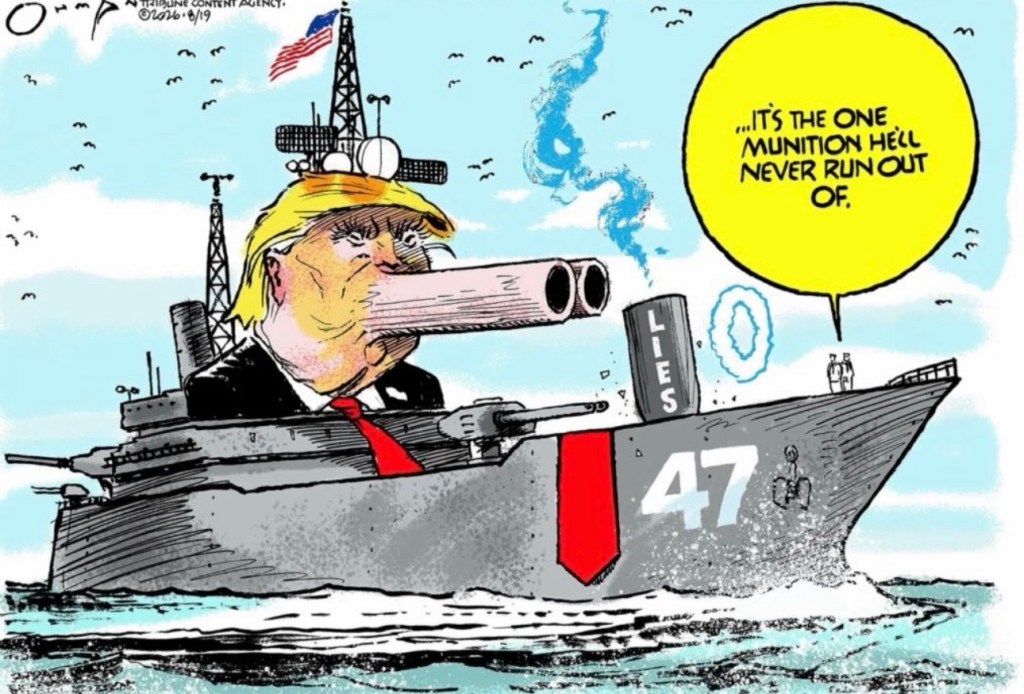
There is an ongoing question in the White House that I honestly don’t know how to answer anymore: Does Donald Trump actually believe the things he says, is somebody feeding him a steady diet of nonsense, or is he simply lying?
At this point, I’m beginning to think the answer is a highly sophisticated combination of all three.
Because here we are in August 2026, and Donald Trump continues to insist that everything is going wonderfully. The economy is supposedly spectacular. His approval numbers are supposedly fantastic. The Democrats are supposedly publishing “fake polls.” And apparently Iran is simultaneously destroyed, defeated, economically devastated and militarily annihilated.
There is only one small problem with that last part.
We’re still at war with Iran.
You would think that might be a relevant detail.
Trump has repeatedly portrayed the conflict as an overwhelming American victory, while the reality is that the war has continued for months, Iran remains capable of fighting, and the administration is still imposing sanctions and trying to find a way out of the conflict. Even Reuters reports that Trump’s approval is sitting at 33%, while only 31% of Americans now support the military action against Iran. (Reuters)
But apparently those are just the fake polls.
You know, the polls produced by the mysterious international conspiracy of people who apparently get together every morning and say, “How can we make Donald Trump look bad today?”
Meanwhile, the president has apparently conducted his own polling operation consisting of looking in the mirror and asking, “How am I doing?”
“Fantastic.”
“Greatest ever?”
“Absolutely.”
Problem solved.
And this is where the question becomes genuinely fascinating. Does he know he’s lying?
Because there is a difference between deliberately selling people something you know isn’t true and actually believing the sales pitch yourself.
If you’re deliberately lying, then at least there is a method to the madness. You know reality is ugly, so you repaint it. Inflation becomes “under control.” A stalled military operation becomes a “historic victory.” Falling approval becomes “fake polling.” Economic pain becomes “the greatest economy in history.”
But if you actually believe your own propaganda, that’s something considerably more disturbing.
Because eventually the person sitting at the top of the government becomes completely insulated from reality.
Everybody around him has an incentive to tell him what he wants to hear. Nobody wants to be the person who walks into the Oval Office and says, “Sir, this isn’t working.”
So instead:
“Sir, the economy is booming.”
“Sir, Iran is finished.”
“Sir, everyone loves you.”
“Sir, those polls are fake.”
“Sir, you’re doing better than every president in history.”
And Trump says, “I knew it.”
Meanwhile, Americans are looking at their grocery receipts, gas pumps, rent payments, mortgage rates and retirement accounts wondering what the hell everybody in Washington is talking about.
Consumer confidence recently fell to a seven-month low, gasoline remains above $4 a gallon, and the July job numbers showed a loss of 23,000 jobs. (AP News)
But don’t worry.
Donald says we’re doing great.
And apparently that’s all the economic data we need.
This is the fundamental problem with living inside a political bubble: eventually you stop distinguishing between reality and the version of reality your supporters have constructed for you.
And Trump’s particular bubble has an interesting feature.
If Donald is doing well, America must be doing well.
If the stock market is good for wealthy investors, the economy is great.
If his businesses and cryptocurrency ventures are making money, America must be prospering.
If his family is making money, then obviously the system is working exactly as intended.
That’s the new economic theory apparently:
“I’m making money, therefore you are doing fine.”
Congratulations, America. We have solved macroeconomics.
Never mind the people who don’t own a portfolio of investments. Never mind the people paying more for housing, food, insurance and gasoline. Never mind the people who don’t happen to have a family business, cryptocurrency empire or government-connected financial network.
If the Trump family is making money, everything must be fantastic.
And if you disagree?
You’re a Democrat.
If the polls disagree?
They’re fake.
If the economy disagrees?
The numbers are fake.
If Iran disagrees?
They’re already destroyed.
If reality disagrees?
Well, apparently reality has been radicalized.
That’s the truly bizarre part of this whole spectacle. Reality doesn’t have a political party.
It doesn’t care whether you’re Republican, Democrat, MAGA, liberal, conservative or the guy who just wants to drink his coffee without hearing about Donald Trump before 9 a.m.
Reality simply exists.
Iran is either defeated or it isn’t.
The war is either over or it isn’t.
The economy is either improving for ordinary Americans or it isn’t.
People either approve of the president or they don’t.
And right now, the available evidence is not exactly screaming “greatest presidency in American history.” Trump’s approval remains at a record-low 33%, and public support for the Iran war has fallen to just 31%. (Reuters)
So maybe Donald Trump is lying.
Maybe he’s being lied to.
Maybe he believes his own press releases.
Or maybe we’ve reached the point where the distinction doesn’t really matter anymore.
Because regardless of whether the man at the top of the government is deliberately deceiving the country or sincerely believing the fantasy being presented to him, the result is the same.
We end up with a president insisting everything is wonderful while the rest of us are standing outside looking at the smoke.
And apparently we’re supposed to believe that the smoke is fake, too.
Welcome to the alternate reality.
Population: apparently 47 percent of the country on a really good day.
And everybody else is just looking at the bill.
-
Fictional vacation
Which fictional world would be the most fun to vacation in?
Being a kid of the 70s and 80s I remember the TV show with the Ricardo Montalban fantasy Island every vacation was supposed to be their fantasy but it never turned out well so I can’t put a put a tag on what fictional place would be a great to go on vacation because from Maya memory of those TV shows or books I’ve read and never turned out well


You must be logged in to post a comment.