Dwain Northey (Gen X)
https://www.cbsnews.com/news/naacp-travel-advisory-florida-says-state-hostile-to-black-americans/
Remember the good old days when there were only travel advisories and or ban for, what some would call, third word countries? Well now because of the vile vitriol of one Governor Ron DeSantis the state of Florida, a vacation destination, has received a travel advisory by the NAACP.
The wannabe future President has made the climate so venomous in Florida the anyone who is a part of any minority group does not feel safe in the state. Black, Brown, LGTBQ+, these are all groups that are under attack in the Sunshine State. The majority Republican legislature and their fearful leader has passed laws that make almost everything a jailable offence and the fact that the state has very loose gun laws and a stand your ground law makes it more dangerous than being a blonde female in central America.
Florida residents are able to carry concealed guns without a permit under a bill signed into law by Republican Gov. Ron DeSantis. The law, which goes into effect on July 1, means that anyone who can legally own a gun in Florida can carry a concealed gun in public without any training or background check. This with their ridiculous stand your ground law, ‘Florida’s “Stand-Your-Ground” law was passed in 2005. The law allows those who feel a reasonable threat of death or bodily injury to “meet force with force” rather than retreat. Similar “Castle Doctrine” laws assert that a person does not need to retreat if their home is attacked.’ Makes it really sketchy to go there.
This in top of the don’t say gay rule and the new trans ruling that just passed.
“Florida lawmakers have no shame. This discriminatory bill is extraordinarily desperate and extreme in a year full of extreme, discriminatory legislation. It is a cruel effort to stigmatize, marginalize and erase the LGBTQ+ community, particularly transgender youth. Let me be clear: gender-affirming care saves lives. Every mainstream American medical and mental health organization – representing millions of providers in the United States – call for age-appropriate, gender-affirming care for transgender and non-binary people.
“These politicians have no place inserting themselves in conversations between doctors, parents, and transgender youth about gender-affirming care. And at the same time that Florida lawmakers crow about protecting parental rights they make an extra-constitutional attempt to strip parents of – you guessed it! – their parental rights. The Human Rights Campaign strongly condemns this bill and will continue to fight for LGBTQ+ youth and their families who deserve better from their elected leaders.”
This law makes it possible for anyone to just accuse someone of gender affirming care to have their child taken from them this would include someone traveling from out of state. This alone justifies a travel ban to the Magic Kingdom for families.
Oh, and I haven’t even mentioned DeSantis holy war with Disney, the largest employer in the state. I really hope the Mouse eats this ass holes lunch.
Well that’s enough bitching, thanks again for suffering though my rant.
-
Old patterns
What’s something you do completely differently from how you were raised?
Being raised in the 70s and 80s, we always had dinner at the table. I can’t remember the last time I had dinner at the kitchen table. I have one but it’s more of a place where cracked stored unfortunately
-
Imagine a World Where Things Didn’t Go Boom
Dwain Northey (Gen X)

Here we are again, apparently living in a country where the definition of “not a war” is apparently whatever the president says it is while American ammunition stockpiles quietly look like the pantry of a college student who just discovered DoorDash.
We are told that what is happening with Iran is not a war. Absolutely not. War is such an ugly word. This is merely an extended disagreement involving aircraft, missiles, bombs, military strikes, exploding things and enough ammunition to make the Pentagon accountants start sweating through their uniforms.
But don’t call it a war.
Because if you call it a war, people might start asking uncomfortable questions.
Like: Where did all our ammunition go?
Well, according to Donald and his loyal chorus of political elk, this is apparently Biden’s fault. Naturally. Because nothing says 2026 quite like discovering that the United States has ammunition shortages and immediately blaming the previous president.
The explanation goes something like this:
“If Biden hadn’t given all those munitions to Zelenskyy, we’d have plenty!”
Except that’s not really how this works.
A significant portion of what Ukraine acquired from the United States consisted of older weapons and ammunition that were already sitting in American stockpiles. Ukraine didn’t magically empty America’s weapons closet and leave us standing there in our underwear. Those older munitions were used as part of a broader process in which the United States replenished and modernized its own inventories.
In other words, we sent old stuff, Ukraine paid for some of it, and we used the money and the opportunity to build newer stuff.
But apparently that doesn’t fit neatly into the “Biden gave everything away and now we’re defenseless” narrative, so naturally we skip that part.
And then there’s the even more fascinating question:
Why do we have to keep making so damn much of this stuff in the first place?
Think about the absurdity of it.
We spend enormous amounts of money developing incredibly sophisticated technologies whose primary purpose is to travel somewhere and destroy something.
Then we manufacture them.
Then we store them.
Then we maintain them.
Then we spend more money replacing them because they age.
Then somebody decides they need to be used.
Then we launch them.
Boom.
And they’re gone.
That’s the entire business model.
Imagine if every other industry operated that way.
Imagine spending $10 million developing the world’s most advanced toaster, manufacturing 50,000 of them, putting them in a warehouse, and then eventually throwing every single one into a volcano because the toaster’s primary function was to cease existing.
And then Congress comes back next year and says:
“We’re running low on toasters. We need another $40 billion.”
And everyone applauds.
This is the part of the defense conversation that seems to get lost behind the flags, the chest-thumping and the endless parade of politicians insisting that somebody else’s president is responsible for whatever happens to be happening today.
Yes, America needs a military.
Yes, America needs ammunition.
Yes, deterrence matters.
Yes, there are legitimate reasons to maintain enormous stockpiles of weapons.
But somewhere along the way we’ve managed to create an economic ecosystem where spending money on things designed to be destroyed is treated as inherently productive.
And somehow questioning that gets interpreted as questioning the military itself.
It isn’t.
It’s questioning whether “we spent another $37 billion on things that go boom” should automatically be considered the pinnacle of fiscal responsibility.
Because here’s the truly bizarre part:
When Ukraine buys American weapons, that money can help replenish American inventories, modernize production lines and create jobs.
When America uses those weapons, they don’t come back.
They’re not reusable.
They’re not recyclable.
They’re not sitting somewhere waiting for their next shift.
They’re gone.
And then we get to buy more.
Again.
And again.
And again.
It’s the world’s most expensive subscription service.
Defense Plus: because apparently the previous missiles have expired by exploding.
And now, when our stockpiles get strained by actual military operations, we’re supposed to pretend this is some shocking mystery caused entirely by the guy who occupied the White House before the guy currently occupying it.
No.
Maybe the bigger question isn’t “Who used too much ammunition?”
Maybe it’s:
Why have we built a civilization where we devote extraordinary amounts of our collective wealth to creating increasingly sophisticated ways of turning perfectly good materials into very expensive explosions?
Imagine what that money could look like if we weren’t constantly preparing to destroy things.
Infrastructure.
Education.
Water.
Energy.
Research.
Healthcare.
Housing.
Technology.
Actual things that remain useful after you use them.
What a radical concept.
A missile can destroy a target once.
A bridge can serve people for generations.
A school can educate thousands of children.
A water system can provide an entire community with something it desperately needs.
A medical breakthrough can save lives indefinitely.
But apparently those things don’t make the same satisfying BOOM.
So here we are.
Arguing about whether Biden used too much ammunition, whether Trump has enough ammunition, whether Ukraine bought too much ammunition, whether Iran is technically a war, and whether the president can find a sufficiently creative synonym for “we are conducting military operations.”
Meanwhile, somewhere in a warehouse, an American taxpayer is looking at an empty shelf and thinking:
“Wait a minute. Didn’t we just spend billions filling that thing?”
Yes.
We did.
Then we built some more.
Then somebody used them.
Then we bought some more.
And we’ll probably keep doing it.
Because apparently the greatest achievement of modern civilization isn’t figuring out how to stop needing so many things that go boom.
It’s figuring out how to manufacture them faster.
What a world it would be if our national imagination was just as enthusiastic about developing things that don’t disappear when we use them.
Imagine investing billions in things where the objective isn’t:
“Congratulations, you successfully destroyed it.”
What a concept.
Maybe someday we’ll discover that the most powerful thing a country can build isn’t another weapon.
Maybe it’s a future worth defending.
-
Data gathering
What are your favorite 5 apps on your phone?
So now we’re asking your favorite five apps why don’t you just ask what the last four my Social Security is or my mother’s maiden name or first pet or length of your third toe? I’ll information just more Data gathering which is craziness.
-
Midterms
Dwain Northey (Gen X)
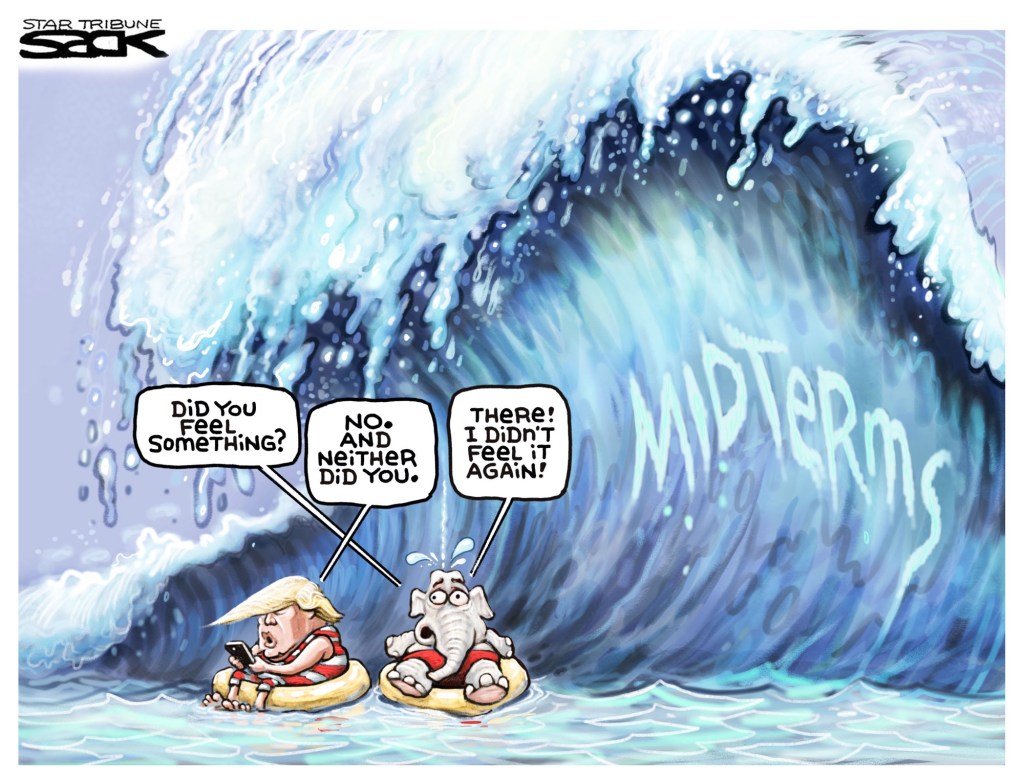
Democrats Need to Become the Party of Yes
Here we are again.
The 2026 midterm elections are right around the corner, and Democrats have a choice to make. We can spend the next few months standing in front of the political wreckage, pointing at Donald Trump and the Republicans and screaming, “Look what you broke!”
And, to be fair, there is plenty to point at.
But eventually somebody has to stop standing around the crime scene taking pictures.
Somebody has to clean the damn thing up.
And that is where Democrats have historically found themselves: arriving after the Republican Party has driven the fiscal bus into a ditch, set the dashboard on fire, and then handed us the keys while announcing that Democrats are responsible for the potholes.
The national debt is complicated, and Democrats certainly don’t get a free pass on fiscal responsibility. But the historical political pattern is hard to ignore: Republicans frequently campaign as the party of fiscal restraint, then pursue tax cuts and spending policies that increase deficits, only to rediscover their deep and abiding concern about the national debt when Democrats take power. The Committee for a Responsible Federal Budget estimated that Trump approved roughly $8.8 trillion in gross new borrowing during his first term. (CRFB)
It’s a remarkable political magic trick.
Republicans spend the money. Democrats inherit the bill. Republicans then complain about the size of the receipt.
And Democrats have been remarkably willing to participate in this routine.
We inherit the mess, spend years trying to repair it, and then discover that all the political oxygen has been consumed by explaining why the previous administration’s mess wasn’t actually our mess.
Meanwhile, the things we supposedly want to accomplish sit in the corner collecting dust.
Affordable healthcare?
Sorry. We’re fixing the budget.
Infrastructure?
Sorry. We’re repairing the infrastructure of government itself.
Education?
Hang on. We’re trying to figure out why the last administration blew a hole in the deficit.
Climate policy?
Maybe next time. We’re still cleaning up the last time.
Voting rights?
Absolutely. Right after we finish explaining the previous six scandals.
And eventually voters look around and ask the perfectly reasonable question:
“Okay, but what are you actually going to DO?”
That’s the question Democrats need to answer in 2026.
Because being anti-Trump is not a governing philosophy.
Being a Never Trumper is a perfectly legitimate position. Hell, it may be the easiest position in American politics right now.
But it isn’t enough.
We cannot simply be the party of NO.
No Trump.
No Trumpism.
No authoritarianism.
No corruption.
No government dismantling.
No attacks on democratic institutions.
No attacks on voting rights.
No dismantling of the federal workforce.
No politicizing the Justice Department.
No turning government agencies into personal loyalty clubs.
No using the machinery of government as a political weapon.
No.
No.
No.
Eventually, Americans are going to look at us and say:
“Okay, you’ve told us what you don’t want about 47,000 times. What the hell DO you want?”
That’s where we need to change the conversation.
We need to become the Party of Yes.
Yes, we are going to protect Social Security.
Yes, we are going to make healthcare more affordable.
Yes, we are going to invest in infrastructure.
Yes, we’re going to address housing costs.
Yes, we’re going to protect voting rights.
Yes, we’re going to rebuild America’s manufacturing capacity.
Yes, we’re going to invest in education.
Yes, we’re going to deal with climate change like adults instead of pretending the thermostat is a partisan issue.
Yes, we’re going to secure the border and build an immigration system that actually works.
Yes, we’re going to address the national debt with an honest conversation about both spending and revenue, rather than pretending that eliminating taxes somehow produces more money.
Yes, we’re going to restore competence to government.
And perhaps most importantly:
Yes, we’re going to repair the institutional damage that has been done to the American government.
Because that’s the part that doesn’t show up neatly on a tax bill.
Trumpism isn’t merely a collection of policies that Democrats can reverse with another piece of legislation.
It’s also the normalization of the idea that government exists to serve the person occupying the Oval Office.
That is the part Democrats need to fight.
Not just Trump.
Not just the latest outrageous statement.
Not just the latest executive order.
Not just the latest scandal.
The paper cuts.
The cumulative damage.
The little changes that individually don’t look catastrophic but collectively transform the way government operates.
Because democracy rarely disappears in one dramatic scene with ominous music playing in the background.
Sometimes it disappears through a thousand administrative decisions nobody bothered to pay attention to.
That’s why the Democratic message in 2026 needs to be bigger than “We’re not them.”
We need to say:
“We’re going to rebuild.”
And then we need to tell people exactly what that means.
We need to offer a vision that doesn’t require voters to spend every waking minute thinking about Donald Trump.
Because here’s the uncomfortable truth:
People don’t want to spend the next two years talking about Donald Trump either.
They want to know whether they can afford their groceries.
Whether their kids can afford college.
Whether they can buy a house.
Whether they can retire.
Whether their healthcare is going to bankrupt them.
Whether their roads, bridges and power grids work.
Whether their government is competent.
Whether their vote actually matters.
Whether America is going somewhere.
That’s our opening.
The Republican Party can keep selling nostalgia, grievance and an endless rerun of the Trump Show.
Democrats need to sell tomorrow.
And yes, we should absolutely remind voters what Republicans did.
But we shouldn’t spend the entire campaign standing beside the wreckage saying, “See? We told you so.”
We should be saying:
“Yes, they broke it. Now here’s what we’re going to build.”
Because that’s the difference between an opposition party and a governing party.
An opposition party says:
“Look at that disaster.”
A governing party says:
“Hand me a hammer.”
And Democrats desperately need to become the second one.
Not because Republicans deserve a pass.
They don’t.
Not because Trump shouldn’t be held accountable.
He should.
Not because Democrats shouldn’t expose corruption, incompetence and authoritarianism.
They absolutely should.
But because America needs more than a cleanup crew.
We need a construction crew.
We need Democrats to stop promising merely to restore the country to January 19, 2017—or January 19, 2025—and start explaining what America should look like on January 20, 2030.
Don’t just tell us what you’re going to undo.
Tell us what you’re going to build.
Don’t just tell us what you’re against.
Tell us what you’re for.
Don’t just promise to repair the damage.
Promise to build something better than what existed before the damage was done.
Because the 2026 election shouldn’t simply be a referendum on Donald Trump.
It should be a referendum on two competing visions of America.
One says: burn it down, blame somebody else, and call the ashes freedom.
The other should say:
Yes.
Yes, we can rebuild.
Yes, government can work.
Yes, democracy is worth defending.
Yes, fiscal responsibility can coexist with investment.
Yes, capitalism can exist without becoming corporate feudalism.
Yes, America can have secure borders without abandoning humanity.
Yes, we can protect individual freedom without turning government into a religious or ideological police force.
Yes, we can disagree without treating our fellow citizens like enemies.
Yes, we can move forward.
And yes, Democrats can finally stop being the political equivalent of the guy who gets called over after the party to unclog the toilet.
We’re allowed to throw our own damn party.
That’s the message.
Not simply:
“We’re not Trump.”
But:
“We’re what comes next.”
-
The Life I Somehow Built
Dwain Northey (Gen X)

There is something strangely sobering about looking backward and realizing that the life you have now may not be some unexpected accident.
Maybe it has been quietly taking shape for a very long time.
I think about being alone at 59, and my first reaction isn’t really surprise. If anything, there is a certain uncomfortable logic to it.
When I was in elementary school, I had one friend. Just one. Then we moved, and whatever continuity there was disappeared. I don’t remember having a large circle of friends after that. In high school, I had a friend for a couple of years, but if I’m being completely honest with myself, proximity probably had as much to do with it as anything else. We were there, we were around each other, and friendship grew out of circumstance.
Then there was Germany.
I had a girlfriend while we lived there, but I wouldn’t say I really had friends. Not the kind of friends I’m talking about now. The kind where there is a history, a trust, a permanence. The kind where you know they’ll still be there years later.
Then, at 18, I came back from Germany by myself.
And for the next two-plus years, I was essentially floating.
I stayed with my brother for a while, then my grandparents. I worked at the mall. I knew people. I had coworkers. But I didn’t really have friends.
Eventually, I went into the military.
There were people there, of course. People I worked with. People I spent enormous amounts of time around. But knowing people and having friends are two very different things.
Then came Florida.
There were people I worked with. Roommates. A girlfriend. People who, at the time, probably would have considered me a friend. But again, there was something temporary about most of those relationships.
Circumstances changed.
People moved.
Jobs ended.
Relationships dissolved.
And eventually, everyone went their separate ways.
Then I got married.
For a while, perhaps marriage fills that space. You have a person. Someone whose life is intertwined with yours. Someone who is supposed to be there tomorrow and the day after that. You don’t necessarily think about friendship because you have something that feels even more permanent.
Until it isn’t.
And eventually you look around and realize that you’ve spent most of your life knowing people without necessarily keeping people.
That’s the part that bothers me.
Not necessarily that I’m alone now, but that when I trace the timeline backward, there isn’t much evidence that this is a temporary condition.
There isn’t a long list of lifelong friends waiting somewhere in the background.
There isn’t a group of people from elementary school who still get together.
There isn’t a high school crew.
There isn’t that guy I’ve known for forty years who can walk through my front door without knocking.
There are chapters.
But there aren’t many characters who appear in more than one chapter.
And maybe that’s why being 59 and looking down the road is different than being 29 and looking down the road.
At 29, you can tell yourself there is plenty of time.
At 39, you can tell yourself you’re just busy.
At 49, you can tell yourself you’ll get around to it.
At 59, you start wondering whether this is it.
Not in some dramatic, tragic, end-of-the-world way.
Just in the quiet realization that life has momentum.
Patterns become habits.
Habits become routines.
Routines become a life.
And maybe I’ve simply become very good at living without people.
That’s a strange skill to develop.
You learn how to entertain yourself.
You learn how to solve your own problems.
You learn not to expect phone calls.
You stop wondering why nobody invited you because eventually you stop expecting invitations.
You become comfortable going places alone because waiting for someone else to go with you means you may never go.
Eventually independence stops being a circumstance and becomes an identity.
And then one day you realize there is a difference between being independent and being disconnected.
That’s where my son enters this story.
He’s 21 now.
He’s married.
He’s moved out.
He’s building his own life.
And I’m proud of him.
He is doing exactly what we spend eighteen or twenty years hoping our children will eventually be capable of doing.
But there is a part of me that is terrified.
Because when I look at my life through the lens of everything I’ve just described, I realize that my son has been the one remarkably consistent human connection I’ve had for a very long time.
For fifteen years after the divorce, he was the center of my world.
Not because I consciously decided that he would carry the emotional weight of my entire existence, but because that’s simply what happened.
He was there.
I was there.
We had a life together.
There were responsibilities, routines, birthdays, arguments, jokes, school, meals, rides, holidays, ordinary Tuesday nights—the thousands of completely unremarkable moments that somehow become the architecture of a life.
And now he’s gone.
Not gone gone.
I know that.
He’s married. He’s on his own. He’s building something that belongs to him. That’s not a failure.
That’s success.
That’s what I was supposed to help him become.
But intellectually understanding something doesn’t make it emotionally painless.
Because when you’ve spent your life watching relationships have expiration dates, you don’t necessarily experience someone moving into the next phase of their life as simply “growing up.”
Some part of you hears:
Another connection is changing.
And that scares the hell out of me.
Because I’ve spent most of my life watching people disappear from my life.
Friends moved.
Circumstances changed.
Jobs ended.
Roommates moved on.
Relationships ended.
Marriage ended.
People who were important during one chapter weren’t necessarily there for the next.
And somehow I learned to adapt.
Maybe too well.
I became accustomed to people being temporary.
I became accustomed to being the person who could pick everything up and start over.
I became accustomed to not needing anybody too much.
And then there was my son.
He wasn’t temporary.
He couldn’t be.
He was the one person whose presence in my life wasn’t dependent upon geography, employment, convenience, or whether a relationship happened to survive.
He was simply my son.
For years, that relationship gave me something I don’t think I fully appreciated at the time:
Continuity.
And now I’m 59 years old, looking at the next several decades with the uncomfortable realization that my son is going to have less and less need for me.
That’s the part nobody really prepares you for.
We spend so much time teaching our children how to become independent that we don’t talk enough about what their independence does to the parent.
You spend twenty years teaching someone how to leave.
Then one day they actually leave.
And you’re standing there thinking:
“Well, shit. I guess that worked.”
It’s funny in the abstract.
It isn’t quite as funny when you’re standing in the empty room.
Because his growing independence forces me to confront something I could avoid when he was younger.
I can’t make him my connection to the world.
I can’t ask him to fill the spaces left by friendships I never maintained or relationships that didn’t last.
I can’t expect him to remain emotionally tethered to me simply because I’m afraid of what happens when he isn’t.
That’s not love.
That’s fear disguised as love.
And recognizing that is probably one of the most humbling things I’ve ever had to admit.
My son doesn’t owe me his adulthood.
He doesn’t owe me proximity.
He doesn’t owe me constant phone calls, visits, or reassurance that I’m still important.
My job now is almost the opposite of what it was when he was a kid.
Then, I was supposed to hold on.
Now, I’m supposed to let go.
And somewhere inside that contradiction is the hardest lesson of parenthood:
You raise your children to become people who don’t need you.
Then you have to figure out who you are when they don’t.
For someone whose life has already been characterized by disconnection, that’s a frightening question.
Because I don’t just fear being alone.
I fear losing the last person who has always been part of my life.
And maybe that’s why this stage feels different.
It’s not simply an empty bedroom.
It’s evidence that time keeps moving whether I’m ready for it or not.
My son has a wife now.
A home.
Responsibilities.
A future that will increasingly revolve around the family he’s creating rather than the family he came from.
That’s exactly how it is supposed to work.
But knowing that doesn’t stop me from mourning the version of our relationship that is gone.
The father-son relationship doesn’t disappear.
It evolves.
But evolution is just a nicer word for things are never going to be exactly the same again.
And maybe that’s what I’m really afraid of.
Not that my son will stop loving me.
Not that he’ll abandon me.
Not even necessarily that we’ll become disconnected.
I’m afraid that the everyday connection will disappear—the casual conversations, the ordinary presence, the feeling that there is another person in the world whose life is fundamentally intertwined with mine.
Because I’ve spent a lifetime becoming accustomed to people leaving.
And now the person I least want to lose is becoming independent enough that I have to accept that I cannot hold on to him simply to protect myself from loneliness.
That’s a hard lesson.
Maybe the most humbling one yet.
But there is another truth hiding underneath all of this.
Maybe the fact that I am alone today doesn’t mean I am destined to be alone forever.
Maybe I’ve spent so much of my life adapting to disconnection that I’ve mistaken adaptation for destiny.
History explains us.
It doesn’t necessarily have to imprison us.
I’ve spent a lifetime learning how to be alone.
Maybe I never learned how to build permanence.
Maybe I never learned how to maintain friendships through all the changes.
Maybe I never learned how to let people get close enough that losing them would hurt.
And perhaps, without realizing it, I became very good at protecting myself from exactly the thing I say I want.
Connection.
Because connection requires vulnerability.
It requires showing up.
It requires calling someone when there isn’t a reason.
It requires letting somebody know you need them.
It requires being needed.
It requires risking disappointment.
And maybe I’ve spent decades avoiding all of that without consciously realizing that’s what I was doing.
So now I’m standing at 59, looking backward at a life that makes my loneliness almost make sense.
And I’m looking forward at a future that scares me because the one relationship that has provided so much continuity is changing.
My son is becoming his own man.
And I have to let him.
I have to let him build his life without making his independence about my loneliness.
I have to let him go without interpreting distance as abandonment.
I have to trust that what we built doesn’t disappear simply because the shape of it changes.
Maybe someday he’ll call me just because he wants to talk.
Maybe he’ll show up at my door.
Maybe we’ll sit around doing absolutely nothing, talking about absolutely nothing, and I’ll realize that letting go didn’t mean losing him.
It meant giving our relationship room to become something different.
And perhaps that’s the real challenge of getting older.
Not accepting that people leave.
I’ve already learned that lesson.
The harder lesson is accepting that people can stay even when they aren’t physically beside you.
That connection doesn’t always look like proximity.
That love doesn’t require possession.
That being needed isn’t the only measure of being important.
And maybe, just maybe, my life isn’t a finished equation.
Maybe 59 isn’t the end of the story.
It’s simply the first time I’m old enough to understand the story I’ve been writing.
I’ve spent a lifetime moving from place to place, relationship to relationship, chapter to chapter, becoming increasingly comfortable with the idea that people are temporary.
Now I have to consider the possibility that permanence isn’t something you find.
Maybe it’s something you build.
And if I want something different in the years I have left, I’m going to have to stop waiting for life to accidentally provide it.
I don’t know if I know how to do that.
But I know I have to try.
Because my son deserves the freedom to build his life.
And I deserve the opportunity to build whatever comes next in mine.
Maybe the most frightening thing isn’t that I am alone.
Maybe it’s that, for the first time, I can see exactly how I got here.
And maybe that is also the most hopeful thing.
Because if I can understand how I arrived here, perhaps I can finally choose where I go next.
-
Four legged friend
What’s the best thing you’ve ever found randomly on the street?
The best thing I randomly found or found me on the street was my dog as a kid that just randomly followed me home, and he was the best dog ever followed me on my paper routes never had to have a leash. He was a good boy silver was a husky German Shepherd run. It just followed me home from school one day and he stayed.
-
The Things We Don’t Know We Don’t Know
Dwain Northey (Gen X)

There is a phrase I’ve always liked: “You don’t know what you don’t know.”
It’s a remarkably humble little sentence. It reminds us that the universe is considerably larger than our personal experience, that other people have lived lives we haven’t lived, seen things we haven’t seen, and learned lessons we haven’t had the privilege—or misfortune—to learn.
Unfortunately, we live in America in 2026, where humility has apparently been classified as a character defect.
We have smartphones.
Therefore, we know everything.
At least that seems to be the theory.
We carry around a tiny computer capable of accessing more information than the Library of Alexandria could have dreamed about, and somehow we’ve interpreted that technological miracle as evidence that we personally are experts on everything.
Politics? Expert.
Medicine? Expert.
Economics? Expert.
Military strategy? Absolutely.
Immigration? Expert.
Climate science? Expert.
The Middle East? Expert.
Constitutional law? Expert.
What happened in a country we’ve never visited? Expert.
What an entire religion, culture, ethnic group, political party or foreign nation supposedly thinks? Expert.
And if Google happens to produce a result that confirms what we already believed, congratulations: We have just completed our doctoral dissertation.
“See? I told you I was right.”
That’s not knowledge.
That’s confirmation bias with Wi-Fi.
The problem isn’t that information is unavailable. The problem is that information isn’t understanding.
You can Google the history of Vietnam without understanding what it feels like to be Vietnamese.
You can read about poverty without knowing what it feels like to wonder whether the electricity is going to be shut off.
You can look up immigration statistics without understanding what it feels like to leave the only country you’ve ever known because you’re terrified your children won’t survive there.
You can read about war without ever hearing artillery in the distance.
You can look up racism without ever experiencing discrimination.
You can read about homelessness without understanding what it feels like to have nowhere to go.
And you can read ten thousand articles about another country without ever understanding what it feels like to actually live there.
That’s the part we seem to have forgotten.
Americans Are Not Automatically the Good Guys
There’s another uniquely American assumption we might want to reconsider:
Everybody loves us.
Why wouldn’t they?
We’re America!
We’re the greatest country on Earth!
Everybody wants to be like us!
They probably all dream of eating hamburgers, watching the Super Bowl and someday owning a 75-inch television while arguing about politics on Facebook.
Except… no.
If you’ve traveled internationally, you learn something pretty quickly:
America is not universally adored.
And frankly, why would it be?
We’ve done some pretty shitty things.
We’ve invaded countries.
We’ve supported governments that were convenient for us even when they weren’t particularly good for the people living under them.
We’ve interfered in other nations’ politics.
We’ve conducted military operations that killed civilians.
We’ve supported dictators when it suited our interests.
We’ve made decisions based on geopolitical strategy, economics, power and ideology that looked considerably different from the perspective of people on the receiving end.
And yes, America has also done extraordinary things.
We’ve helped rebuild nations.
We’ve provided humanitarian assistance.
We’ve defended allies.
We’ve created extraordinary technological and scientific advances.
We’ve welcomed millions of immigrants.
We’ve contributed enormously to medicine, science, culture and democracy.
Both things can be true.
America can be a remarkable country and still have a remarkably ugly history.
Those ideas aren’t mutually exclusive.
In fact, perhaps genuine patriotism requires being able to acknowledge both.
Because if your definition of patriotism requires believing your country has never done anything wrong, that’s not patriotism.
That’s nationalism wearing a flag as camouflage.
Perspective Is a Humbling Thing
Imagine being born somewhere else.
Just for a moment.
You didn’t choose your country.
You didn’t choose your parents.
You didn’t choose your language.
You didn’t choose your religion.
You didn’t choose the historical events that shaped your nation.
You didn’t choose whether your country was rich or poor.
You didn’t choose whether your grandparents survived a war.
You didn’t choose whether your homeland was colonized.
You didn’t choose whether a foreign military once occupied your city.
You didn’t choose any of it.
Yet somehow we expect people everywhere to see the world through our particular windshield.
And when they don’t, we’re shocked.
“How could they possibly think that?”
Maybe because they have a different history.
Maybe because they learned different lessons.
Maybe because something we consider heroic is something they remember as devastating.
Maybe because their grandparents told them stories about America that weren’t included in our fourth-grade history books.
That’s the uncomfortable thing about history:
There are usually at least two sides to the story, and sometimes both sides have receipts.
Empathy Doesn’t Require Agreement
This is where collective empathy comes in.
Empathy doesn’t mean agreeing with everybody.
It doesn’t mean pretending that every opinion is equally valid.
It doesn’t mean abandoning your principles.
It simply means being capable of saying:
“I don’t understand this person’s experience, but maybe I should try before I judge it.”
That’s it.
That’s the revolutionary concept.
Maybe we don’t have to immediately categorize someone as stupid, evil, lazy, ignorant, socialist, fascist, woke, racist, privileged, radical or whatever convenient little box we’ve invented this week.
Maybe we could actually listen.
Maybe the person screaming about immigration has never actually spoken to an immigrant.
Maybe the person screaming about poverty has never been poor.
Maybe the person screaming about crime has never lived in a neighborhood where crime is a daily reality.
Maybe the person dismissing someone’s fear has never had that particular fear.
Maybe the person insisting that another country “hates America” has never bothered to ask anyone from that country.
And maybe—just maybe—we should stop assuming that our personal experience is the universal human experience.
Google Can’t Give You Perspective
Technology has given us something previous generations never had: instantaneous access to information.
But we’ve confused access to information with possession of knowledge.
Google can tell you what happened.
It can’t necessarily tell you what it meant.
It can give you statistics.
It can’t make you feel the consequences behind them.
It can show you someone’s words.
It can’t automatically give you the context behind those words.
And it certainly can’t make you care.
That’s our job.
Empathy is still analog.
You have to talk to people.
You have to listen.
You have to travel.
You have to read things written by people who don’t agree with you.
You have to occasionally admit that the person you despise might have a legitimate reason for believing what they believe.
And perhaps most importantly, you have to occasionally say:
“I don’t know.”
Those three words might be among the most intellectually honest words in the English language.
I don’t know.
I might be wrong.
I haven’t experienced that.
I hadn’t considered that.
Tell me more.
Imagine if those became common phrases again.
Imagine an America where being uncertain wasn’t considered weakness.
Where changing your mind wasn’t considered losing.
Where learning something new wasn’t an admission that you were stupid.
Where saying, “I don’t know what I don’t know,” was considered the beginning of wisdom rather than the end of an argument.
Because here’s the uncomfortable truth:
We are all walking around with incomplete information.
We all have blind spots.
We all have biases.
We all have experiences that distort our understanding of other people’s experiences.
And no smartphone is going to fix that.
No search engine can give you a lifetime of someone else’s experiences.
No algorithm can substitute for compassion.
And no amount of being absolutely convinced you’re right changes the possibility that you’re missing something.
Maybe that’s the humility we need.
Not “I’m wrong about everything.”
Just:
“I might not know everything.”
Because there is a gigantic difference between being informed and being wise.
And if we’re ever going to become a more compassionate society, perhaps we should start by accepting that the person standing across from us isn’t necessarily an idiot simply because they see the world differently.
They might know something we don’t.
They might have lived something we haven’t.
They might understand something our little glowing rectangle hasn’t taught us.
And maybe, instead of immediately reaching for Google to prove them wrong, we could do something far more difficult.
We could listen.
Because sometimes the most important things we don’t know aren’t sitting somewhere on the internet.
They’re inside another human being.
-
R.I.N.O.
Dwain Northey (Gen X)
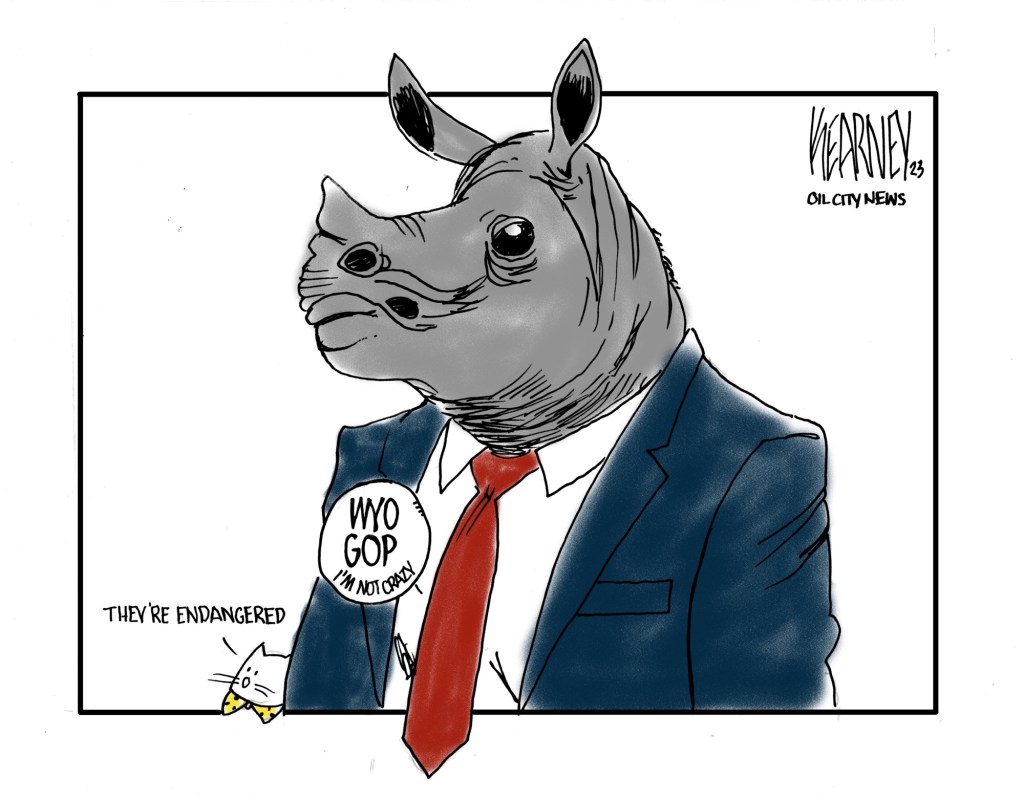
The Republican Party Has Apparently Lost the Meaning of Republican
I confess, I am becoming increasingly confused by the term RINO—Republican in Name Only.
Apparently, according to the modern Republican Party, a RINO is no longer someone who secretly wishes to join the Democratic Party, worships at the altar of socialism, or spends their evenings knitting Bernie Sanders sweaters.
No. A RINO is now a Republican who believes in traditional Republican ideas.
You know—the quaint, old-fashioned stuff.
Smaller government. Lower taxes. Personal responsibility. Individual liberty. Limited government intrusion into people’s private lives. Fiscal restraint. Strong national defense. Free markets. Federalism. The general concept that government should probably stay out of your business unless there is a compelling reason for it to be there.
Apparently, those ideas have become dangerously radical.
The truly remarkable part is watching the modern, increasingly radicalized right accuse the people who still believe in those traditional principles of being Republican in Name Only.
Wait a minute.
If someone is a Republican who believes in the Republican philosophy Republicans have been selling for decades, how exactly does that make them a Republican in Name Only?
Wouldn’t that make the people who abandoned those principles the RINOs?
I mean, if we are going to play this game, let’s at least use the English language correctly.
Imagine walking into a Republican meeting from, say, 1985 and telling Ronald Reagan, George H. W. Bush, Bob Dole, or any number of traditional conservatives that someday Republicans would demand that the government involve itself in what books children can read, what medical decisions families make, what happens in people’s bedrooms, what businesses can say, what universities can teach, what companies can sell, and what private citizens are allowed to do with their own lives.
They might reasonably ask:
“Wait…isn’t the whole point of conservatism supposed to be getting government OUT of people’s lives?”
And that’s where things get wonderfully absurd.
The party that once lectured Democrats about government overreach now has a growing faction that seems to believe government isn’t involved in enough things.
Apparently, the new conservative philosophy is:
Government should be small enough to fit in your wallet—unless we’re talking about someone else’s personal life. Then we need the full federal government, three committees, six agencies, a task force, and possibly a SWAT team.
And then comes the accusation:
RINO!
That’s the part I genuinely don’t understand.
If you are a Republican who says, “I want lower taxes, smaller government, fewer regulations, fiscal responsibility, individual liberty, and a strong military,” and someone responds, “You’re not a real Republican,” perhaps the problem isn’t with your Republican credentials.
Perhaps the problem is that the definition of Republican has moved.
Maybe the people screaming “RINO” at everyone haven’t noticed that they have wandered so far away from the original Republican philosophy that they now have to redefine the people standing in the middle as impostors.
It’s like showing up to a family reunion and discovering that someone has remodeled the house, knocked down all the walls, moved the kitchen into the garage, painted everything purple, installed surveillance cameras in the bedrooms, and then accused you of not belonging because you remember where the living room used to be.
And here’s the part that truly baffles me:
Why aren’t traditional Republicans turning the RINO accusation around?
Why aren’t they saying:
“Hold on. I’m the Republican who still believes in limited government, lower taxes, fiscal responsibility, individual liberty, free markets, and personal responsibility. You’re the one who has turned the Republican Party into a vehicle for government intervention in nearly every aspect of American life. Maybe I’m not the RINO. Maybe you are.”
Because that’s the obvious counterargument.
The traditional Republican should be asking the radicalized Republican:
“Which part of Republicanism did I abandon?”
Was it the smaller government?
No.
Lower taxes?
No.
Personal liberty?
No.
Limited government?
No.
Fiscal responsibility?
No.
Free markets?
No.
Strong national defense?
No.
So what exactly makes me the RINO?
Apparently, the answer increasingly seems to be:
“You didn’t agree with me.”
And there it is.
The definition of ideological purity has replaced the definition of political philosophy.
You aren’t a Republican anymore because you believe in Republican principles.
You’re a Republican only if you believe in everything the current Republican faction believes today.
And tomorrow, of course, those requirements may change.
That’s the funny thing about purity tests. Eventually, everyone fails one.
Today you’re a conservative hero.
Tomorrow you’re a RINO.
Next week you’re a communist sympathizer because you suggested balancing the budget.
By next month, you’re apparently a socialist because you think the government shouldn’t be reading your neighbor’s text messages.
At this rate, the Republican Party may eventually consist of one person standing in an empty room shouting “RINO!” at the mirror while demanding that the government regulate the mirror’s political opinions.
And honestly, that may be the ultimate irony.
The people who claim to be defending the Republican Party from RINOs may actually be driving away the very Republicans who built the philosophical foundation of the party they claim to love.
Maybe it’s time for traditional Republicans to stop accepting the label as an insult.
Maybe they should proudly say:
“Yes. I’m a RINO—if by RINO you mean I still believe in the traditional Republican principles you abandoned.”
Because if believing in limited government makes you a Republican in Name Only, then perhaps we need to stop asking who the RINOs are.
Maybe we should start asking:
Who changed the definition of Republican—and why are the people who stayed Republican being accused of leaving?
Now that is a political identity crisis worthy of the modern Republican Party.
And somewhere, Ronald Reagan is probably looking down and wondering why the party that once told America, “Government is not the solution to our problem,” now seems determined to make government everyone’s problem.
Progress, apparently, comes in many forms.
Sometimes it even comes with a four-letter acronym.
RINO.
Funny how quickly Republican in Name Only can become a description of the people shouting it the loudest.
-
Honesty
What’s the kindest thing someone has ever done for you?
It makes it sound completely counterintuitive, but the kindest thing anyone has ever done for me is not let me get away with my own bullshit and was completely honest with me.
-
Phoenix sad landscaping choice
Dwain Northey (Gen X)

The Utterly Useless Palm Tree: Phoenix’s Most Overrated Stick
When I was a kid growing up in Colorado—and in various other places that actually experienced things like seasons—palm trees meant something.
Palm trees meant vacation.
They meant tropical islands, expensive resorts, ocean breezes, umbrella drinks, and some guy named Chad telling you he was “just taking some time to find himself.”
You saw a palm tree and immediately thought: Paradise.
Then I moved to Phoenix.
And apparently, nobody told the palm trees.
Because here, the palm tree isn’t a symbol of luxury.
It is a 30-to-60-foot-tall wooden middle finger to common sense.
You drive around Phoenix long enough and you start noticing something fascinating. The taller and more pathetic the palm tree is, the more likely you are to find it in a place that looks like it hasn’t received a meaningful investment since the Reagan administration.
Trailer parks? Palm trees.
Semi-abandoned shopping centers? Palm trees.
Strip malls where three of the five storefronts are empty and the remaining two are a payday lender and a vape shop? Palm trees.
Somewhere, there will inevitably be one of these magnificent botanical disasters standing proudly in the parking lot.
Except “proudly” may be giving it too much credit.
I’m talking about those enormous Phoenix palms that consist of approximately one 50-foot stick with six confused fronds attached to the top.
They look like something the Muppets would construct if they were given a landscaping contract.
You look at one and think, Is that a tree or did someone leave a broom standing vertically in the desert?
And here’s the really remarkable part:
They provide absolutely nothing.
No meaningful shade.
No edible fruit worth eating.
No cooling canopy.
No protection from the sun.
No privacy.
No windbreak.
Nothing.
They just stand there.
For decades.
Drinking water.
Because apparently Phoenix looked at a desert and thought:
“You know what this place needs? A giant plant whose entire personality is consuming water while providing the shade equivalent of a cocktail umbrella.”
And we have hundreds of thousands of them.
Possibly millions.
We have spent enormous amounts of water keeping giant decorative sticks alive in a city where people are constantly being reminded that water is a finite resource.
This is especially hilarious when you compare them to the palm trees found in genuinely luxurious places.
Go to a resort somewhere tropical and look at the palms.
They’re full.
They’re lush.
They’re magnificent.
They’re surrounded by greenery.
Their fronds actually extend far enough to make something resembling shade.
They look like they belong in a postcard.
Phoenix’s luxury palms can be impressive too, because someone actually maintains them.
But the neglected ones?
Holy hell.
Those aren’t palm trees.
Those are botanical survivors of a nuclear apocalypse.
And somehow, the worse the neighborhood looks, the more likely you are to find these towering skeletons of former landscaping ambition.
There’s something almost poetic about it.
The shopping center is falling apart.
The asphalt is cracked.
The stucco is fading.
Half the signs are missing.
There’s a shopping cart abandoned in the parking lot.
The air conditioner on the building died sometime during the Bush administration.
And standing majestically above the entire scene is a 45-foot palm tree with six leaves.
Because priorities.
Apparently the landlord couldn’t afford to fix the roof, but by God, we’re keeping the giant decorative asparagus alive.
And let’s talk about shade.
Phoenix.
A city where summer temperatures routinely turn the outside world into the surface of the sun.
A city where you can literally get second-degree burns from sitting on a car seat.
A city where walking across a parking lot in July feels like crossing the Sahara while carrying a hair dryer.
So what do we plant?
Something with a massive trunk and a canopy approximately the size of a dinner plate.
Meanwhile, the trees that actually provide shade—the broad-canopied desert-adapted trees that can make sidewalks, homes and parking lots meaningfully cooler—are apparently expected to fight for their lives for landscaping space.
The palm tree gets a free pass.
Because it looks tropical.
And apparently looking tropical is enough.
This is the great Phoenix landscaping contradiction.
We live in a desert, so we’ve learned to pretend we don’t.
We build enormous air-conditioned buildings.
We install artificial grass.
We construct swimming pools.
We fill neighborhoods with palm trees.
Then we look at the water situation and say:
“Well, this is unexpected.”
The Phoenix palm tree may be the perfect metaphor for the city itself: expensive, thirsty, completely out of context and designed primarily to create an illusion.
Because when you’re from Colorado, a palm tree makes you think you’re somewhere special.
Vacation.
Paradise.
Luxury.
In Phoenix, you eventually learn that a palm tree can just as easily mean:
“Welcome to the parking lot behind the abandoned Kmart.”
And that’s the thing about nostalgia.
As a kid, I thought palm trees were exotic.
I thought they represented someplace better.
Someplace warmer.
Someplace beautiful.
Now I drive around Phoenix and see a 60-foot palm tree towering over a collection of aging mobile homes, providing exactly enough shade for a squirrel’s left testicle, and I realize:
The palm tree wasn’t the symbol of paradise.
It was just a really good marketing department.
And Phoenix bought the entire campaign.
At least the palm trees are consistent.
They’ll be here long after the shopping centers have been abandoned, the strip malls have been demolished and the water restrictions have become so severe that we’re all fighting over who gets to flush the toilet on Tuesday.
There they’ll stand.
Fifty feet tall.
Six sad fronds.
No shade.
No useful purpose.
Drinking precious desert water.
Looking vaguely embarrassed.
Phoenix’s magnificent monuments to the proposition that just because you can grow something doesn’t mean you damn well should.


You must be logged in to post a comment.