Dwain Northey (Gen X)
https://www.cbsnews.com/news/naacp-travel-advisory-florida-says-state-hostile-to-black-americans/
Remember the good old days when there were only travel advisories and or ban for, what some would call, third word countries? Well now because of the vile vitriol of one Governor Ron DeSantis the state of Florida, a vacation destination, has received a travel advisory by the NAACP.
The wannabe future President has made the climate so venomous in Florida the anyone who is a part of any minority group does not feel safe in the state. Black, Brown, LGTBQ+, these are all groups that are under attack in the Sunshine State. The majority Republican legislature and their fearful leader has passed laws that make almost everything a jailable offence and the fact that the state has very loose gun laws and a stand your ground law makes it more dangerous than being a blonde female in central America.
Florida residents are able to carry concealed guns without a permit under a bill signed into law by Republican Gov. Ron DeSantis. The law, which goes into effect on July 1, means that anyone who can legally own a gun in Florida can carry a concealed gun in public without any training or background check. This with their ridiculous stand your ground law, ‘Florida’s “Stand-Your-Ground” law was passed in 2005. The law allows those who feel a reasonable threat of death or bodily injury to “meet force with force” rather than retreat. Similar “Castle Doctrine” laws assert that a person does not need to retreat if their home is attacked.’ Makes it really sketchy to go there.
This in top of the don’t say gay rule and the new trans ruling that just passed.
“Florida lawmakers have no shame. This discriminatory bill is extraordinarily desperate and extreme in a year full of extreme, discriminatory legislation. It is a cruel effort to stigmatize, marginalize and erase the LGBTQ+ community, particularly transgender youth. Let me be clear: gender-affirming care saves lives. Every mainstream American medical and mental health organization – representing millions of providers in the United States – call for age-appropriate, gender-affirming care for transgender and non-binary people.
“These politicians have no place inserting themselves in conversations between doctors, parents, and transgender youth about gender-affirming care. And at the same time that Florida lawmakers crow about protecting parental rights they make an extra-constitutional attempt to strip parents of – you guessed it! – their parental rights. The Human Rights Campaign strongly condemns this bill and will continue to fight for LGBTQ+ youth and their families who deserve better from their elected leaders.”
This law makes it possible for anyone to just accuse someone of gender affirming care to have their child taken from them this would include someone traveling from out of state. This alone justifies a travel ban to the Magic Kingdom for families.
Oh, and I haven’t even mentioned DeSantis holy war with Disney, the largest employer in the state. I really hope the Mouse eats this ass holes lunch.
Well that’s enough bitching, thanks again for suffering though my rant.
-
When will the Rats Run?
Dwain Northey ( Gen X)

The MAGA movement, for all its bluster about loyalty and unshakable faith in their chosen God-King, is built on the same brittle foundation as every cult of personality: fear, self-interest, and the promise of power. Loyalty lasts only as long as the checks clear, the rallies feel like Woodstock with red hats, and the illusion of invincibility remains intact. The moment the ship starts tilting, history tells us, the rats start sprinting for the lifeboats, claws bared, shoving one another into the waves.
Predictions? The unraveling is already underway. The first wave of defectors will be those who were always half in, half out—professional opportunists like certain senators and governors who rode the MAGA train for votes but never bought the hat for personal wear. They’ll start speaking in “regretful tones,” offering soft critiques while insisting they “still respect the base.” Expect this within six months of Trump’s next major public embarrassment—whether it’s a legal defeat, an electoral flop, or a health scare that proves the King bleeds like any other mortal.
The second wave will be the loyalists who suddenly remember they have “deep reservations” and were “concerned all along.” These will be the loudest hypocrites, elbowing each other for the microphone as they proclaim, with crocodile tears, that the movement betrayed them. That stage takes another year, maybe two.
Finally, the diehards will fracture. A few will remain tattooed with the man’s name until their graves, but most will splinter into mini-tribes, each crowning a new wannabe strongman. By that point, MAGA will no longer be a coherent movement—just a political shipwreck with survivors fighting over the last scraps of influence.
So, to answer plainly: the sinking has started. The kicking begins the minute the water reaches their ankles.
-
New Isolationism
Lyle Northey (Silent/Boomer)

A new wrinkle in the methods of getting people out of the country, now we are going to denaturalize individuals that we deem to be unfit. Who do you suppose they will target first? The person that has committed a crime like robbery or worse? Some one that runs a business that violates some rule like DEI or whatever? How about an individual that has been elected to Congress but represents the opposition? What a crook of crap this administration is has been pointed out in so many ways and it just gets worse. This rule, or law, or whatever you call it has popped up and most likely been overlooked because of all the other shit that been hitting the fan, and yet it could be so very devistating to many among us. The brutal methods used on people by ICE or whoever the MASKED men, they ain't the Lone Ranger, are show that they want someone to show even the slightest resistance so they can then be as brutal as possible. How much are these guys being paid to sink into the cesspool of subhumanity that is required to be an agent? One day we will see this rein of terror come to an end and when we do all records of who these guys are should be made public and all of them should be awarded the kind of prize they deserve. Let your imagination run wild as to what you feel those prizes should be. For starters I would expect that once this career goies away and they become known that they never get another job, cannot apply for assistance and the list goes on. Not only will this be negative for them but their families are not going to be very forgiving at that point. If any of you HERO's are reading this just keep in mind that what goes around comes around and your windfall today will very likely be your downfall tomorrow. These conformation hearings for some of the most unqualified people to fill important positions keeps moving along like a very dangerous snake. Why do the idiots keep voting for these people? If Trump has the stroke to primary everyone then all of you should make him put his money and his inflluence on the table. Think about what his tariff policies are doing to coorporations and the wealthy owners behind them. Do you honestly believe that his influence is still high enough to go after all that are up for reelection? We all know the GOP has for years tried to destroy every public supportive program and oganization we have, an yet when and if they considered that without the middle and lower classes they would have nothing it would seem obvious that their effort to destroy those programs in pretty much like committing self destruction. Keep on with all these negative efforts and watch as the world shrinks. When you can no longer go to other countries because we Americans are no longer welcome. When there are no venues to entertain you grandchildren becasue there are no people to man Disneyland and all you have left are some golf courses, possibly overgrown as there are not labor personnel to keep things up. Without those that do the work all the money in the world is just as useless as statement coming from your great leader, pure unaulterated bullshit. Another issue that seems to be getting some attention, not necessarily positive attention, is that of younger people getting involved in politics. Well guess what, they need to get involved as they are going to inherit this mess very soon. There are younger people in the current administration but most are not terribly well versed in government, or the Constitution. They are also overly impressed that daddy dump picked them to be in certain positions, not because they are qualified but because they kiss ass. The impression is that everyone working for Trump is pleased with the fact that, although they are unqualified, are happy to be in these positions so they can be the school yard bully as long as they don't challenge daddy. The consequences of this gross stupidity are currently being visited upon the populace but when the power change happens those consequences are going to be dumped in the laps of the idiots that so happily signed on to the job of stooge. It may take time to get all of them punished but the fact that you get to spend your life looking over your shoulder waiting for the hammer to fall won't be any fun. This administration has done it's best to destroy our Democracy and when we get it back the destruction will be visited on those that did the bidding of a fool. -
Photos by Michelle

-
Can we go back to boring
Lyle Northey (Silent/Boomer)
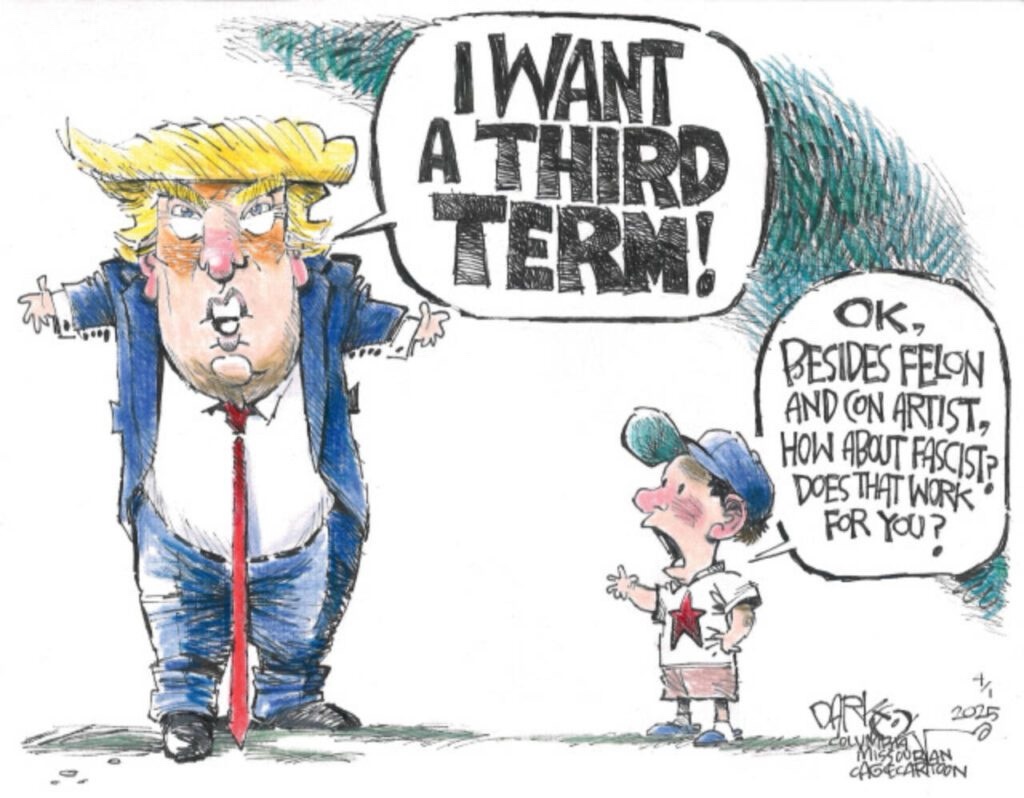
Ah yes, let’s all rise and salute the good old days when Barry Goldwater’s campaign ad had schoolchildren reciting the Pledge of Allegiance like little wind-up patriot dolls. Because nothing says “freedom” like mandatory loyalty chants. Do we still do that? Of course! And if some lawmakers had their way, not only would kids be pledging allegiance every morning, they’d be kneeling before a golden tablet of the Ten Commandments mounted above the Smartboard. Forget math, forget science—just recite “Thou shalt not kill” before heading off to active-shooter drills. The irony practically screams from the chalkboard: politicians pretending they care about morality while simultaneously passing laws that turn every strip mall into the O.K. Corral. Truly, we live in a master class of hypocrisy that could only be described as Olympic-level stupidity.
Meanwhile, freedom—remember that quaint little concept?—is hanging by a thread. The idea that one party, already mangled beyond recognition, could dominate every part of our lives is no longer a cautionary tale; it’s a business plan. Their economic “program” has already tanked jobs and stunted growth faster than you can say “trickle-down.” And the immigrant raids? Nothing like state-sponsored home invasions to really capture that warm, fuzzy, family-values vibe. Our so-called moral compass is less “north-south” and more “spinning wildly like a broken ceiling fan.” Brute force has now become a lifestyle brand—one part dystopia, one part reality TV, and somehow people are buying the merch.
And what’s the cherry on top of this sundae of national decline? More guns, of course! Because nothing says “problem solved” like flooding the streets with weapons while removing whatever pitiful regulations still exist. The logic here is dazzling: create chaos, then use that chaos as justification for more brute force. It’s the kind of brilliant strategy you’d expect from someone who thinks “Home Alone 2” is a documentary. Civil war cosplay is being openly courted, and the recruits? ICE agents being paid handsomely today, only to become tomorrow’s cannon fodder in a game where the rules are written in crayon.
And let’s not forget the police officers and soldiers being used as chess pieces in this empire-building fantasy. Every day, they wake up to the possibility that they’ll be asked to sacrifice not for liberty, not for justice, but for the fragile ego of a coward who confuses tweeting with leadership. National Guard troops are already signaling: “Hard pass, we’re not dying for your tantrum.” If being King is such a burning passion, then by all means, hand the man a rusty bayonet and point him toward the front line. Spoiler alert: he won’t go. He’ll sit on his gaudy throne, tweeting about his “strength,” while others pay the ultimate price.
And those who follow him blindly? They’re not marching toward greatness; they’re marching straight into the abyss. But hey, at least they’ll have the Ten Commandments framed nicely on the wall while everything else burns to ash.
-
National PTSD
Dwain Northey (Gen X)

We are, without a doubt, living in a collective national state of PTSD courtesy of the first Trump administration. Remember that? Those four years felt like sitting in a chair that’s constantly about to tip backward—not quite falling, but close enough to make your stomach lurch every second of every day. Sure, you didn’t actually fall and break your neck, but you lived with that buzzing anxiety in your chest, like a fire alarm with a dying battery that never, ever stopped chirping. And now, as we gaze down the barrel of yet another potential Trump chapter, it’s less “oh no, I might tip over” and more “oh no, the Mango Moron is about to drive us straight into an active volcano while bragging about how only he could discover magma.”
We used to think politics was boring. The biggest scandal was a senator getting caught with a mistress or a campaign staffer accidentally sending the wrong email. Quaint times, weren’t they? But with Trump, every morning was like spinning the Wheel of Stupidity to find out what flavor of national humiliation we’d be tasting that day. Would it be locking children in cages and then losing track of their parents like mismatched socks? Would it be cozying up to dictators while spitting on long-time allies? Or maybe just some casual Twitter diplomacy, threatening nuclear war in 280 characters because someone hurt his feelings?
And now, the sequel promises to be even worse—because like any bad reality show, Trump knows he’s got to top himself. Who wouldn’t feel traumatized waking up to see headlines like: “Trump Declares War on Argentinian Fishing Boats 11,000 Miles Away” or “President Orders Space Force to Build Wall Around the Moon”? If you’re not living with heart palpitations at this point, check your pulse—you might already be dead.
It’s not just the chaos itself, though—it’s the gaslighting that leaves us all twitching. In Trump World, nothing is ever what it seems. Children in cages? No, those are “summer camps.” Nazis marching with tiki torches? “Very fine people.” A deadly virus killing hundreds of thousands? “Totally under control, like a miracle, it’ll disappear.” And when reality is twisted like a balloon animal every single day, the rest of us are left doubting our sanity. Did that really happen? Did the President of the United States actually suggest injecting bleach? Yes. Yes, he did. And we all need therapy for remembering it.
The worst part is the anticipation—the endless “what now?” dread that makes you jump at shadows. Every time Trump stepped up to a podium, you could feel the country collectively holding its breath, like kids waiting to see if Dad is about to read them a bedtime story or hurl the TV out the window. And when the Mango Moron opened his mouth, it was always the latter. Always.
So yes, America is in a perpetual state of PTSD. We flinch at press conferences. We brace for the next executive order like it’s a hurricane. We eye the news the way a war veteran eyes fireworks—because we know one stupid spark can set off a national catastrophe. Trump didn’t just wreck policy; he wrecked our nervous systems. And now, with the prospect of another four years of this lunacy, it’s not just a chair tipping anymore—it’s the whole damn house sliding into the ocean while Trump stands on the roof, tweeting about how only he can save us from drowning.

-
FloriDUH
Dwain Northey (Gen X)
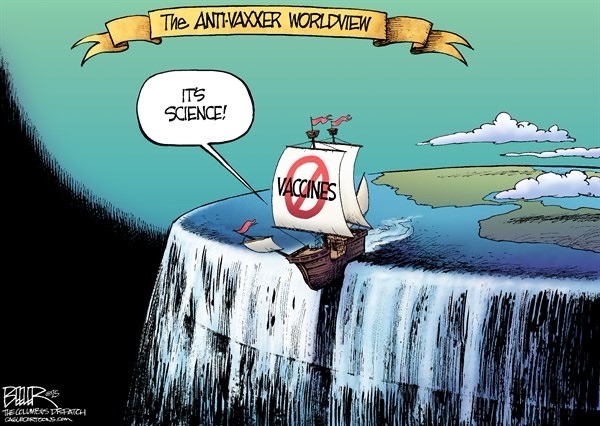
Florida has long branded itself as the “Sunshine State,” but somewhere along the way, the glow turned into a spotlight on a parade of bad ideas. For years, it’s been less a beacon of freedom and more the kid in the neighborhood who insists on eating glue and then acts shocked when the stomachache sets in. And leading this crusade into the swamp of terrible policy is none other than Governor Ron DeSantis and his band of yes-men, who’ve managed to make Florida synonymous with political stunts and public health hazards.
It started, at least in the modern chapter, with DeSantis’s war against Disney. You know, Disney—the company responsible for making childhood dreams, family vacations, and mouse-ear hats. But apparently, being tolerant of LGBTQ employees and guests was one magic kingdom too far for the governor. Instead of focusing on things like infrastructure, affordable housing, or climate change (you know, the stuff actually flooding his state), DeSantis threw his weight into punishing the House of Mouse. It was less a bold stand and more like a toddler screaming at his toys because they wouldn’t play his way.
But the Disney debacle was just one act in a much longer-running theater of bad ideas. Florida was one of the earliest adopters of “Stand Your Ground” laws, the kind of legislation that makes gun manufacturers salivate and the rest of us wonder if we’re living in a spaghetti western. These laws have given Floridians the green light to escalate conflicts into shootouts under the guise of self-defense. Predictably, they’ve done wonders for gun violence statistics and absolutely nothing for public safety. But hey, in Florida, it seems every confrontation is just one itchy trigger finger away from becoming headline news.
Then came the great book purge. Because nothing says “freedom” quite like banning books. Across Florida schools, everything from novels about racial history to young adult fiction with LGBTQ characters has been yanked off shelves faster than a library sale on free Slurpee Day. The result? Students are learning less about history, diversity, and critical thinking, and more about how fragile adults can be when confronted with ideas they don’t like.
And just when you thought the state couldn’t possibly top itself, here comes the pièce de résistance: no more vaccine mandates of any kind. That’s right. The governor and his Surgeon General—who seems to think “public health” is a phrase best avoided—have decided that not even children need to be vaccinated to attend school. Forget the decades of progress against measles, chickenpox, whooping cough, or polio. Florida is ready to roll back the clock to the good old days when childhood illnesses spread unchecked and cemeteries filled up faster than theme park parking lots.
What does this mean for the rest of us? Simple: Florida is about to become the kid who poops in the pool. And not just once—repeatedly. Thanks to interstate travel, contagious diseases won’t politely stay behind the state line. Nope, they’ll spread outward like a tourist’s sunburn, carried across the country by snowbirds, spring breakers, and business travelers.
So thank you, Florida. Thank you for reminding us that sunlight isn’t always the best disinfectant. Sometimes it just illuminates the bad decisions in full, glaring detail. And with leadership this committed to being wrong, the only thing we can count on is that the hits—and the diseases—will just keep coming.
-
Big Mad
Dwain Northey (Gen X)

Oh, the tragedy. The heartbreak. The utter devastation sweeping across the Fox News set. You almost need to send in FEMA relief teams to mop up all the crocodile tears over the Democrats refusing to “move on” from the Epstein files. Because nothing—and I mean nothing—makes the Benghazi-Hunter’s-Laptop crowd more distraught than when actual victims of actual crimes speak up and refuse to be neatly shelved away like a stack of old campaign yard signs. The poor darlings are simply beside themselves.
After all, Republicans spent years screaming about Hillary’s emails, running endless primetime specials with ominous sound effects and blurry graphics of servers, servers everywhere. Hunter Biden’s laptop? Forget about it. That was their Super Bowl. They could talk about that imaginary laptop like it was the Dead Sea Scrolls, handed down by God Himself and containing every secret of civilization. But now, when actual evidence of crimes—real crimes, involving rich and powerful men abusing minors—threatens to come into daylight? Suddenly, Fox & Friends would prefer if everyone stopped talking and just turned the channel back to immigration panic.
And let’s not forget the star of this soap opera: Donald J. Trump, the man who once promised, cross-his-heart-and-hope-to-grift, that he’d release the Epstein files. Remember that? He was going to shine the cleansing sunlight of truth on the whole sordid affair. But fast-forward to today, and now he’s threatening to prosecute anyone who dares even whisper about opening those files. Because, of course, it’s not about justice or transparency; it’s about protecting the club. You know the club—the Mar-a-Lago cocktail crowd where loyalty is worth more than morality, and “family values” are whatever helps in the polls that week.
Fox commentators are in mourning. You can see it in their faces, hear it in their voices, those brave soldiers who wanted the whole country to obsess over every stray text message from Hunter Biden but now beg us to respect the “privacy” of the Epstein mess. “Why can’t we just move on?” they wail, clutching their pearls so hard you’d think the string would snap. How dare the victims—yes, the actual human beings who were minors when these crimes occurred—make themselves heard? Don’t they know they’re interrupting the regularly scheduled programming about caravans and pronouns?
It’s almost poetic how this crowd manages to contort itself into Olympic-level hypocrisy. When the accused are Democrats, you get 24/7 coverage, complete with countdown clocks and scary red graphics. When the accused might include Republican donors, socialites, or even he-who-must-not-be-subpoenaed himself, suddenly it’s all “witch hunt,” “political theater,” and “weaponization.” They’ve gone from “lock her up” to “please, for the love of Tucker, lock those files back in the safe.”
And the cherry on top? Trump’s threats. The man who once styled himself as the Great Exposer of Secrets now growls that anyone supporting the release of Epstein’s files could face charges in whatever alternate-universe statute he dreams up between golf rounds. Maybe it’ll be “conspiracy to embarrass my friends.” Maybe “felony lack of loyalty.” Or my personal favorite: “first-degree exposure of inconvenient truths.” Whatever it is, you can be sure it’ll sound very serious on Truth Social, especially when written in ALL CAPS.
So yes, pour one out for the Benghazi-Hunter Laptop faithful. Their favorite weapon—moral outrage—is being turned against them, and it hurts. The victims won’t stay quiet, the files might see daylight, and their chosen king is now threatening anyone who dares to call his bluff. If irony were a renewable energy source, Fox News headquarters would be glowing brighter than Times Square.
-
Population not Land
Dwain Northey (Gen X)
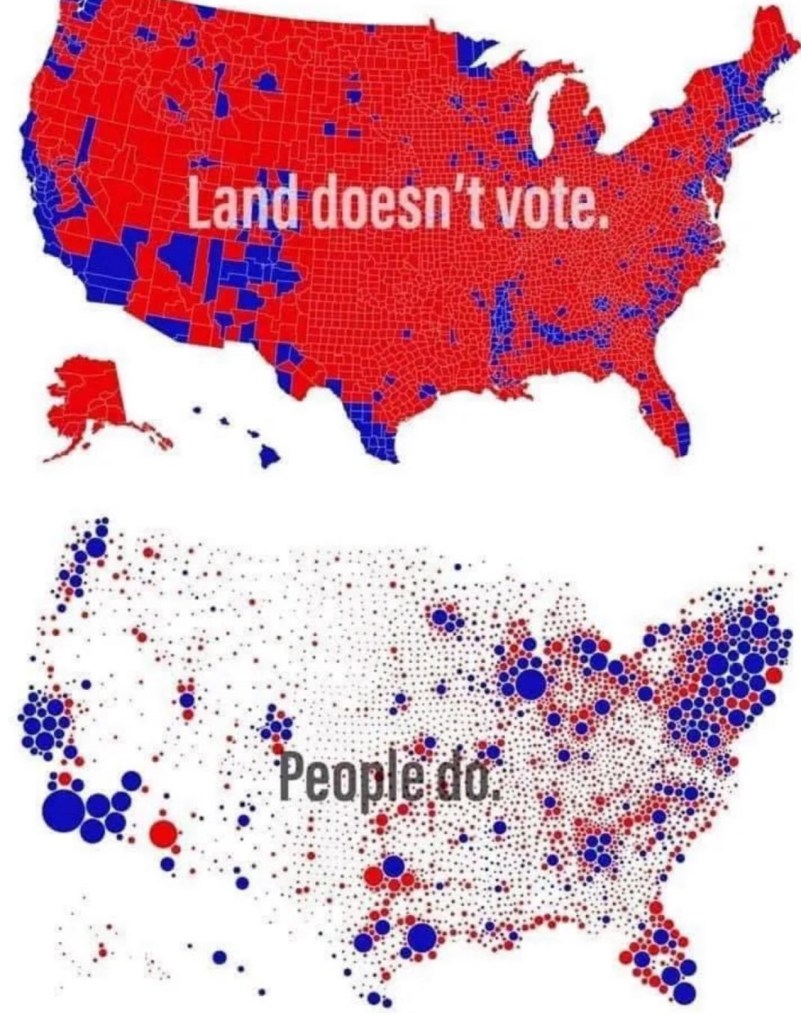
When Americans look at voting maps on election night, especially the ones splashed across cable news, the picture can be very misleading. Those maps are usually shaded red and blue by county or by state, and at first glance they often give the impression that Republicans dominate the country. Vast swaths of the map glow in red, while the areas marked in blue seem like small islands scattered across the coasts and a handful of urban centers. But here’s the catch: maps show area, not population—and in a democracy, it’s people who cast ballots, not acres of farmland or square miles of prairie.
This is where the illusion comes in. States such as Wyoming, Nebraska, and the Dakotas sprawl across thousands of square miles, but they are sparsely populated. A single New York City borough or a chunk of Los Angeles County contains more people than entire Great Plains states combined. Yet when maps are shaded by area, those huge but lightly populated regions overwhelm the visual impression, giving the appearance that Republican votes are far more dominant than they actually are.
The distortion becomes even clearer when you look at county-level maps. Rural counties tend to lean Republican, and there are thousands of them, each covering broad geographic areas. Urban counties, which lean Democratic, are geographically tiny but packed with millions of voters. On a conventional map, the urban centers look like small blue dots surrounded by an ocean of red, even though those dots represent huge concentrations of actual ballots.
Political scientists often use cartograms—maps that resize regions based on population rather than land area—to correct this distortion. When you view a cartogram of the United States after an election, the country looks completely different: cities expand like balloons, rural states shrink dramatically, and the true balance of voter power emerges. Suddenly, it’s obvious that Democrats aren’t confined to a few islands, nor are Republicans overwhelmingly dominant simply because they “own” more land.
This misperception isn’t just cosmetic. It shapes political psychology. When people see a sea of red across the map, they can assume Republicans have an iron grip on the electorate, when in reality elections are often decided by razor-thin margins in key states. The truth is that land doesn’t vote—people do. And where those people live matters far more than the number of square miles they occupy.
-
The Weave…
Dwain Northey (Gen X)

Donald Trump calls it the weave. As if he were some sort of golden-tongued orator carefully stitching together a tapestry of thought. In reality, it’s not a weave. It’s not even a tangle. It’s what happens when a Roomba gets trapped in a corner and just keeps bumping into the same wall until the battery dies. His “weave” is a mess of half-sentences, non sequiturs, and whatever Fox News chyron happened to be scrolling through his brain five minutes before he took the podium.
If your Uncle Donnie launched into one of these word salads at Thanksgiving, you wouldn’t nod politely. You’d quietly remove the carving knife from his hand and whisper to Aunt Carol to get the car running because you’re headed straight to the psych ward. Imagine it: you’re trying to pass the gravy, and Uncle Donnie starts in—“A lot of people don’t know, but gravy, very special gravy, the best, I had gravy, everybody said, sir, that’s the best gravy they’ve ever seen, no one has ever seen gravy like this, except maybe Abraham Lincoln, but Lincoln wasn’t that great with gravy, believe me, believe me.” At that point, you’re not thinking “presidential.” You’re thinking “adult supervision required.”
The so-called weave isn’t rhetorical strategy—it’s verbal whiplash. He jumps from immigration to lightbulbs to windmills killing birds to Hunter Biden’s laptop in the space of a single breath, and somehow thinks this qualifies as coherence. It’s like watching a drunk uncle try to tell a joke he doesn’t remember the punchline to, only stretched out for 90 minutes in front of a screaming crowd. The audience nods along, not because they understand, but because they’ve long since given up trying.
And the pauses. Oh, the pauses. He stares out, lips pursed, like he’s just delivered the Gettysburg Address, when in reality he’s just said, “People are saying we’re doing very, very strongly, maybe the strongest, some say ever, maybe not ever, but probably ever.” If Uncle Donnie did that at the dinner table, you wouldn’t clap—you’d confiscate the wine and start Googling “early signs of dementia.”
So let’s be honest. “The weave” is not brilliant branding for his speaking technique. It’s just incoherent rambling dressed up in a cheap suit. If anyone else spoke this way, you’d stage an intervention. But somehow, when Trump does it, his fans call it “refreshing.” Right. Refreshing in the same way eating paste is a refreshing sn
-
Carbon Sinks
Dwain Northey (Gen X)

When we talk about climate change, the conversation usually points toward the Amazon rainforest—the so-called “lungs of the Earth.” We hear about the tragedy of deforestation, the destruction of carbon sinks, and the loss of biodiversity. While those are critically important issues, focusing almost exclusively on forests hides a much larger, often overlooked truth: the oceans are the planet’s greatest carbon sink. Plankton, algae, and other marine microorganisms absorb more carbon dioxide and produce more oxygen than all the world’s forests combined. Yet, the ongoing warming of our oceans is undermining this capacity at an alarming rate, perhaps even faster and more severely than deforestation on land.
The scale of this is staggering. Phytoplankton—microscopic, plant-like organisms that drift with ocean currents—perform photosynthesis just like trees do. In the process, they absorb enormous quantities of carbon dioxide and release oxygen back into the atmosphere. Scientists estimate that these oceanic organisms are responsible for producing at least half, and possibly as much as 70 percent, of the oxygen we breathe. Compare that to the Amazon, which contributes less than 10 percent, and suddenly our fixation on forests alone seems deeply incomplete.
The oceans not only produce oxygen but also lock away carbon. Through a process known as the “biological pump,” plankton absorb carbon dioxide at the surface and, when they die, carry some of that carbon to the deep ocean, where it can remain trapped for centuries or even millennia. This invisible, constant carbon capture system dwarfs the capacity of terrestrial forests. Without it, atmospheric carbon levels would be dramatically higher, and Earth’s climate would already be far less habitable.
But here’s the problem: global warming is sabotaging this system. Rising sea surface temperatures inhibit plankton growth, because warm waters stratify and reduce the mixing of nutrient-rich waters from below. Without those nutrients, plankton populations decline. Warmer oceans also hold less dissolved oxygen, further stressing marine ecosystems. Add acidification from carbon absorption, which makes it harder for organisms like plankton and shellfish to build their calcium carbonate structures, and the result is a cascading collapse of the very foundation of the marine food web.
The consequences ripple outward. Fewer plankton mean less carbon absorption, accelerating climate change in a vicious feedback loop. Declining oxygen production directly threatens the balance of life on Earth, while marine ecosystems from coral reefs to fisheries suffer devastating losses. These disruptions are happening now, not in some distant future. Ocean “dead zones”—areas so depleted of oxygen that they can no longer support life—are already expanding worldwide, directly linked to warming and pollution.
And yet, global discourse is tilted heavily toward forests. That’s not to say reforestation and halting deforestation aren’t urgent—they are. But it’s dangerously misleading to pretend that saving trees alone will stabilize our climate. If we fail to protect our oceans and the microscopic engines that drive them, all the tree planting in the world won’t offset the collapse of the largest carbon sink on the planet.
A shift in focus is overdue. Protecting marine ecosystems, reducing ocean pollution, curbing greenhouse gas emissions, and funding research into ocean health must stand alongside forest conservation in climate policy. The oceans are our true lungs. If we neglect them, we’ll find ourselves gasping for air in more ways than one.


You must be logged in to post a comment.