Dwain Northey (Gen X)
https://www.cbsnews.com/news/naacp-travel-advisory-florida-says-state-hostile-to-black-americans/
Remember the good old days when there were only travel advisories and or ban for, what some would call, third word countries? Well now because of the vile vitriol of one Governor Ron DeSantis the state of Florida, a vacation destination, has received a travel advisory by the NAACP.
The wannabe future President has made the climate so venomous in Florida the anyone who is a part of any minority group does not feel safe in the state. Black, Brown, LGTBQ+, these are all groups that are under attack in the Sunshine State. The majority Republican legislature and their fearful leader has passed laws that make almost everything a jailable offence and the fact that the state has very loose gun laws and a stand your ground law makes it more dangerous than being a blonde female in central America.
Florida residents are able to carry concealed guns without a permit under a bill signed into law by Republican Gov. Ron DeSantis. The law, which goes into effect on July 1, means that anyone who can legally own a gun in Florida can carry a concealed gun in public without any training or background check. This with their ridiculous stand your ground law, ‘Florida’s “Stand-Your-Ground” law was passed in 2005. The law allows those who feel a reasonable threat of death or bodily injury to “meet force with force” rather than retreat. Similar “Castle Doctrine” laws assert that a person does not need to retreat if their home is attacked.’ Makes it really sketchy to go there.
This in top of the don’t say gay rule and the new trans ruling that just passed.
“Florida lawmakers have no shame. This discriminatory bill is extraordinarily desperate and extreme in a year full of extreme, discriminatory legislation. It is a cruel effort to stigmatize, marginalize and erase the LGBTQ+ community, particularly transgender youth. Let me be clear: gender-affirming care saves lives. Every mainstream American medical and mental health organization – representing millions of providers in the United States – call for age-appropriate, gender-affirming care for transgender and non-binary people.
“These politicians have no place inserting themselves in conversations between doctors, parents, and transgender youth about gender-affirming care. And at the same time that Florida lawmakers crow about protecting parental rights they make an extra-constitutional attempt to strip parents of – you guessed it! – their parental rights. The Human Rights Campaign strongly condemns this bill and will continue to fight for LGBTQ+ youth and their families who deserve better from their elected leaders.”
This law makes it possible for anyone to just accuse someone of gender affirming care to have their child taken from them this would include someone traveling from out of state. This alone justifies a travel ban to the Magic Kingdom for families.
Oh, and I haven’t even mentioned DeSantis holy war with Disney, the largest employer in the state. I really hope the Mouse eats this ass holes lunch.
Well that’s enough bitching, thanks again for suffering though my rant.
-
All about Messaging
Dwain Northey (Gen X)
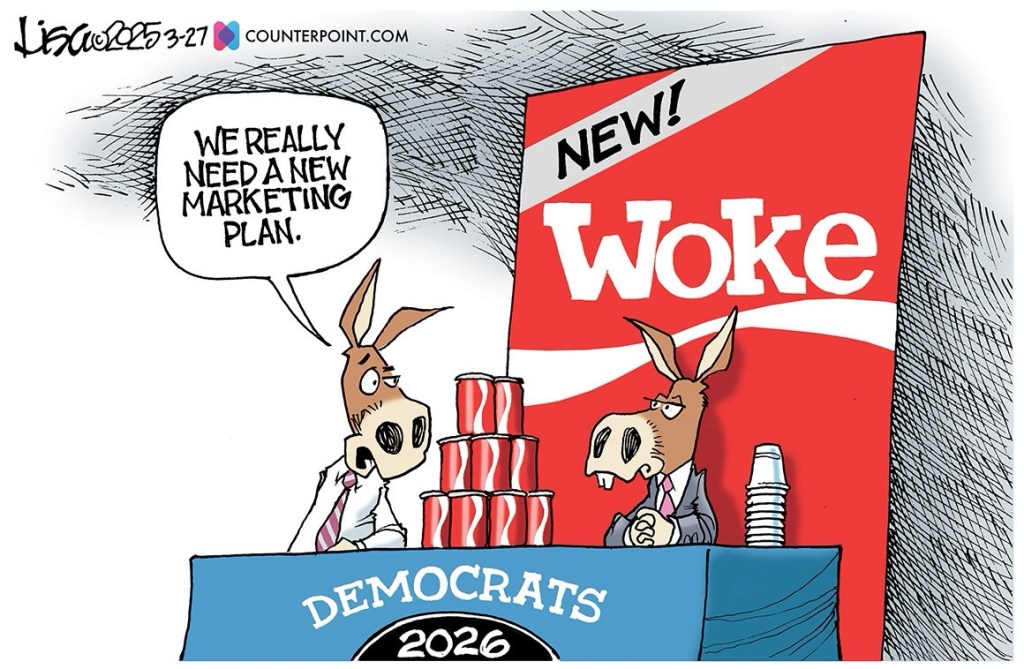
Republicans are the undisputed champions of branding. They can take a steaming pile of legislation, slap a patriotic bow on it, and suddenly half the country thinks it’s apple pie. It’s political Mad Men without the cigarettes and whiskey. Democrats, meanwhile, often sound like your overqualified professor explaining macroeconomics to a room full of people who just wanted to know if rent is due on the first or the fifth.
Let’s look at some of the GOP’s greatest hits in the “sounds good, screws you” category — and what Democrats should be calling them instead.
1. “Right to Work”
GOP Spin: Freedom! Choice! Your boss is your best friend! Reality: It’s the “Right to Work for Less.” Wages go down, benefits evaporate, and unions get kneecapped. Democratic Rebrand: Call it what it is: “The Boss’s Bill of Rights” — because the only one with rights in this setup is your employer.
2. “Tax Cuts and Jobs Act”
GOP Spin: Jobs raining from the sky, tax relief for the little guy. Reality: A corporate piñata stuffed with goodies for billionaires. Your crumbs expire while theirs don’t. Democratic Rebrand: “The Trickle-Down Scam Act.” Because even Republicans admit that “jobs” somehow never trickle down.
3. “Parents’ Rights”
GOP Spin: Who doesn’t love parents having a say? Reality: A Trojan horse for banning books, targeting LGBTQ+ kids, and erasing uncomfortable history. Democratic Rebrand: “Parents’ Wrongs.” Or better: “The Book Burning Act of 2025.”
4. “Election Integrity”
GOP Spin: We just want safe, honest elections! Reality: Translation: “How do we stop college kids, Black voters, and seniors from casting ballots?” Democratic Rebrand: “Voter Suppression by Design.” Or the more sarcastic: “Because You Can’t Win Fairly Act.”
5. “School Choice”
GOP Spin: Who doesn’t want options for their kids? Reality: Public schools get gutted while tax dollars fund private academies and fundamentalist Sunday schools. Democratic Rebrand: “School Theft” or “Public Schools for the Privileged.”
6. “Energy Independence”
GOP Spin: Sounds patriotic, right? Reality: Drill, baby, drill. Burn baby, burn. Renewable energy? Sorry, doesn’t pad oil execs’ wallets. Democratic Rebrand: “Oil CEO Welfare.” Straight to the point.
7. “Religious Freedom”
GOP Spin: We’re just protecting people’s faith. Reality: It’s a license to discriminate, usually against LGBTQ+ folks or women who dare want healthcare. Democratic Rebrand: “The Freedom to Hate Act.”
8. “Pro-Life”
GOP Spin: Who doesn’t love life? Reality: Once you’re born, good luck with healthcare, childcare, or gun violence. Democratic Rebrand: “Forced Birth Movement.” Or my personal favorite: “Pro-Birth, Anti-Life.”
9. “Entitlement Reform”
GOP Spin: Just fixing inefficiencies. Reality: Translation: “We want to take your Social Security and Medicare and give it to Wall Street.” Democratic Rebrand: “The Retire in Poverty Plan.”
10. “America First”
GOP Spin: Sounds patriotic! Reality: Isolationist, xenophobic, and usually means “corporations first, you second.” Democratic Rebrand: “America Screwed.”
So What Should Democrats Do?
Stop talking like a C-SPAN transcript and start marketing like it’s a Super Bowl ad. Republicans figured out decades ago that Americans respond to simple, punchy words. Democrats respond with 12-point policy briefs that sound like they were written by your tax accountant’s tax accountant.
Here are a few rules Democrats should steal from the GOP playbook:
Keep It Short. Call it the “Billionaire Tax Cut” instead of “The 2017 Tax Cuts and Jobs Act.” Make It Visual. Voters remember “drain the swamp,” not “increase federal transparency.” Use Sarcasm. Point out the hypocrisy. “Right to Work? Yeah, right to work for poverty wages.” Brand Aggressively. Don’t wait for Republicans to define the issue. Call it what it is before Fox News gets to it. Repeat Until It Sticks. If the GOP can convince people that book bans are about “parents’ rights,” Democrats can convince people that Social Security cuts are “The Steal from Grandma Act.”
Republicans have the Madison Avenue magic. They take policies designed for billionaires and brand them as if they were hand-knitted sweaters for working families. Democrats? They need to stop being the earnest librarian and start being the sarcastic friend who tells you the label on the bottle is a lie. Because in politics, if you don’t brand your opponent’s ideas first, they’ll brand themselves as the hero — and you as the villain.
-
Photos by Michelle


-
Thank a liberal for Labor Day
Dwain Northey (Gen X)

Labor Day is here again, which means burgers, beer, and a few politicians pretending to care about workers while secretly plotting how to squeeze them for every last dime. So let’s set the record straight: if you’re enjoying that long weekend, you should be sending a thank-you card to liberals and organized labor. Because the last time the Republican Party actually gave a damn about unions, Eisenhower was in office, gas was 30 cents a gallon, and Elvis was still scandalous for shaking his hips on TV.
Dwight D. Eisenhower, bless him, once said only a fool would try to break unions. Well, after Ike, the GOP apparently decided “fool” was their official brand identity. Barry Goldwater lit the match, Ronald Reagan poured gasoline all over it by firing the air traffic controllers in 1981, and every Republican since has been dancing around the flames of corporate greed like it’s some kind of patriotic bonfire.
Since then, the GOP playbook has been pretty simple: weaken unions, block wage increases, gut pensions, and sell it all to you with a bow-wrapped slogan like “right-to-work.” Sounds nice, right? Who wouldn’t want the right to work? Except it’s really the right to work for less money, fewer benefits, and no job security while your boss pockets record profits and buys his third yacht. Congratulations, worker—you get a pat on the back while Wall Street buys another island.
Meanwhile, union membership plummeted—not because workers stopped wanting fair treatment, but because Republicans made sure organizing a union was harder than getting Taylor Swift tickets online. Court rulings stacked with conservative justices? Check. State legislatures gleefully passing union-busting laws? Double check. And every time workers cry out for fair wages, Republicans tell them to be grateful for the scraps. After all, in their worldview, CEOs are “job creators” and workers are just lucky to exist in their shadow.
Compare that to liberals, who—though far from perfect—have consistently fought to give workers a fighting chance. Democrats brought us the minimum wage, Social Security, Medicare, OSHA, family leave, workplace safety standards, and yes, the very idea that you shouldn’t work yourself into the grave before you’re 50. Today, it’s liberals pushing for higher wages, student debt relief, universal healthcare, and stronger unions, while Republicans are busy protecting billionaires from paying an extra nickel in taxes.
So this Labor Day, when Republicans wrap themselves in the flag and talk about freedom, remember what they mean: freedom for corporations to exploit you, freedom for the wealthy to hoard profits, and freedom for workers to quietly accept less. If you’ve got a weekend, thank a liberal. If you’ve got overtime pay, thank a union. If you’ve got retirement security, thank progressive politics.
Republicans? They’ve given you… what exactly? Oh right—an economy where your boss can fire you over text message, call you a “contractor” to dodge benefits, and then funnel your labor into his stock dividends. Maybe the next time the GOP shows up at a Labor Day parade, workers should hand them a broom—because the only job they’ve been doing is sweeping away your rights.

-
Kenaf 3rd Pillar
Dwain Northey (Gen X)

When we talk about saving the planet, two names dominate the conversation: hemp and bamboo. They’ve been crowned the poster children of sustainability, rediscovered as miracle materials to replace the destructive habits of the fossil fuel and deforestation era. Hemp gives us textiles, bioplastics, and even building materials like hempcrete. Bamboo builds homes, furniture, and even clothing, growing back faster than we can cut it. But the green revolution needs more than two heroes. There is a third pillar, a largely overlooked plant that could balance the equation and push us closer to true environmental reinvention: kenaf.
Most people have never heard of kenaf. That’s the tragedy. While it sits in obscurity, we are watching forests disappear, plastic choke oceans, and climate chaos accelerate. Yet kenaf could stand shoulder to shoulder with hemp and bamboo as a renewable powerhouse. A member of the hibiscus family, kenaf is a tall, fibrous plant that grows with astonishing speed—up to 18 feet in just a few months. While we’re waiting 20 years for a tree to be harvested for paper, kenaf completes its life cycle in a single season. Imagine the pressure it could take off the world’s forests if we simply replaced tree pulp with kenaf pulp for paper and packaging.
But it doesn’t stop at paper. Kenaf fibers are strong enough to replace synthetic composites in cars, furniture, and plastics. Carmakers have already experimented with kenaf panels to reduce weight and environmental impact. Its inner core is so absorbent that it can clean up oil spills, serve as eco-friendly animal bedding, or replace the toxic fillers used in many industrial processes. In short, kenaf is not a one-trick crop—it’s an all-purpose workhorse, quietly capable of transforming multiple industries at once.
And here’s the kicker: kenaf is not picky. Unlike bamboo, which prefers tropical and subtropical zones, or hemp, which still carries the baggage of outdated cannabis laws, kenaf can grow almost anywhere cotton does. From the southern United States to India, Africa, and Latin America, kenaf can be seeded, grown, and harvested in a single warm season. For farmers, this means a new cash crop. For humanity, it means a carbon sink, a plastic alternative, and a forest saver—all rolled into one.
If hemp is the rebel and bamboo is the showman, kenaf is the unsung laborer—the one quietly doing the job nobody notices until it’s gone. And right now, what the green revolution desperately needs is not just flashy promises but reliable, scalable, renewable materials. Kenaf offers exactly that.
The truth is, we don’t have the luxury of ignoring plants like kenaf any longer. To reinvent our relationship with the environment, to move beyond slogans and toward actual solutions, we need to elevate this “forgotten” crop into the spotlight. Hemp, bamboo, and kenaf: three pillars of a new, renewable world. That’s not just agriculture—it’s survival.
-
Bamboo #2
Dwain Northey (Gen X)

Bamboo is one of those gifts of nature that we keep rediscovering, almost like it’s been patiently waiting for humanity to catch up to its potential. In the middle of the so-called “green reinvention revolution,” bamboo stands as a symbol of what happens when we stop trying to out-engineer nature and instead partner with it. The plant is at once ancient and futuristic, deeply rooted in tradition while perfectly suited for the challenges of a warming, resource-strapped planet.
First, let’s talk about its ecological brilliance. Bamboo is technically a grass, which means it grows at a speed that puts nearly every other renewable resource to shame. Some varieties can shoot up more than three feet in a single day, making trees look like they’re stuck in slow motion. Unlike hardwood forests that take decades to regenerate after harvest, bamboo can be harvested sustainably in a cycle of just three to five years. And it doesn’t need replanting—its root system keeps sprouting new shoots, improving soil health and preventing erosion as it goes. To top it off, bamboo is a carbon vacuum, absorbing massive amounts of CO₂ while releasing more oxygen per acre than many tree species.
But bamboo’s magic is not just in how it grows—it’s in what it becomes. For millennia, cultures across Asia, Africa, and South America have relied on bamboo for everything from food to shelter to medicine. Today, as we search for low-carbon alternatives, bamboo is staging a global comeback. It is stronger than steel in tensile strength, yet flexible enough to withstand earthquakes, making it a construction material of choice for sustainable architecture. “Bamboo homes” and “bamboo skyscrapers” are no longer wild concepts but real-world demonstrations of strength meeting sustainability. Then there’s bamboo flooring, bamboo panels, and bamboo composites that rival traditional lumber but without the deforestation guilt.
The textile industry, too, is embracing bamboo. Its fibers can be spun into fabrics that are naturally breathable, antimicrobial, and luxuriously soft—think of it as eco-friendly silk without the silkworm. Bamboo clothing and linens are no longer niche but growing in mainstream appeal, offering consumers a way to literally wear sustainability on their sleeves. Add in bamboo paper, bamboo utensils, and even bamboo toothbrushes, and you begin to see how this plant could undercut the mountain of plastics and tree-pulp products clogging landfills.
And don’t forget bamboo as food. Its shoots are a staple in many cuisines, rich in fiber and nutrients. In regions plagued by food insecurity, bamboo cultivation offers both nourishment and economic opportunity. Pair that with its ability to thrive in degraded soils with minimal pesticides, and bamboo suddenly looks like a quiet revolutionary—one that brings resilience to communities as well as ecosystems.
The wondrous value of bamboo lies in its versatility and renewability. In a time when humanity is facing the twin crises of climate change and overconsumption, bamboo feels less like an option and more like a necessity. It’s as if nature built us the perfect material ages ago, and only now are we wise—or desperate—enough to truly embrace it. If the green revolution has a mascot, bamboo might just be it: fast, strong, flexible, endlessly useful, and, most importantly, sustainable.
-
Yeah, that’ll work
Dwain Northey (Gen X)
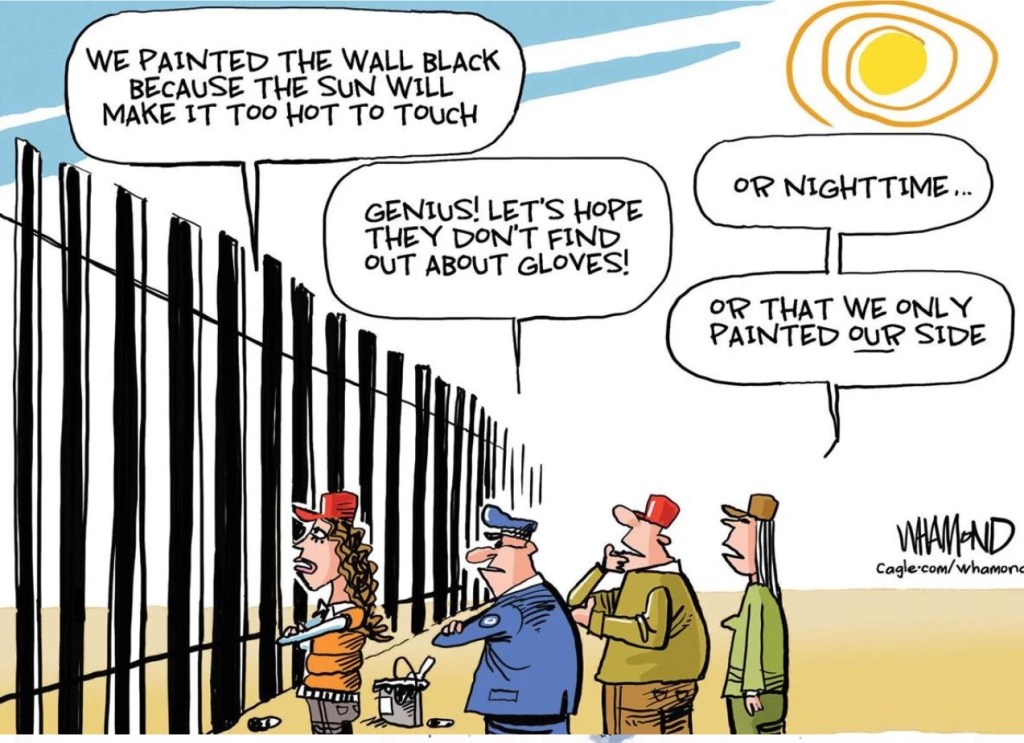
Painting the wall black is the latest masterstroke of genius from the “build the wall” crowd—a cosmetic fix masquerading as policy. Apparently, the idea is that slapping a coat of black paint on steel slats will magically turn it into a super deterrent, a wall so menacing and ominous that people will simply stop attempting to cross it. Of course, the first wall itself accomplished exactly nothing. It didn’t halt immigration, it didn’t end smuggling, and it didn’t solve the root causes that push people to come here. What it did do was create a very expensive, very symbolic photo op—steel and concrete as political theater.
Now, Christie Noem and the MAGA architects of this plan want to double down with Sherwin-Williams authoritarian chic. Painting it black is supposed to make it hotter in the sun so that migrants won’t touch it, or maybe it’s supposed to look scarier on Fox News drone shots. Either way, it’s a band-aid painted in asphalt gloss on the gaping wound of failed immigration policy. The original wall created more ladders, more tunnels, and more desperation. This will create, at best, slightly more blistered hands—and the exact same result: not a damn thing.
The wall was never a real solution; it was always a campaign prop, a chant to rally the faithful. Painting it black is just the sequel nobody asked for—a lazy metaphor for the emptiness of the policy itself. Like the wall before it, this will be nothing more than a costly monument to futility. Because at the end of the day, immigration isn’t stopped by barriers or paint jobs—it’s addressed with policy, diplomacy, and humanity. But those don’t make for catchy slogans. Black paint, apparently, does.
-
Hemp #1
Dwain Northey (Gen X)
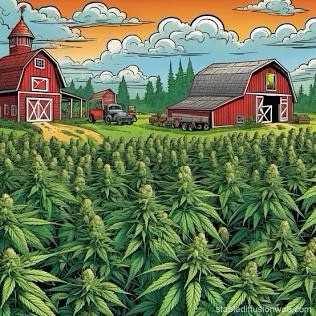
For decades, the word “hemp” conjured images of stoner stereotypes, Bob Marley posters, and a cloud of suspicion from anyone in a suit. Meanwhile, the actual plant sat in the corner of history, raising its hand like the quiet kid in class who knows the answer but is ignored. Now, in the middle of a so-called green revolution, we’ve suddenly remembered: oh right, hemp isn’t just about THC and joints—it’s about survival.
This is not discovery. This is rediscovery, with a touch of sheepishness. Long before hemp was outlawed into obscurity, it was one of civilization’s favorite multi-tools. Builders mixed it into walls, sailors relied on it for ropes and sails, and farmers knew it was a crop that grew fast, needed little pampering, and gave back more than it took. Then, thanks to the chemical industry and some paranoia about its psychoactive cousin, hemp was demonized into exile. We paved paradise, burned oil, and forgot the plant that could’ve helped us all along.
Take hempcrete. Today’s architects and engineers treat it like the hot new eco-material, yet medieval Europeans were already using hemp-lime mixtures to build walls that resisted fire, pests, and decay. Hempcrete doesn’t just sit there—it actively absorbs carbon dioxide as it cures. Concrete, by contrast, is a climate villain, responsible for up to 8% of global CO₂ emissions. Hempcrete says, “hold my stalks, I’ll fix that.” And still, we act like we’ve stumbled on some magical innovation rather than simply picking up where our ancestors left off.
Or consider clothing. We fell head over heels for cotton, a thirsty diva of a crop that demands pesticides and gallons upon gallons of water. Meanwhile, hemp just grows—sturdy, low-maintenance, and producing fibers that are stronger and more durable than cotton. It was once the backbone of maritime empires: ropes, sails, uniforms. Today, it’s sustainable fashion’s “latest trend,” when in fact it’s a centuries-old standard we rudely ghosted.
And let’s not forget Henry Ford. Nearly a hundred years ago, he unveiled a car with a hemp-based body and designed it to run on hemp biofuel. That’s right—before Teslas, before “sustainable mobility,” there was Ford swinging a mallet at a hemp composite panel to show off its strength. But Big Oil wasn’t about to let some plant upstage its empire, so hemp went into hibernation while we built a society addicted to fossil fuels. Now, as we scramble for greener cars, we’re rediscovering what Ford already knew: hemp had the answers all along.
The rediscovery of hemp is humbling, but it’s also instructive. If hemp could sit ignored for decades while its benefits were obvious, what other plants are hiding in plain sight? Kenaf could replace plastics and paper. Bamboo might be the steel of tomorrow. Algae could be fuel, food, and climate salvation all at once.
The truth is, the green revolution isn’t about innovation—it’s about amnesia. We’re not inventing our way into sustainability. We’re crawling back to ideas we once abandoned, embarrassed that the solutions were growing in our fields the whole time. Progress, it turns out, might just mean rediscovering the wisdom we were too arrogant to remember.
-
Jingling keys
Dwain Northey (Gen X)
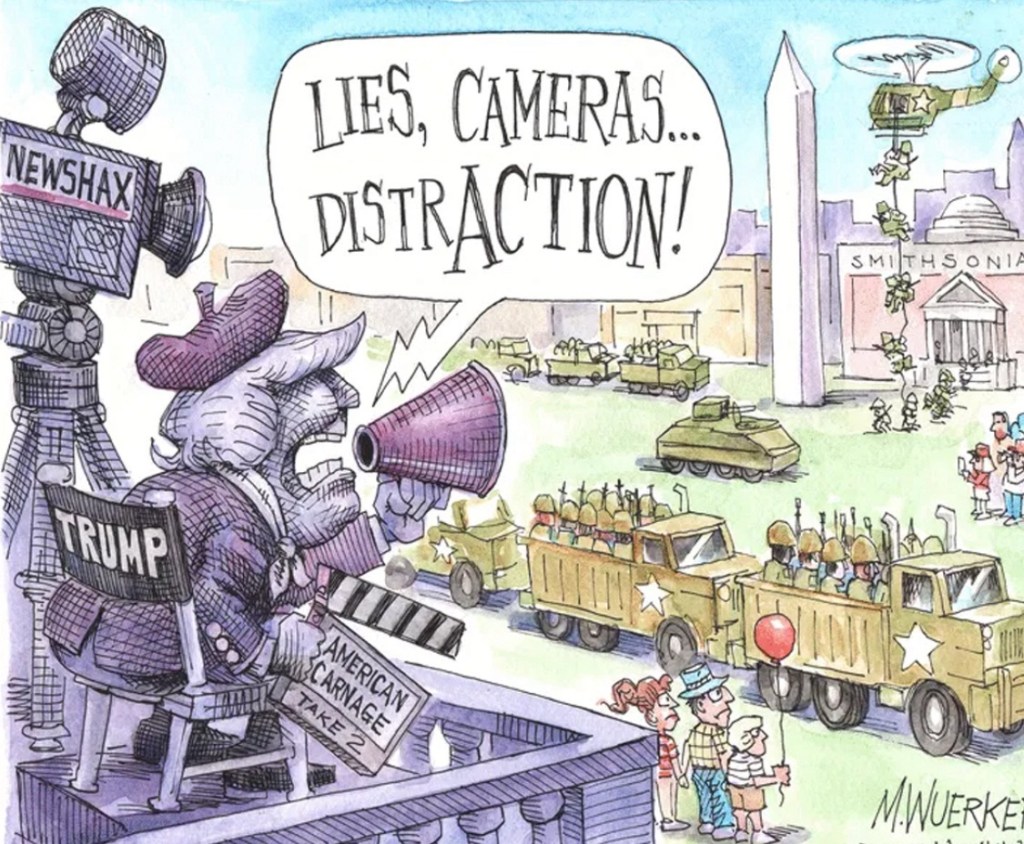
The American media circus is in town again, and as always, the clowns are working overtime. A shooting in Minnesota should spark conversations about the insanity of our gun laws, but no, that would be too real, too uncomfortable, too close to the bone. Instead, the headlines scream: the shooter was trans. Ah yes, of course—because identity is more important than the fact that bullets were flying in yet another public space where families should’ve been safe. Forget gun reform. Forget the endless body count. Let’s reduce a human tragedy into a culture war sideshow, complete with talking heads foaming at the mouth, because nothing distracts quite like a fight about gender. It’s red meat for the audience, and they’ll chew it right up.
And then, as if the distraction wasn’t theatrical enough, we get RFK Jr. making the rounds with his science fair word salad. He drops “mitochondria” into a speech like he’s auditioning for Jeopardy!—as though the word itself proves he’s smarter than every virologist, epidemiologist, and doctor who ever walked the Earth. His followers nod in awe, dazzled by the syllables, convinced that if you can pronounce “mitochondria,” you must be the rightful steward of their health decisions. Never mind the years of debunked nonsense trailing behind him like toilet paper stuck to a shoe. He’s figured out the trick: sound smart to people who don’t know better, and you’re suddenly a prophet. It’s not education; it’s manipulation. He’s basically the guy at the bar who says “quantum physics” three times and walks out with your wallet.
This is nothing new. Dickens would laugh himself sick at how familiar it all looks. In David Copperfield, the street urchins dance and sing, pulling focus while the real theft happens quietly in your coat pocket. Fast forward a couple hundred years, and the same act is playing on every screen in America. Only instead of scrappy kids, we’ve got cable news producers and politicians running the con, making sure your outrage is pointed anywhere except at them. While you’re yelling about bathrooms or “cancel culture,” your paycheck, your healthcare, and your democracy are being siphoned away, drip by drip.
And in the middle of it all, there’s Donald Trump, stumbling through speeches, forgetting names, mistaking countries, and clearly showing signs of decline. But God forbid anyone in the media actually call it what it is. No, they’re already rehearsing the spin. When he finally keels over, some sycophantic “doctor” will emerge from Mar-a-Lago with a press release claiming he was healthier than an Olympic decathlete, destined to live until the year 3000, and therefore his demise must have been murder most foul. Cue the conspiracy theories, cue the martyrdom, cue the endless distraction machine grinding into overdrive.
Meanwhile, the real crises—climate collapse, wealth inequality, corruption so thick you could bottle it—get buried under the noise. And that’s the whole point. We’re the dupes in the carnival, dazzled by the flashing lights while our pockets are being emptied. If Dickens were alive, he’d recognize the scam in an instant. The difference is that his marks eventually figured it out. We? We’re still staring at the shiny distraction, swearing it’s the main event.
-
When…!!
Dwain Northey (Gen X)

What kind of grotesque nation have we become when children are gunned down in their classrooms and our leaders respond with “thoughts and prayers” as if platitudes were bulletproof vests? This is not Gaza. This is not Falluja. These are not war zones, yet America tolerates daily carnage on its streets, in its churches, in its schools. We tolerate it because cowards in suits—politicians bought and paid for by the gun lobby—decided long ago that campaign donations matter more than children’s lives.
Let’s say it clearly: the United States is the only developed country where mass shootings are routine. Not occasional. Routine. Our children practice active shooter drills as often as fire drills. Imagine telling a child in France or Japan or Australia to duck under their desk because a gunman might storm their classroom at any moment. They’d look at you like you were insane. And they’d be right. Other countries have mental illness. Other countries have violent media. Other countries even have guns. But only America has leaders so spineless, so morally bankrupt, that they let an entire generation grow up with the expectation that they may die at school.
The excuse-makers are relentless. “It’s a mental health crisis.” “It’s video games.” “It’s broken families.” Wrong. This is a gun crisis, engineered and sustained by politicians who cower before the NRA and its blood-soaked checkbook. They wring their hands, weep crocodile tears on camera, and then turn around and block even the mildest reforms—background checks, red flag laws, limits on weapons of war—because doing the right thing would cost them their next campaign ad buy.
Every mass shooting is not just a tragedy; it is a political choice. It is the choice of senators who block legislation. It is the choice of representatives who parrot gun lobby talking points. It is the choice of governors who sign laws making it easier, not harder, for unstable individuals to carry assault rifles in public. When they stand in front of cameras after the next massacre and say, “This is not the time to talk about policy,” what they mean is: “This is not the time to threaten my donor pipeline.”
And while they posture, parents bury children. Survivors carry scars you cannot see. Teachers prepare to throw themselves in front of bullets because adults in charge refuse to do their jobs. America is not exceptional in this. America is deranged.
We must stop pretending this is some unsolvable riddle. Australia acted after one mass shooting. New Zealand acted. Britain acted. Meanwhile, America buries its dead and shrugs. The Second Amendment was not intended as a suicide pact, but that’s exactly how our leaders interpret it—every gun sale sacred, every coffin of a child expendable.
This isn’t freedom. It’s a moral collapse. It’s national rot. Until we decide that the lives of children matter more than the profits of gun manufacturers and the cowardice of politicians, we will continue to live in a country where schools resemble combat zones. And the blood on the floor isn’t just from the bullets—it’s on the hands of every lawmaker who looked at this epidemic and chose money over life.
-
Poison Pen
Dwain Northey (Gen X)

I am sorry that I keep venting about the Orange Menace but his BS has taken up residence in my rage meter.
Mango Mussolini fancies himself a dictator, but let’s be honest — if he’s a dictator, then Chuck E. Cheese is fine dining. This is not a man with the discipline of a Stalin or the cunning of a Putin; he’s more like a bloated mascot in a polyester suit, waddling around screaming “Respect my authority!” while his handlers frantically swap out cue cards. The only iron fist he has is the one he uses to clutch a Big Mac.
He signs executive orders with the flourish of a monarch, convinced his Sharpie is a royal scepter. Every signature becomes, in his mind, a commandment etched in gold: “Thou shalt not burn the flag. Thou shalt praise Dear Leader. Thou shalt watch Fox News or face eternal damnation.” Of course, the Supreme Court already settled the flag issue decades ago, but why let precedent stand in the way of Mango Mussolini’s royal decrees? He doesn’t read court rulings; he barely reads menus.
And yet, for all his cosplay as America’s Mussolini, one has to ask: who’s actually in charge here? The Heritage Foundation writes policy binders thicker than his skull, Putin whispers sweet kompromat from Moscow, and Stephen Miller slithers out of his crypt each night to draft fresh xenophobic talking points. Mango Mussolini thinks he’s the puppeteer, when in reality he’s the orange sock puppet flopping around on stage. Picture him dangling on strings: “Build the wall!” says Miller. “Sanctions? What sanctions?” says Putin. “Destroy the EPA!” says Heritage. And there he goes, signing whatever lands in front of him like a toddler scribbling with crayons.
His idea of leadership is firing off tweets that ruin lives, demanding people be sacked simply for disagreeing with him. Dictators jail dissidents; Mango Mussolini rage-tweets them into unemployment. He mistakes petty cruelty for strength, tantrums for policy, and applause at rallies for global legitimacy. He is, at best, a dictator LARPing in a poorly fitted suit. At worst, he’s a hollow marionette who thinks the strings yanking him around are actually his own muscles.
But here’s the problem: even a bad actor can burn the stage down. Every executive order he scribbles, every unconstitutional stunt he attempts, every hissy fit disguised as policy leaves dents in the foundation of democracy. He doesn’t need competence to cause chaos; chaos is his brand. Mango Mussolini is like a wrecking ball that thinks it’s Michelangelo.
So no, he’s not a dictator. He’s not even capable of being one. Real dictators are terrifying; Mango Mussolini is absurd. But absurdity with power is still dangerous. He’s the carnival barker who stumbled into the Oval Office, the marionette who thinks he’s Caesar, the orange-tinted Mussolini knockoff whose ego is bigger than his IQ. And yet, through sheer volume, vanity, and venom, he’s managed to drag the country into his sideshow act.
The tragedy? The world is forced to sit through it — a dictator cosplay gone horribly, stupidly, dangerously wrong.


You must be logged in to post a comment.