Well, folks, I suppose we can finally stop wondering what could possibly go wrong.
The Senate has now confirmed Donald Trump’s former personal defense attorney, Todd Blanche, as the Attorney General of the United States. Because apparently when you’re trying to convince the country that the Department of Justice is completely independent from the president, the obvious solution is to put the president’s former lawyer in charge of it.
What could possibly go wrong?
Blanche wasn’t merely some random lawyer who happened to cross paths with Donald Trump once at a cocktail party. He was Trump’s personal attorney. He represented him in criminal matters. He was part of Trump’s legal defense team.
And now he is the nation’s top law enforcement officer.
Let’s just sit with that for a moment.
The Attorney General is supposed to be the lawyer for the United States of America—not the lawyer for Donald Trump. The distinction is rather important. In fact, it is the entire fucking point of having a Justice Department that is supposed to operate independently of the White House.
But apparently we have decided that distinction is just unnecessarily complicated.
The Senate confirmed Blanche 50–49, with the vote taking place in the early morning hours as the Senate was preparing to leave for recess. (Le Monde.fr)
Because nothing says “we are completely comfortable with this decision” quite like holding the vote while most of America is asleep.
It has the unmistakable aroma of a legislative version of quietly sneaking out of the house after curfew.
“Hey, everybody! Nothing to see here! We’re just confirming the president’s former personal lawyer to run the entire federal law-enforcement apparatus at four in the morning. Go back to sleep.”
And before somebody tells me this is an unfair comparison, let me explain the comparison I’m making.
This isn’t about whether Todd Blanche is personally competent as a lawyer. It isn’t even necessarily about whether he is a good person. It is about the fundamental conflict created when the president’s former personal attorney becomes the person responsible for overseeing investigations involving that same president.
That is precisely why recusal rules and ethical independence matter.
In fact, Blanche had previously been advised by Justice Department ethics officials that he should recuse himself from matters involving Trump. (Senator Schiff)
And now the guy who was supposed to recuse himself from Trump’s cases is running the entire department that handles those cases.
That is not exactly what I would call a reassuring organizational chart.
And this is where the comparison to Roy Cohn becomes difficult to ignore.
Cohn was famous for operating as Donald Trump’s mentor, fixer and personal attorney, and for treating the machinery of government as something to be manipulated on behalf of his clients and allies.
The Attorney General is supposed to be the exact opposite of that.
The Attorney General is supposed to be the person who can look the president in the eye and say:
No.
Not “No, sir, because the polling isn’t good.”
Not “No, sir, because the Senate might get upset.”
Not “No, sir, because Fox News might have a problem with it.”
No, because the law doesn’t allow you to do that.
That is the job.
And that is precisely why the Senate’s decision matters.
Because if the president can install his personal lawyer as the nation’s chief law-enforcement officer, the question isn’t merely whether the DOJ has been politicized.
The question becomes whether we are redefining what the DOJ is for.
Is it still an institution whose responsibility is to enforce federal law regardless of who happens to occupy the Oval Office?
Or is it becoming the president’s legal department—with a few million employees, guns, prosecutors, grand juries and federal prisons attached?
Because those are two very different things.
And here’s the part that really makes my Gen-X bullshit detector start screaming:
We’ve spent decades hearing Republicans lecture everyone about the importance of law and order.
Law and order.
Law and order.
Law and order.
Apparently the slogan has now been updated to:
Law and order, provided the order comes from the guy in charge.
The irony is almost too perfect.
The people who spent years screaming about Hillary Clinton’s emails, Hunter Biden’s laptop, Benghazi, FBI investigations, congressional investigations and the supposed weaponization of government are now apparently perfectly comfortable with putting the president’s personal lawyer in charge of the Justice Department.
Because apparently government weaponization is only terrifying when the other team has the weapon.
When it’s your guy holding it?
Well, that’s different.
That’s patriotism.
That’s leadership.
That’s probably just “draining the swamp,” somehow.
And before anyone accuses me of declaring that the weaponization of the DOJ is now legally or factually “complete,” let me be precise: that is my characterization of what this appointment represents. But the concern isn’t imaginary. Blanche’s confirmation has already been described by critics as a major threat to the traditional independence of the Justice Department, particularly because of his previous role as Trump’s personal lawyer. (The Guardian)
So congratulations, America.
We have apparently reached the stage where the person who used to defend the president can now decide who gets investigated by the federal government.
And they held the vote in the middle of the damn night.
What could possibly go wrong?
Honestly, at this point, I’m afraid to ask.
Because every time we do, somebody in Washington seems to interpret it as a fucking challenge.
If your future self could send you one sentence, what do you hope it would say?
My future self would probably be just as sarcastic as I am so I probably wouldn’t have anything really good to say than well. I guess that didn’t work try again.
What’s the best local dish you’ve ever eaten while traveling?
I can’t say that I’ve had an amazing dish when I’ve traveled. I have traveled. I’ve seen a lot of places. I’ve had good schnitzel in Germany. I’ve had good wine cheese and baguettes in France. Great pasta in Italy, fish and chips in England. Any number of jerked meats or dishes in Jamaica beignets in New Orleans very good Atlantic seafood in Nova Scotia or Pacific seafood in the upper Northwest, but I can’t say that it’s something that marked the trip I’m just as happy to have a cup of coffee in a diner or outside with conversation that’s far more important than the food. I don’t live to eat I eat because I have to.
This is my opinion, and I want to make that distinction clear because apparently in 2026, having an opinion that doesn’t come with a government-issued talking point is becoming an act of rebellion.
I have come to believe that the current Republican Party—or the Trump Republican Party, MAGA, whatever branding we’re using this week—has developed something that looks an awful lot like political Stockholm syndrome.
Not literally, of course. I’m talking about the psychological dynamic where someone becomes so accustomed to intimidation, threats, punishment, and control that eventually they begin defending the person doing the intimidating, threatening, punishing, and controlling.
And honestly, what could be more useful to an authoritarian than that?
You don’t necessarily need everyone to love you.
You just need them to become afraid enough of what happens if they stop loving you.
That’s a very different thing.
There is a familiar metaphor for this: the abused spouse who learns to navigate the household by avoiding the next explosion.
“I’ll make dinner. I’ll keep my mouth shut. I’ll tell you you’re right. I’ll do whatever you want. Just don’t hit me again.”
Eventually, survival starts looking like loyalty.
And that’s what I see happening with a significant portion of today’s Republican Party.
Again, that’s my opinion. I’m not claiming that every Republican is an authoritarian, that every Trump supporter is abused, or that political disagreement is somehow equivalent to domestic violence. I’m talking about a behavioral dynamic that, from where I sit, increasingly resembles the psychology of someone who has learned that obedience is the safest option.
Trump doesn’t have to convince them that everything he does is good.
He only has to convince them that everything he does is preferable to whatever he tells them is waiting on the other side.
Immigrants.
Democrats.
Socialists.
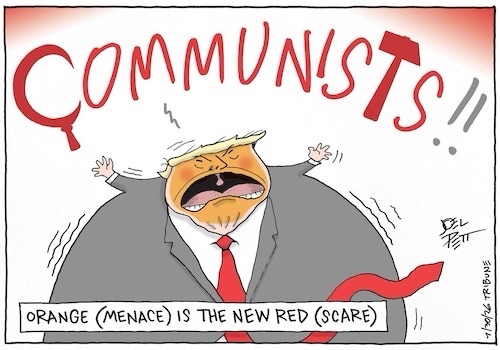
“Communists.”
The “deep state.”
The media.
Universities.
Scientists.
Teachers.
Minorities.
LGBTQ Americans.
Anybody who can be turned into the next existential threat.
Fear becomes the currency.
And once fear becomes the currency, the person who claims to be the only one capable of protecting you suddenly becomes indispensable.
That’s one of the oldest tricks in the authoritarian playbook.
Create the threat.
Amplify the threat.
Convince people that only you can save them from the threat.
Then make obedience the price of protection.
And suddenly people aren’t asking, “Is this person behaving like a democratic leader?”
They’re asking, “What do I have to do so he doesn’t turn on me?”
That’s not patriotism.
That’s survival instinct.
And here’s the particularly bizarre part: some people will actually defend the person frightening them because admitting they’ve been manipulated is psychologically painful.
Nobody wants to look in the mirror and say, “Holy shit. I’ve been defending the guy who has been making me afraid.”
It’s much easier to say, “No, he’s fighting for people like me.”
So the abuse gets rationalized.
The threats become jokes.
The cruelty becomes strength.
The lies become “owning the libs.”
The corruption becomes “draining the swamp.”
The attacks on institutions become “taking back our country.”
And every time the behavior becomes more extreme, the rationalization has to become more extreme right along with it.
It’s a psychological treadmill.
And eventually, you aren’t even running because you believe in where you’re going.
You’re running because you’re terrified of stopping.
I’ve never been a Republican. But I’ve always liked to think for myself, and that’s precisely why this bothers me.
I don’t care whether someone is Republican, Democrat, independent, conservative, liberal, socialist, libertarian, or politically undecided. Nobody should surrender their capacity for independent thought to a political personality.
Democracy requires citizens who can look at their own side and say, “You’re wrong.”
That’s the whole damn point.
Your political party isn’t your spouse.
Your president isn’t your parent.
Your political movement isn’t a religion.
And your vote isn’t a blood oath.
If your guy does something terrible, you don’t have to invent a reason why it’s actually wonderful because he’s your guy.
You can simply say:
“That’s wrong.”
It shouldn’t be revolutionary.
Yet here we are.
And I think something interesting is happening beneath all the noise.
People are waking up.
Maybe not all at once. Maybe not dramatically. Maybe not with some Hollywood moment where everybody suddenly drops their MAGA hat in the rain and realizes they’ve been living in a political cult.
Real life doesn’t work that way.
Trauma doesn’t disappear because somebody finally recognizes it.
But little by little, people are beginning to recognize the pattern.
They’re recognizing the constant outrage.
The constant enemy.
The constant emergency.
The constant demand for loyalty.
The constant insistence that criticism is betrayal.
The constant shifting of the goalposts.
And eventually somebody starts asking the most dangerous question an authoritarian can hear:
“Wait. Why am I afraid of my own government?”
That’s when the spell starts to break.
Because authoritarianism ultimately depends on people believing that resistance is more dangerous than obedience.
And the moment enough people decide that obedience has become more dangerous than resistance, the equation changes.
That’s why I don’t think this is permanent.
I’m not a Republican.
I never have been.
But I’m an American, and I don’t want to live in a country where half the population has been psychologically conditioned to believe that keeping the powerful happy is the same thing as keeping the country safe.
I don’t want a political system where the objective is simply to avoid getting hit again.
I want citizens who don’t have to negotiate with power like an abused spouse negotiating with an angry partner.
“I’ll make dinner. I’ll stay quiet. I’ll tell you you’re right. Just please don’t hurt me.”
No.
That’s not freedom.
That’s compliance.
And compliance is not democracy.
Maybe the most patriotic thing any American can say to their own political party is:
“No. You’re wrong.”
Even when it’s your guy.
Especially when it’s your guy.
Because if you have to surrender your conscience to keep your political tribe happy, you’ve already surrendered the one thing democracy was supposed to protect in the first place:
Every once in a while, I try to explain racism to someone who genuinely seems unable to understand what the problem is with it.
And honestly, I don’t know how to do it without making my own fucking head hurt.
So let’s try something completely ridiculous.
Not because the subject is funny, but because sometimes the only way to explain an irrational idea is to construct an equally irrational one and follow it all the way to its logical conclusion.
Imagine that tomorrow morning, humanity collectively decides that eye color determines human worth.
Not personality.
Not character.
Not intelligence.
Not what you’ve accomplished.
Your fucking eyes.
And because green eyes are among the rarest eye colors in the world, we decide that green-eyed people are obviously the superior form of humanity.
Why?
Because they’re rare.
And apparently, in this hypothetical universe, rarity equals superiority.
Congratulations.
We have invented Eye Color Nationalism.
Green eyes are now the gold standard.
If you’re green-eyed, you’re automatically considered intelligent, trustworthy, sophisticated, beautiful, hardworking and morally superior.
Nobody has actually tested any of this.
There are no studies proving it.
There is no scientific basis for it.
But look at those eyes!
They’re green!
Clearly, God, evolution, or some mysterious cosmic accounting department has selected these people for greatness.
Brown eyes?
Too common.
Blue eyes?
Nice try.
Hazel?
Confusing.
Gray?
Suspicious.
Green?
Ah. The master race.
And now we build an entire society around this completely arbitrary characteristic.
Green-eyed people get the best schools.
They get preferential treatment when applying for jobs.
They get the nicest neighborhoods.
They get more political representation.
When a green-eyed person commits a crime, everyone says, “Well, that was an individual.”
When a brown-eyed person commits the same crime, suddenly we’re having a national conversation about the behavioral tendencies of brown-eyed people.
See how quickly this becomes insane?
Now imagine that we start teaching children this nonsense.
Generation after generation grows up hearing that green-eyed people are superior.
Eventually, green-eyed people begin to believe it.
Some become genuinely convinced that their green eyes are evidence of superior intelligence.
Others become convinced that brown-eyed people are naturally lazy.
Blue-eyed people are supposedly emotional.
Hazel-eyed people can’t be trusted.
And gray-eyed people are apparently communists.
Nobody remembers where these beliefs came from anymore.
They’re just traditions.
They’re part of the culture.
They’re what we’ve always believed.
Then somebody finally asks:
“Wait a minute. Why are green-eyed people superior?”
And the answer is:
“Because they’re green-eyed.”
“Okay, but what does that have to do with their intelligence?”
“They’re green-eyed.”
“What does it have to do with their character?”
“They’re green-eyed.”
“What does it have to do with whether they’re a good person?”
“They’re green-eyed.”
“Can you prove any of this?”
“Well, look how many successful green-eyed people there are.”
And now we’ve arrived at the really interesting part.
Because if green-eyed people have spent generations receiving better schools, better jobs, better housing, better healthcare, better opportunities and greater social acceptance, eventually you’re going to be able to point to those outcomes and say:
“See! Green-eyed people really are more successful.”
No shit.
You’ve been stacking the fucking deck for them.
That’s not evidence of inherent superiority.
That’s evidence that opportunity produces results.
And here’s where the thought experiment gets even more absurd.
Imagine two newborn babies.
They are born on the exact same day.
They have healthy brains.
They have the same potential.
Neither has committed a crime.
Neither has done anything good or bad.
Neither has demonstrated intelligence, laziness, courage, cowardice, honesty, dishonesty, kindness, cruelty, ambition or apathy.
They are fucking babies.
Now imagine that one baby has green eyes and the other has brown eyes.
And somebody looks at those two infants and says:
“I already know something important about these human beings because of the color of their eyes.”
No.
You don’t.
You know what color their eyes are.
That’s it.
You haven’t discovered their personality.
You haven’t unlocked their IQ.
You haven’t examined their moral character.
You haven’t received a divine notification informing you of their future behavior.
You know what color their fucking eyes are.
Yet somehow humanity has repeatedly taken completely arbitrary physical characteristics and tried to turn them into hierarchies of human beings.
And here’s the part that should make anybody’s brain hurt:
What if we reversed the colors?
What if tomorrow we decided brown eyes were the rare and desirable ones?
Suddenly brown-eyed people are exceptional.
Blue-eyed people are suspicious.
Green-eyed people are overrated.
And every argument we previously made about the inherent superiority of green eyes suddenly becomes applicable to brown eyes.
The biological reality didn’t change.
The people didn’t change.
The eye colors didn’t change.
Only the story we told ourselves about them changed.
And that’s the point.
**The hierarchy was never actually contained in the eye color.
We put the hierarchy there.**
That’s what makes racism so profoundly fucking stupid.
Human beings take a visible characteristic—skin color, ancestry, facial features, whatever—and attach a completely unrelated set of assumptions to it.
Then we spend centuries defending those assumptions as though they’re laws of physics.
But skin color doesn’t contain a personality.
It doesn’t contain a work ethic.
It doesn’t contain an IQ score.
It doesn’t contain morality.
It doesn’t contain criminal intent.
It doesn’t contain kindness.
It doesn’t contain courage.
It doesn’t contain ambition.
It doesn’t contain the contents of someone’s fucking soul.
It’s a biological characteristic.
That’s it.
Just like eye color.
And here’s another thing that people sometimes miss.
Even if you could demonstrate a statistical difference between two enormous populations—and that conversation would require considerably more nuance than a fucking meme—you still haven’t told me anything meaningful about the individual standing in front of you.
If I tell you that men are, on average, taller than women, that doesn’t mean every man is taller than every woman.
If I tell you one population has a particular statistical characteristic, that doesn’t give you permission to assign that characteristic to every individual member of that population.
That’s called stereotyping.
And we already understand this concept.
We understand it perfectly when it applies to almost everything else.
We don’t look at a random person and say:
“You’re from Arizona, therefore I know your personality.”
We don’t look at someone wearing a baseball cap and say:
“Ah. I have determined your entire moral character.”
We don’t meet a 6-foot-4 man and immediately conclude:
“Obviously, this man is good at basketball.”
Because that would be fucking stupid.
Yet somehow, when it comes to race, human beings have repeatedly decided that this is an acceptable shortcut for understanding other human beings.
And then we get offended when somebody points out that the shortcut is bullshit.
Racism is essentially the intellectual laziness of replacing a human being with a category.
Instead of learning who someone actually is, you decide you already know.
Instead of judging an individual by their behavior, you judge them by their ancestry.
Instead of asking, “What kind of person is this?” you ask, “What category does this person belong to?”
Congratulations.
You’ve replaced a human being with a filing system.
And what makes this even more absurd is that none of us chose the characteristics we’re supposedly being judged by.
Nobody walked into the delivery room and said:
“Excuse me, doctor. I’d like to order the melanin package, please.”
Nobody selected their parents.
Nobody selected their ancestry.
Nobody selected the geographic location of their ancestors thousands of years ago.
Nobody picked their genetic lottery numbers.
And yet we’re perfectly willing to construct elaborate hierarchies around things people never had the opportunity to choose.
That isn’t meritocracy.
That’s assigning people grades for an exam they weren’t allowed to study for and didn’t even know they were taking.
And if your response is, “Well, my group is better,” I have a very simple question:
Better at what?
And according to whom?
And based on what?
Because the moment you start answering those questions, you eventually discover that you’re not really talking about race anymore.
You’re talking about culture.
Economics.
History.
Geography.
Education.
Opportunity.
Family.
Environment.
Politics.
Individual behavior.
And suddenly we’ve arrived at the uncomfortable truth:
People are complicated.
Which is precisely why racism is so attractive to people who don’t want to deal with that complexity.
Racism gives you a shortcut.
It allows you to take billions of individual human beings and shove them into a handful of boxes.
Good box.
Bad box.
Smart box.
Dangerous box.
Deserving box.
Undeserving box.
It’s wonderfully convenient.
It’s also fucking stupid.
Because human beings are not categories.
They’re human beings.
There are brilliant people and idiots in every population.
There are saints and assholes in every population.
There are criminals and doctors, heroes and cowards, geniuses and morons, generous people and selfish people in every imaginable demographic.
The distribution of human character does not conveniently stop at the boundaries of someone’s skin color.
And perhaps that’s the part that makes my head hurt the most.
If racism were actually some brilliant system for identifying human worth, you might at least understand why someone would be tempted by it.
But it isn’t.
It is an extraordinarily primitive attempt to make an impossibly complicated world easier to understand.
And the price of that simplicity is treating actual human beings as abstractions.
So if you genuinely don’t understand why racism is a bad idea, try this:
Imagine waking up tomorrow and discovering that your eye color determines your place in society.
Imagine being told you’re inferior because your eyes aren’t green.
Imagine watching someone with green eyes receive opportunities you never received.
Imagine being told that the statistical differences created by that system prove green-eyed people are naturally superior.
Imagine being judged before you speak.
Imagine being distrusted before you do anything.
Imagine someone deciding you’re inferior before they’ve learned your name.
Imagine your accomplishments being discounted because of what you look like.
Imagine your failures being treated as evidence against millions of people who share your ancestry.
Imagine being told that the circumstances of your birth somehow constitute evidence about the quality of your character.
Then imagine somebody finally looking at the whole thing and saying:
“Wait.
This is fucking ridiculous.
They’re just eyes.”
Exactly.
They’re just eyes.
And skin is just skin.
We’re the ones who decided otherwise.
And if you can understand the absurdity of inventing a hierarchy based on eye color, then congratulations.
You already understand racism.
Because the fundamental problem isn’t that somebody picked the wrong color.
The fundamental problem is believing that a person’s physical characteristics give you permission to decide what kind of human being they are.
Rarity isn’t morality.
Scarcity isn’t virtue.
Genetics isn’t a résumé.
And the circumstances of your birth are not evidence of your worth.
We’re all just human beings who happened to be born with different combinations of genetic lottery numbers.
The truly insane part isn’t that we are different.
The truly insane part is that we looked at those differences and decided some people deserved to be treated as less human because of them.
That’s the part that should make all of our heads fucking hurt.
It would be nice day if schools actually taught critical thinking and financial literacy. I feel like when I was in school you had to critically think now everything is standard night tests, which don’t teach you to think at all they teach how to take tests and how to be a robot but I wish they would teach these kids how to actually think for themselves.
I’ve been listening to campaign ads lately, and apparently we have reached a point in American politics where being against masks is considered a qualification for public office.
I’m sorry, but as someone who spent years working in medical and hospital environments, I genuinely do not understand this one.
Of all the hills available to die on in American politics—taxes, healthcare, infrastructure, education, immigration, the economy, climate change, foreign policy, the national debt, or perhaps the small matter of keeping the government functioning—you picked masks?
You’re running for office and your big selling point is:
“I opposed masks.”
Congratulations?
Do you want a certificate?
Because here’s the thing that seems to have been lost somewhere between the campaign consultants and the Facebook memes: masks did not become a medical technology in March of 2020.
Hospitals were using them long before COVID existed.
Surgeons wear masks.
Dentists wear masks.
Nurses wear masks.
Doctors wear masks.
People working around infectious diseases wear masks.
People who are performing procedures where bodily fluids might be flying around wear masks.
And, remarkably, none of these people were doing it because the World Health Organization had secretly joined a global conspiracy to ruin your Fourth of July barbecue.
They were doing it because germs exist.
This is not exactly cutting-edge science.
So I would genuinely like to ask some of these candidates who are still proudly advertising their opposition to masks a very simple question:
Would you like your surgeon to wear one?
Because if your answer is yes, congratulations. You have just admitted that masks have a legitimate medical purpose.
Would you like your dentist to wear one while they are six inches from your face with a drill in your mouth?
Would you like the dental hygienist to wash their hands before sticking their fingers into your mouth?
Would you prefer the nurse drawing your blood to use a sterile needle?
Would you like the person inserting a catheter to understand the basic principles of infection control?
Would you like the medical staff handling an open wound to wash their hands?
Of course you would.
Nobody walks into a hospital and says, “Hey, before you operate on me, could everyone please remove their masks? I want to make sure we’re exercising our constitutional freedom from fabric.”
Because suddenly, when you’re the patient, infection control looks pretty damn reasonable.
And that’s what makes the political obsession with masks so strange.
There is a difference between debating the effectiveness, timing, enforcement, or appropriateness of a particular public-health policy and turning “I refused to wear a mask” into some sort of modern-day Medal of Honor.
You can argue about whether mandates were appropriate.
You can argue about whether particular restrictions went too far.
You can argue about whether governments communicated effectively.
Those are legitimate political and policy arguments.
But somehow we’ve turned basic infection-control equipment into a symbol of political oppression.
A piece of cloth became a culture-war battlefield.
And now, years later, politicians are still bragging about which side of the mask aisle they stood on as though they stormed the beaches of Normandy without a face covering.
I worked around medicine long enough to understand something very simple:
Healthcare workers don’t wear masks because they’re afraid of freedom.
They wear them because they understand that microscopic organisms don’t give a damn about your political ideology.
Viruses don’t vote Republican.
Bacteria don’t vote Democrat.
Influenza doesn’t check your voter registration before infecting your lungs.
And COVID certainly wasn’t sitting there thinking, “Oh hell, this guy voted for Trump. I better respect his personal liberty.”
That’s not how biology works.
And maybe that’s the bigger problem here.
We’ve become so accustomed to turning absolutely everything into a political identity that even basic medical precautions have become tribal symbols.
You don’t simply wear a mask anymore.
Apparently, you must declare what wearing a mask means about you as a human being.
Which is ridiculous.
Sometimes a mask is just a mask.
Sometimes washing your hands is just washing your hands.
Sometimes covering your mouth is simply a courtesy to the people standing next to you.
And sometimes the person who is about to stick a scalpel into your abdomen wearing a mask is actually a comforting thing.
Personally, I don’t want my surgeon making a political statement while operating on me.
I don’t need them standing over the operating table saying, “Ladies and gentlemen, I refused to wear a mask during COVID, and I’m proud of it.”
No.
I would prefer:
“I’ve washed my hands, sterilized my equipment, put on my mask, and I’m ready to operate.”
Because there comes a point when political posturing collides with common sense, and common sense usually wins.
So to all the politicians still proudly advertising their anti-mask credentials:
You don’t have to convince me that you’re tough because you refused to wear a piece of medical equipment.
I’d actually be much more impressed if you could demonstrate that you understand why medical professionals use it in the first place.
Because if your entire political identity can be summarized as “Nobody was going to tell me to wear a mask,” I have to wonder:
What exactly are you planning to accomplish after you’ve finished being angry at the surgical mask?
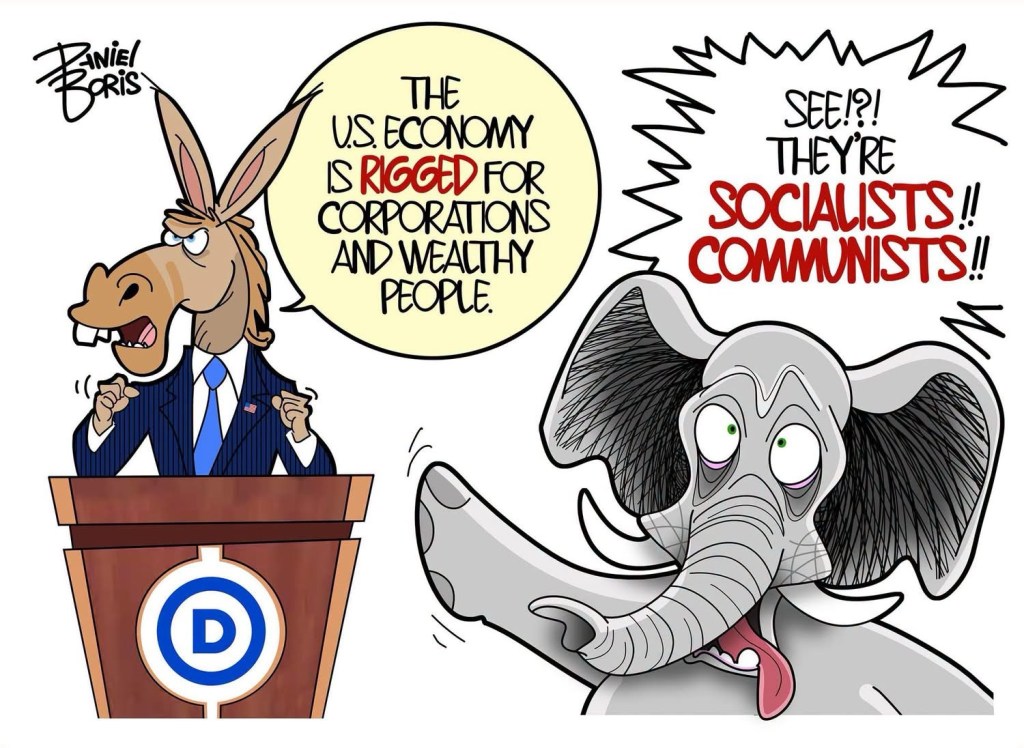
Watching the Republican Party resurrect the McCarthy-era Red Scare is like watching a band that hasn’t had a hit since the 1950s insist that this next tour is going to change everything.
According to Vice President J.D. Vance, Stephen Miller, and plenty of conservative commentators, Democrats aren’t just Democrats anymore. We’re socialists. And socialism, as everyone knows from the Republican cinematic universe, inevitably leads to communism. Then come the bread lines, government seizure of your lawn furniture, and your third grader comes home quoting Karl Marx instead of learning cursive.
It’s all very dramatic.
There’s just one tiny flaw.
The things they claim socialism will destroy are the exact things they’ve been trying to dismantle for years.
Public schools?
Republicans have spent decades pushing vouchers, privatization, charter expansion, and gutting the Department of Education. They’ve insisted public schools are failing while trying to redirect public money elsewhere. At the same time, they want schools to reflect their religious and cultural values while claiming everyone else is indoctrinating children.
So Democrats are supposedly going to destroy public education…
…by funding public education?
That’s certainly one strategy.
Police?
Every election cycle we’re told Democrats want to eliminate law enforcement. Yet many of the same Republicans warning about that are eager to slash federal spending, oppose grants to local governments, and reduce funding for programs they don’t like.
Healthcare?
They’ve spent years trying to repeal or reduce government healthcare programs while insisting Democrats are somehow the threat to your healthcare.
Government services?
Infrastructure?
Scientific research?
Environmental protection?
Every budget seems to feature another proposal to shrink, privatize, or eliminate programs that millions of Americans rely on.
Then they turn around and warn that Democrats are going to take those very programs away.
It’s like listening to the arsonist lecture everyone about fire safety.
And can we please have a conversation about the word “socialism”?
Apparently everything Democrats support is socialism.
Universal healthcare? Socialism.
School lunches? Socialism.
Libraries? Socialism.
Roads? Probably socialism.
At this rate, using a public restroom will require denouncing Che Guevara before you’re handed the key.
Meanwhile, I’d like to ask my proudly capitalist Republican friends one simple question.
What is insurance?
Seriously.
You’re required to buy auto insurance.
Many insist everyone should have health insurance.
Banks require homeowners insurance.
Businesses carry liability insurance.
Everyone pays into a giant pool of money.
Most people won’t use all of it.
Some people will need a lot of it.
The money from everyone helps cover the losses of the few.
Congratulations.
You’ve just described socialism.
The only difference is that instead of society benefiting, a corporation takes a profit off the top.
It’s socialism with shareholders.
Or, as I like to call it, for-profit socialism.
Somehow that’s perfectly acceptable.
Pooling risk so your neighbors don’t go bankrupt after a tornado? That’s apparently the free market.
Pooling tax dollars so every kid gets a decent education? Suddenly we’re one step away from the Soviet Union.
Make it make sense.
The irony is that conservatives already embrace collective responsibility whenever it benefits them.
They just object when the collection isn’t generating dividends for a corporation.
We socialize risk all the time.
Insurance.
The military.
Police.
Fire departments.
Social Security.
Medicare.
Public roads.
Air traffic control.
These are all systems built on the idea that everyone contributes because everyone benefits from living in a functioning society.
That’s not communism.
That’s called civilization.
The modern Republican strategy seems to rely on Americans having the political memory of a goldfish.
“We have to stop the socialists before they destroy public education!”
“…also we’d like to eliminate the Department of Education.”
“We have to stop them before they destroy government!”
“…government is the problem.”
“We have to stop them before they eliminate these public programs!”
“…which we’ve been trying to cut for the last thirty years.”
It’s difficult to fear someone stealing your house when the person warning you is already loading your furniture into their truck.
This isn’t really about socialism.
It’s certainly not about communism.
It’s about finding a convenient boogeyman so no one has to discuss policy. Calling someone a socialist is easier than explaining why schools need less funding. Calling someone a communist is easier than defending cuts to healthcare or scientific research.
It’s political Mad Libs.
Insert “socialist” wherever an actual argument should be.
For a movement that constantly warns us not to rewrite history, they’re awfully fond of recycling it.
The Cold War ended over three decades ago.
The Soviet Union no longer exists.
Joseph McCarthy is long gone.
Yet here we are, dusting off the same tired script and pretending that every Democrat is secretly plotting a Marxist revolution through school board meetings, wind turbines, and free school lunches.
What’s the best piece of advice you’ve ever received?
Probably the best advice I’ve ever been given and we’ve probably all been given it at some point, but it takes a while for it to sink into your head is when my dad told me when I was a teenager and it really didn’t sink until I was probably in my 30s that you’ll truly never move on as long as you continue to worry about what other people think about your actions or your decisions sometimes you just gotta mess up to move forward and you can’t always depend on somebody else’s unsolicited opinion to make that granted sometimes you do need other people’s input but on personal matters relationships whatever it is sometimes you just have to trust yourself and not worry about what your friend thinks or what your neighbor thinks, sir you know multitudes of other issues just don’t let that other persons personal take on what you’re doing whether it’s wasting your education or whatever it is just do what’s best for you as long as it’s not hurting somebody else that’s the best advice I was ever given.








You must be logged in to post a comment.