What’s a conspiracy theory you actually find believable?
Is for conspiracies go I’m pretty sure that there are actually groups that go back hundreds of years that have always been in power will continue to be in power because they have money and they can hide their agenda and you know the bushes being in Scullin bones and things like that are absolutely plausible
There is something almost beautifully absurd about the way our federal government has decided to define “service.”
Before diving in, it’s worth acknowledging an important reality that often gets lost in these comparisons: military service members and members of Congress operate in fundamentally different roles. One involves the possibility of physical danger, strict discipline, relocation, and legally binding orders that can place a person in harm’s way. The other involves legislative responsibility, policymaking, and governance in a civilian political system. Their responsibilities, risks, and compensation structures are not meant to be identical—and in many ways, they cannot be.
But here is where the comparison starts to bother me.
Take the typical young person who enlists in the Army, Navy, Air Force, Marines, or Space Force. They are often 18, 19, or 20 years old when they sign on the dotted line. Maybe they spend six years doing something absolutely essential but decidedly unglamorous—working behind a desk, processing paperwork, maintaining records, handling logistics, or doing any of the thousand administrative jobs required to keep the military functioning.
They may never fire a shot. They may never see combat. They may never come particularly close to a battlefield.
But they still signed a contract with the United States government.
They surrendered six years of their youth, accepted military discipline, gave up considerable personal freedom, and remained subject to being sent wherever the government decided they were needed.
They serve their six years.
Then what?
If they leave without a service-connected disability, congratulations! Here is your GI Bill. Maybe some education benefits. Maybe some other veterans’ benefits depending on the circumstances.
Thank you for your service.
Now let’s turn the telescope around.
Run for Congress.
Get elected to the House of Representatives.
Except there’s one little wrinkle in our comparison: the person running for Congress generally isn’t 18 years old.
They have to be at least 25 to serve in the House, and most members are considerably older than that when they first arrive. They have already had decades of life experience, education, careers, professional networks, and time to establish themselves.
So let’s make the comparison as fair as possible.
Imagine that young 18-year-old enlistee stays in the military for 20 years.
At 18, they put on a uniform.
At 20, they’re learning the job.
At 25, they’re a seasoned service member.
At 30, they’re an experienced noncommissioned officer.
At 35, they’re still serving.
And at 38?
They finally reach the point where they can say:
“I have given twenty years of my life to the United States military, and now I have earned my retirement.”
Twenty years.
Two decades.
Half the average American’s working lifetime.
Now take the other person.
Let’s say they don’t even get elected to Congress until they’re 32.
They serve six years.
At 38, they’re finished.
The military veteran has spent 20 years serving the government.
The politician has spent six.
Both are 38.
And yet their post-government trajectories can look remarkably different.
The military veteran walks away with a military retirement calculated from an enlisted pay scale.
The former member of Congress walks away with a congressional résumé that can open doors the enlisted veteran couldn’t even get through the lobby of.
That’s the part that makes me scratch my head.
The argument will inevitably be, “But Congress is a difficult job.”
Absolutely.
So is being a military member.
Congressional service carries enormous responsibility. Members deal with legislation, constituents, national policy, political pressure, public scrutiny, and the possibility of being voted out of office.
But here’s the absurdity:
The military doesn’t require you to be in danger for your service to count.
That administrative specialist sitting behind a desk is still subject to military law. They can be transferred. They can be deployed. They can be ordered into situations they didn’t choose. They don’t get to simply say, “You know what? I’m not really feeling Afghanistan this year.”
Their civilian counterparts can quit.
The enlisted member can’t just hand in a two-week notice.
And after six years, that 24-year-old veteran is suddenly expected to translate “military personnel specialist” into something a civilian corporation understands.
Meanwhile, the 38-year-old former congressman puts six years in Congress on the résumé and suddenly becomes an “experienced government affairs consultant.”
Funny how that works.
And let’s make the comparison even more uncomfortable.
The service member who joins at 18 and serves until 38 has given the government twenty years during the most formative decades of their adult life.
The person who gets elected at 32 and leaves at 38 has given the government six years.
Yet the six-year politician can potentially walk away with federal retirement benefits, continued access to federal healthcare programs, a substantial political network, and a résumé that can be worth a fortune in the private sector.
The military veteran has earned a pension through two decades of service.
The politician has acquired something arguably even more valuable:
connections.
The former congressman knows lobbyists.
Corporations know the former congressman.
Government agencies know the former congressman.
Other politicians know the former congressman.
And suddenly that six-year government employee is being offered a consulting contract worth more than the military retiree’s annual pension.
Again:
Funny how that works.
And this is where I think the conversation about “thanking veterans for their service” needs to become something more than a bumper sticker.
Because there is a profound difference between recognizing service and adequately rewarding sacrifice.
We have created a system where an 18-year-old can give the government twenty years of his life and still emerge financially behind someone who entered federal public service at 32, served six years, and left with a congressional résumé.
The young enlisted person gave the government their twenties.
Their thirties.
Their holidays.
Their weekends.
Their geographic freedom.
Their ability to make spontaneous decisions about where they wanted to live.
And potentially their physical health.
The politician gave the government six years.
Again, I’m not saying members of Congress don’t work hard.
I’m saying the scale of the commitment is wildly different.
And if we’re going to compare public servants, then let’s at least have the intellectual honesty to compare the entire package.
Not just the job.
The opportunity cost.
The years.
The restrictions.
The risk.
The retirement.
And most importantly, what happens after the government no longer needs you.
Because the military veteran gets a DD-214.
The congressman gets a résumé.
And in America, sometimes the résumé is worth considerably more.
Perhaps that’s the real irony.
We spend billions telling young people that military service is one of the noblest things they can do for their country.
And it is.
But maybe someday we should build a compensation system that reflects that nobility.
Because if an 18-year-old can give America twenty years and a 32-year-old politician can give America six, and the politician still walks away with the better long-term financial and professional deal, perhaps the problem isn’t that we’re failing to thank our veterans.
Perhaps we’re failing to value them.
There are two kinds of government service.
There is service to the government.
And there is service in government.
One gets you a DD-214.
The other can get you a pension, healthcare, a powerful résumé, a Rolodex full of influential people, and a second career explaining to corporations how government works.
And then we have the nerve to tell the kid who spent twenty years wearing the uniform:
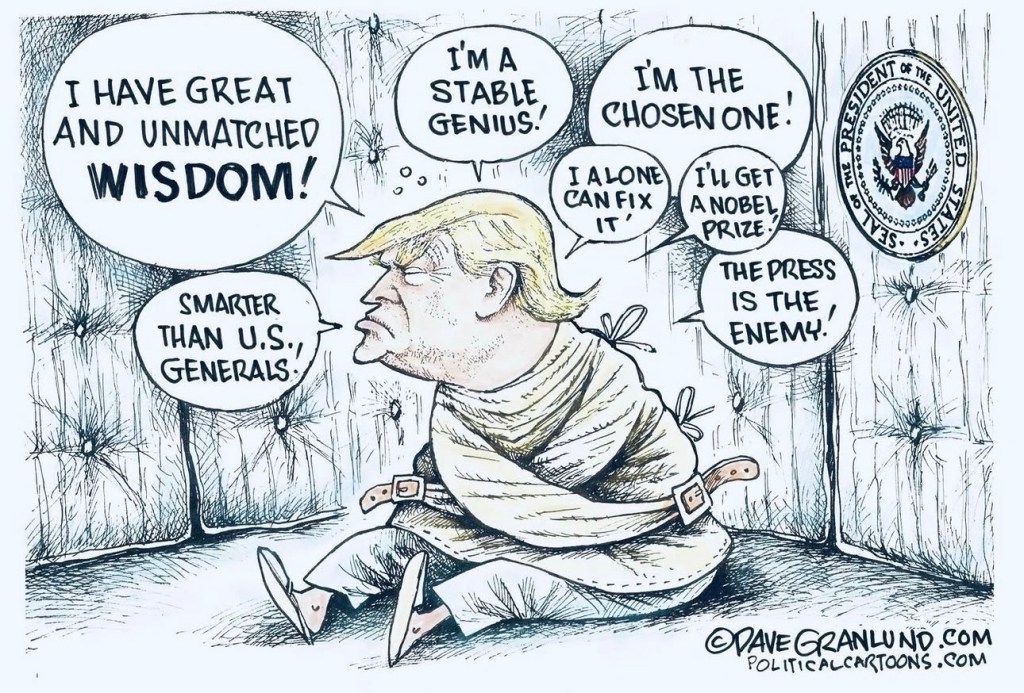
There is a peculiar superpower possessed by Donald John Trump that has nothing to do with nuclear weapons, tariffs, executive orders, or the ability to turn a press conference into a three-ring circus.
His superpower is the ability to be wrong without ever actually being wrong.
No matter what happens, somehow Donald Trump is either responsible for the success, the victim of someone else’s failure, or both simultaneously. If something goes well, he did it. If something goes badly, somebody else screwed it up. And if something goes catastrophically badly, well, clearly nobody understands just how brilliant the strategy was supposed to be.
It is a remarkable form of political physics.
The man appears to exist in a universe where accountability is subject to executive privilege.
And that becomes especially dangerous when you surround yourself with people whose careers, salaries, influence, and access to power depend upon telling you that you are doing a fantastic job.
Because eventually, you stop getting advice.
You start getting applause.
And that may be Trump’s greatest problem right now: he has too many toadies at his feet and not enough people willing to tell him that the emperor is, in fact, standing naked in the middle of Fifth Avenue.
The problem with sycophants isn’t merely that they flatter you. The real danger is that they become an information filter between you and reality.
They tell you the polls are wrong.
The generals are wrong.
The economists are wrong.
The journalists are wrong.
The allies are wrong.
The markets are wrong.
The protesters are wrong.
The voters are wrong.
And eventually, apparently, reality itself is wrong.
Meanwhile, Trump continues to take credit for virtually anything that can possibly be spun as a victory while treating failures as if they were delivered to his desk by some disgruntled intern.
That strategy works remarkably well in politics—until reality becomes too large to spin.
And that appears to be where we are now.
Look at Iran.
The administration entered this conflict promising strength, dominance, decisive action and, presumably, some version of the magical Trump formula in which America simply announces that it has won and everyone else politely agrees.
Except wars don’t work that way.
Six months into the conflict, the Strait of Hormuz remains a central problem, oil shipments have been severely disrupted, gasoline prices have risen, and diplomatic efforts are once again consuming enormous amounts of American attention. Reuters reports that tanker traffic through Hormuz has nearly halted and that Trump is now telling Americans to accept higher gasoline prices as a necessary sacrifice. (Reuters)
That is a rather remarkable destination for a president who has spent years promising Americans cheaper energy.
And the irony becomes almost Shakespearean when Trump starts talking about potentially making the Strait of Hormuz American territory.
Because when your original plan is supposed to demonstrate overwhelming American power, and six months later you’re talking about essentially claiming the world’s most important oil chokepoint because you can’t convince the people who control it to cooperate, perhaps the strategy deserves a little less applause and a little more scrutiny.
Even The Washington Post’s editorial assessment this week described the Iran war as a strategic failure, arguing that the initial decapitation strategy did not produce the anticipated collapse of the Iranian regime and that significant threats remain. (The Washington Post)
That’s what happens when the guy in charge is surrounded by people whose primary responsibility appears to be explaining why the guy in charge is never wrong.
And then comes the truly bizarre part.
Trump doesn’t seem to understand the difference between taking responsibility and taking credit.
Those are not the same thing.
A leader takes responsibility when something goes wrong.
A narcissist takes credit when something goes right.
A real leader says, “I made the decision. It didn’t work. Here’s what I learned, and here’s what we’re going to do differently.”
Trump’s political operating system seems to say:
“It worked because I’m a genius. It didn’t work because somebody betrayed me.”
That is not leadership.
That’s an adult version of a toddler insisting he didn’t break the lamp while standing beside the broken lamp holding the baseball.
And the world is watching.
That’s the other problem for Trump now.
You can fool a domestic political audience for a surprisingly long time because American politics has become an industrial-strength propaganda machine. You can find a television network, podcast, social-media account, congressional surrogate or loyal commentator willing to explain almost anything.
But you cannot spin reality to every other country on Earth.
Foreign governments don’t have to watch the campaign rally.
They watch the ships.
They watch the markets.
They watch military deployments.
They watch alliances.
They watch negotiations.
They watch whether threats produce results.
And right now, the world is getting a rather uncomfortable demonstration of the difference between projecting strength and actually possessing strategic competence.
That’s why the situation is becoming so dangerous politically.
The people around Trump can tell him he’s winning.
They can tell him the economy is fantastic.
They can tell him the war is going according to plan.
They can tell him everyone loves him.
They can tell him every problem is somebody else’s fault.
But eventually the president has to confront something Fox News can’t fix, Truth Social can’t fix, and a room full of yes-men can’t fix:
Reality doesn’t care about your approval rating.
Reality doesn’t care how many people clap.
Reality doesn’t care how many times you say “nobody has ever seen anything like this.”
Reality simply sends the bill.
And America is beginning to receive it.
The tragedy isn’t that Donald Trump can’t admit he was wrong.
The tragedy is that the presidency isn’t supposed to be a personality cult in which admitting error is considered a sign of weakness.
Presidents are supposed to have people around them who say, “Sir, I think you’re wrong.”
They are supposed to have generals who can disagree.
Diplomats who can disagree.
Economists who can disagree.
Cabinet officials who can disagree.
Advisers who can say, “This isn’t working.”
Because the most dangerous sentence in government isn’t “Mr. President, I disagree.”
It’s:
“Mr. President, you’re doing a great job.”
Especially when you’re not.
And perhaps the most brutally ironic assessment of the current situation comes from the very people who would ordinarily be considered America’s enemies.
Iran doesn’t need Donald Trump dead to oppose him.
They don’t need to assassinate him.
They don’t need to overthrow him.
They don’t even necessarily need to defeat him militarily.
They can simply let him continue making mistakes.
Why interfere with an opponent who appears perfectly capable of creating his own problems?
That’s the dark punchline.
“We don’t want him dead. He’s doing a remarkably effective job of damaging America all by himself.”
And therein lies the greatest danger of a leader who cannot admit error.
You don’t need someone who hates America to weaken it.
Sometimes all you need is someone who believes so absolutely in his own infallibility that he cannot hear anyone telling him he’s driving in the wrong direction.
And a presidential motorcade traveling 80 miles an hour in the wrong direction is still traveling in the wrong direction.
No amount of flags, applause, television coverage, slogans, sycophants or presidential adjectives can change that.
Eventually, you reach the cliff.
And the only question left is whether somebody in the car has the courage to say:
“Donald, maybe—just maybe—you should stop driving.”
Uncertainty is kind of open ended question I would say uncertain to me is opportunity. Nothing is ever written in stone so you have to roll with the punches sometimes things disappear and you have to take them as you can. You can’t dwell on it.
Imagine, just for a moment, that history had taken a completely different turn.
Imagine that when the ancient Greeks looked toward Mount Olympus, the most powerful figures weren’t Zeus, Poseidon, and Hades, but goddesses representing love, knowledge, wisdom, intuition, creation, and perhaps even mercy. Imagine that the supreme divine authority wasn’t embodied primarily in the thunderbolt, the trident, and the underworld, but in the ideas of understanding, relationship, learning, and preservation.
Now go one step further.
Imagine that Genesis had placed Eve—not Adam—at the center of humanity’s creation story. Eve was made in the image of God. Eve was the first human being. Eve was the archetype from which humanity understood itself.
Imagine that the great stories of the Bible had followed the same pattern. Noah was Noah, but she was a woman. Moses was Moses, but she was a woman. Abraham was Abraham, but she was a woman. The prophets were women. The apostles were women. And Jesus—the central figure of Christianity—was a woman.
Not because men had been eliminated. Not because women had become the oppressors and men the oppressed.
Simply because, at some foundational point in human history, civilization had decided that the feminine was not secondary.
What kind of world might that have produced?
Of course, this is a thought experiment, not a claim that women are inherently peaceful and men are inherently violent. History doesn’t permit anything nearly that simple. Women have participated in wars, supported authoritarian regimes, and committed terrible acts. Men have been extraordinary teachers, caregivers, philosophers, pacifists, and advocates for peace.
But there is something fascinating about asking what happens when the default archetypes of power change.
Because mythology matters.
Religion matters.
The stories a civilization tells about its gods and heroes become part of the psychological architecture of that civilization. They teach us what greatness looks like.
And look at some of the ancient world’s most powerful male archetypes.
Zeus throws lightning.
Poseidon commands the seas.
Ares represents war.
Kings conquer.
Heroes slay monsters.
Empires expand.
The language of power becomes remarkably physical: territory, domination, conquest, victory.
Now imagine that the civilization’s highest divine archetypes were instead centered around knowledge, love, intuition, fertility, healing, creation, and preservation.
What would children learn when they were taught what greatness meant?
Perhaps greatness wouldn’t necessarily mean defeating someone.
Perhaps it would mean understanding something.
Perhaps wisdom would be considered more impressive than conquest.
Perhaps the greatest person in the room would be the person who could prevent a war rather than the person who could win one.
And that distinction is enormous.
Human civilization has spent thousands of years constructing an almost absurd equation between masculinity and power. The warrior became the hero. The conqueror became the king. The general became the statue in the square.
We built monuments to men on horseback.
We named ships after battles.
We named cities after emperors.
We celebrated borders expanding as though geography itself were keeping score.
And then we wondered why humanity kept going to war.
What if our oldest stories had taught us something different?
What if the ultimate act of heroism wasn’t killing Goliath but convincing Goliath that nobody needed to die?
What if Moses’ greatest accomplishment wasn’t leading people out of Egypt through divine intervention, but creating a society where nobody had to become Pharaoh?
What if the great biblical moral authority wasn’t a male prophet descending from a mountain with commandments, but a woman whose defining characteristic was her ability to understand the human consequences of those commandments?
And what if Jesus had been a woman?
That one change alone would have been an earthquake beneath Western civilization.
Imagine Christianity developing around the image of a female savior whose defining teachings emphasized compassion, forgiveness, humility, love of one’s enemy, care for the poor, and rejection of worldly power.
Imagine generations of children being told that God had chosen a woman to embody divine love.
Suddenly, the sentence “God created humanity in God’s image” would have carried a very different psychological implication.
Women wouldn’t merely have been created by God.
They would have been one of the civilization’s most powerful symbols of God.
And that could have changed everything.
Or perhaps it wouldn’t have.
That’s the uncomfortable part of the thought experiment.
Because changing the gender of the characters doesn’t necessarily change the human beings writing the story.
A patriarchal society could still turn a female deity into an excuse for patriarchal behavior. A woman could still become a tyrant. A female monarch could still wage war. A female religious institution could still accumulate wealth and power.
Humans are remarkably talented at taking beautiful ideas and finding ways to weaponize them.
But perhaps the deeper question isn’t whether women would have magically eliminated war.
It’s whether civilization might have developed a different definition of power.
Consider the difference between domination and influence.
Domination says:
“I have power because you cannot stop me.”
Influence says:
“I have power because you trust me.”
Those are radically different forms of authority.
And perhaps a civilization whose foundational mythology emphasized love, knowledge, intuition, and preservation might have placed greater cultural value on the second.
Maybe the hero wouldn’t be the strongest person.
Maybe it would be the wisest.
Maybe the leader wouldn’t be the person who could make everyone obey.
Maybe it would be the person who could make everyone cooperate.
Maybe intelligence wouldn’t be measured by how effectively someone defeats an opponent, but by how effectively they prevent opponents from becoming enemies in the first place.
And perhaps that would have affected warfare itself.
Wars are rarely started by ordinary people sitting around a table saying, “You know what sounds wonderful? Let’s send our children to die.”
Wars are generally constructed through leadership, ideology, nationalism, fear, resources, territory, revenge, and the glorification of sacrifice.
And someone has to convince millions of people that killing strangers is necessary.
Imagine if the cultural mythology surrounding leadership had made that persuasion more difficult.
Imagine if the most revered leader in history wasn’t remembered for conquering twelve nations but for preventing twelve wars.
Imagine if the greatest monument in every capital wasn’t a general on horseback but a mother embracing the mothers of former enemies.
Imagine if history books devoted entire chapters to treaties that prevented bloodshed rather than merely battles that produced winners.
Maybe we’d still have wars.
Probably.
But perhaps fewer of them.
Or perhaps they would look different.
And there’s another fascinating possibility.
A more matriarchal civilization wouldn’t necessarily have been a world where women ruled men.
The real revolution would be eliminating the assumption that one gender must rule the other at all.
Instead of replacing patriarchy with matriarchy, perhaps humanity could have developed something closer to partnership.
The masculine and feminine would not represent opposing political factions. They would represent complementary dimensions of humanity.
Strength without compassion becomes brutality.
Compassion without strength can become helplessness.
Knowledge without empathy becomes cold calculation.
Intuition without knowledge can become superstition.
Perhaps the ideal civilization would have recognized that humans need all of these things.
And maybe that is the greatest flaw in the way we’ve traditionally constructed our myths.
We’ve often treated power as though it were a scarce resource.
Someone must dominate.
Someone must submit.
Someone must win.
Someone must lose.
But what if power was never supposed to be the ability to stand above everyone else?
What if power was the ability to lift everyone else up?
That’s the civilization I keep imagining when I run this thought experiment to its logical conclusion.
Not a world where women become the new tyrants.
Not a world where men are relegated to some historical apology.
A world where the feminine principles traditionally dismissed as weakness—empathy, intuition, nurturing, cooperation, emotional intelligence, preservation—are recognized as forms of intelligence and power rather than deviations from it.
Because perhaps humanity’s greatest historical mistake wasn’t choosing men over women.
Perhaps it was choosing domination over cooperation.
And maybe that distinction matters more than gender.
We have spent thousands of years worshiping thunderbolts.
Perhaps it was time we tried worshiping wisdom.
We’ve built civilizations around conquest and then congratulated ourselves for becoming civilized.
Maybe civilization begins when winning stops being the highest human achievement.
Maybe the greatest revolution imaginable isn’t putting a woman on a throne.
Maybe it’s finally realizing that the throne itself was never the point.
What’s a moment when you realized you were officially an adult?
At 59 their days I still don’t feel like an adult other than when every single responsibility is on me that’s when it hits or win climbing the step ladder seems like it’s a bridge too far adulting kind of sucks.
I couldn’t tell you what’s the best restaurant in my city because as a divorced single guy that hasn’t dated in more than a decade I don’t eat out. I prefer to just cook at home.
I couldn’t tell you what’s the best restaurant in my city because as a divorced single guy that hasn’t dated in more than a decade I don’t eat out. I prefer to just cook at home.
I couldn’t tell you what’s the best restaurant in my city because as a divorced single guy that hasn’t dated in more than a decade I don’t eat out. I prefer to just cook at home.




You must be logged in to post a comment.