If you had to be an animal for a week, which one would you be and why?
If I had to be an animal for a week, I’d wanna be my dog. He just gets to sleep and play and eat and poop. Do nothing be so nice to not have to think about anything for an entire week and somebody else take care of it.
One of the phrases that has completely lost its meaning in American politics is, “We just need to meet in the middle.”
Really?
The middle of what?
Because what Republicans often call “the middle” isn’t halfway between two competing ideas. It’s halfway between where they started and where they want to end up. Somehow, the compromise always seems to involve Democrats giving up half of what they’re trying to protect while Republicans give up half of what they’re trying to dismantle.
That’s not compromise. That’s negotiating the speed of the demolition.
Take Social Security.
The political left isn’t proposing some radical socialist experiment. The solution has been discussed for decades: raise or eliminate the payroll tax cap so higher earners continue paying into the same system that has successfully kept millions of seniors out of poverty for nearly ninety years. Keep it public. Keep the guarantee. Make the math work.
Republicans, meanwhile, routinely float ideas ranging from privatization to raising the retirement age to reducing benefits. Their preferred “reforms” often involve handing retirement savings to Wall Street, private equity firms, investment banks, or financial managers who would happily collect fees while assuming little of the actual risk.
So where exactly is the “middle”?
Half public and half privatized?
Half guaranteed and half subject to the stock market?
That’s like saying the middle ground between owning your house and selling it is letting someone else collect your mortgage payments.
The destination is still the same.
This pattern repeats itself over and over.
Healthcare? The left argues healthcare should remain accessible and affordable. The right says privatize more of it. The “middle” somehow becomes giving private insurers even more influence.
Education? The left wants to strengthen public schools. The right wants vouchers and privatization. The compromise somehow becomes slowly starving public education while expanding private alternatives.
Environmental policy? Scientists say reduce emissions. Republicans say drill more. The “middle” becomes drilling a little less while still ignoring the science.
Notice a pattern?
The compromise always moves in one direction.
Imagine two people standing on opposite sides of a football field. One walks fifty yards toward the center while the other walks five. Then the second person complains that the first refuses to compromise because they won’t walk the remaining forty-five yards.
That’s what today’s “meet in the middle” often sounds like.
Compromise is supposed to mean both sides surrender something while preserving the underlying goal. It isn’t supposed to mean one side abandons its principles while the other simply slows down long enough to call it bipartisanship.
As a Gen Xer, I grew up believing compromise meant nobody got everything they wanted. Today, it too often means one side gets eighty percent of what it wanted and then congratulates itself for being reasonable because it didn’t demand the remaining twenty percent.
If preserving Social Security means raising the income cap so the wealthiest Americans contribute more to the system they’ve benefited from, that’s a policy debate worth having.
If the alternative is turning one of America’s most successful social insurance programs into another revenue stream for financial institutions, don’t tell me the middle is somewhere between guaranteed retirement security and gambling your future on quarterly earnings reports.
That’s not the middle.
That’s just taking a detour on the road to privatization.
Words matter. “Compromise” means both sides move. “Middle” means halfway. When one side keeps dragging the center toward its own position and then declares that wherever it stopped is the new middle, that’s not moderation.
It’s marketing.
And after hearing it for decades, some of us are simply tired of pretending otherwise.
What’s a piece of technology you’re convinced will exist in 20 years?
 I think that a lot of the technology that we currently have we will still have it will just be more advanced. AI will get better. We obviously still have cell phones. They’ll be more satellites in the world, but the one technology that I hope that we work on in advance to a greater degree is water desalinization because that’s one thing that we definitely need. The oceans aren’t going away, but if we can desalinate and purify water so that it’s more potful for consumption that will help and if it can be done with green energy that would be even better so that rain out at the end of the desalinization process through solar or geothermal heat won’t cause more climate change.
I know a lot of people are gonna put on this post that the book they’ve read the most is the Bible, which I find insane because most people have never read the whole thing I have but it’s not my favorite book. I did my thesis paper in College in English literature on Moby Dick which I’ve read probably five or six times. I’ve read the great Gatsby a couple times I like the classics. I’ve read a couple Stephen King novels a few times. I will admit that I did read the Harry Potter series more than once, but I’m a reader so I wouldn’t say that there’s a favorite book but the one I’ve spent the most time with my nose in is Moby Dick.
For nearly seventy years, American conservatives have used the phrase “liberal media” as though it were a self-evident insult. It’s become one of those political slogans that gets repeated so often people stop asking what it actually means.
Maybe it’s time we did.
Traditional journalism was never supposed to tell us what to think. It was supposed to tell us what happened, verify it with evidence, confirm it with multiple sources, and separate fact from rumor. That’s not liberalism. That’s journalism.
Somewhere along the way, conservatives began equating reality itself with liberalism. If reporting is based on documented evidence, official records, scientific research, court filings, or observable facts, and those facts happen to contradict conservative narratives, suddenly the problem isn’t the narrative—it’s the media.
Think about that for a moment.
If facts consistently have a liberal bias, perhaps the issue isn’t the facts.
For decades, journalists like Walter Cronkite became trusted not because they were activists, but because they painstakingly verified what they reported. Cronkite wasn’t famous for telling America what he wished were true. He was famous for ending each broadcast with the simple phrase, “And that’s the way it is.”
That wasn’t an opinion.
It was a mission statement.
Today’s media landscape has largely abandoned that distinction. We now have entire networks whose business model revolves around commentary disguised as news. Panels of pundits speculate endlessly, personalities tell audiences what they should feel, and evidence often becomes secondary to outrage.
Opinion has become entertainment.
Entertainment has become news.
And news has become whatever confirms someone’s existing beliefs.
Ironically, the media conservatives often dismiss as “left-wing” generally spends enormous amounts of time citing documents, interviewing experts, linking to source material, and issuing corrections when mistakes are made. Is it perfect? Of course not. Journalists make mistakes because journalists are human.
But there is a profound difference between making an error and intentionally constructing a narrative regardless of the evidence.
Conservatives have spent generations attacking the very idea that facts should be the foundation of reporting. Instead, they increasingly reward media that begins with a conclusion and then searches for evidence to support it. That isn’t journalism.
That’s marketing.
Or propaganda.
There’s nothing inherently liberal about believing that climate data should come from climatologists, medical information should come from physicians, election results should come from certified counts, or court cases should be reported using actual court documents.
That’s simply respecting evidence.
If that makes someone a liberal in today’s political vocabulary, then perhaps we’ve reached a strange place where believing verifiable facts has become a partisan identity.
The irony is almost impossible to ignore.
What many conservatives have spent seventy years calling “liberal media” is often nothing more than journalism doing exactly what journalism was always intended to do: gather evidence, verify facts, correct mistakes, and report reality whether people like it or not.
Reality isn’t liberal.
Reality simply exists.
Facts don’t vote.
Facts don’t care about political parties.
Facts don’t change because they make us uncomfortable.
And perhaps the greatest compliment modern journalism can receive is being accused of bias simply because it refuses to abandon the evidence.
As Walter Cronkite reminded America every evening, the goal was never to tell us what we wanted to hear.
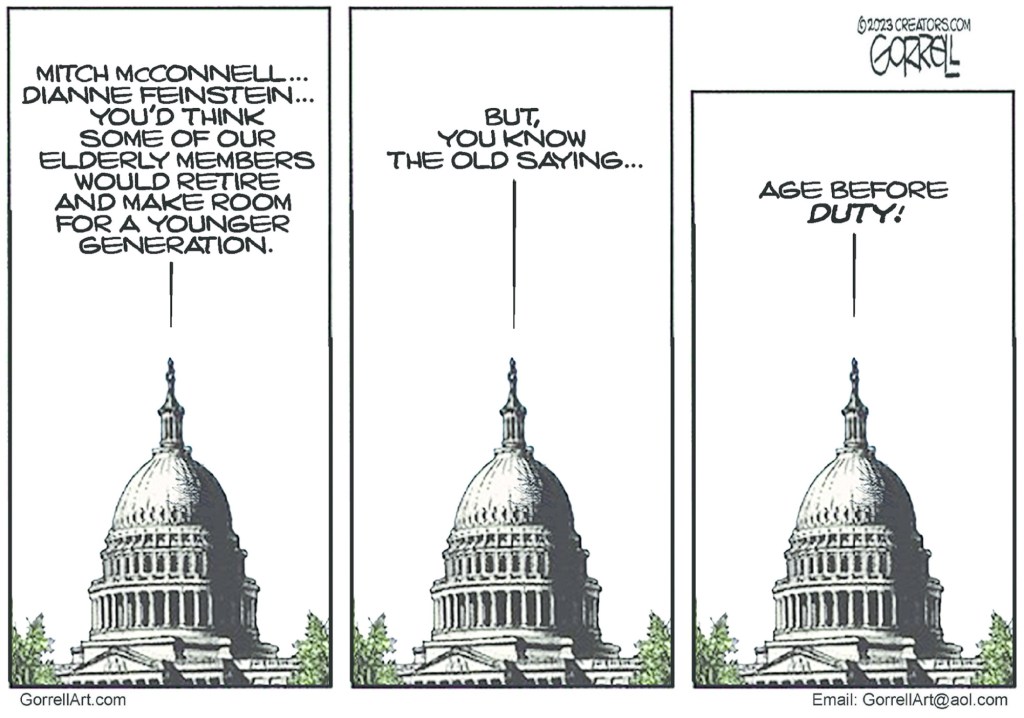
The Republican Party suddenly finds itself facing a political problem that has nothing to do with polling, fundraising, or campaign strategy. It is confronting something every political party eventually must: the reality that time catches everyone.
With the reported passing of Senator Lindsey Graham and the continuing uncertainty surrounding Senator Mitch McConnell’s health and political future, Republicans are entering unfamiliar territory. Even if they retain a Senate majority today, that majority has become noticeably thinner, and every vacancy, retirement, or prolonged absence magnifies the influence of every remaining senator.
In a chamber where a single vote can determine whether legislation advances, judicial nominees are confirmed, or a budget passes, arithmetic matters more than ideology. A three-seat cushion feels comfortable until it becomes a one-seat cushion. Then every illness, every resignation, and every special election becomes national news.
The challenge extends well beyond the current Congress. Republicans now have to ask what their Senate map looks like heading into the 2026 midterms. Do they spend valuable resources defending seats they assumed were secure? Do they recruit new candidates capable of replacing decades-long incumbents? Or do they continue relying on personalities who have dominated the party for years while hoping the transition takes care of itself?
Leadership transitions are never simple. Mitch McConnell has shaped Senate Republican strategy for nearly two decades. Whether one admired his tactics or opposed them, few would argue that he wasn’t extraordinarily effective at counting votes and keeping his conference together. Replacing institutional knowledge accumulated over decades isn’t as simple as holding a leadership election.
Lindsey Graham occupied a different role. He often served as one of the party’s most visible communicators on national security, judicial appointments, and foreign policy. His absence leaves another gap—not just in committee assignments but in the public face of Senate Republicans.
Democrats have faced similar moments. Parties inevitably lose senior members through retirement, defeat, or death. The question is whether they have spent enough time cultivating the next generation of leadership before the transition becomes unavoidable.
The Republican Party has increasingly become identified with one dominant figure at the top and a relatively small circle of long-serving senators around him. That concentration of experience creates stability—until it doesn’t. When several pillars begin disappearing at roughly the same time, succession suddenly becomes the central issue.
Looking toward 2026, Republicans may discover that maintaining a majority is only part of the challenge. They must also convince voters that the party has a deep bench capable of governing for the next decade rather than simply preserving the last one.
Political parties often spend so much time preparing for the next election that they forget to prepare for the next generation. Demographics, health, and time don’t consult polling averages before making their decisions.
The Senate’s balance of power may not change overnight, but its center of gravity already has. And that could make 2026 less about partisan ideology and more about who is ready to inherit the responsibility of governing when an era comes to an end.
If you’re asking the question as a traditional learner sitting in classrooms, I would say I’m a learner. I do continue to take classes. I do have a college degree and I’d like to read, but I always refer back to what my dad told my son years ago, cause my dad went back to school and my son said you and my dad are weird every time you’re bored you pick up a book or you go back to school and my dad told my son very frankly that boy the day you stop learning is the day they start throwing dirt on your face.
One of the more fascinating things about modern America is how many people loudly proclaim themselves to be Christians while appearing to have skipped over the parts where Jesus actually speaks.
The phrase I hear over and over is, “People just need to pull themselves up by their bootstraps.”
It’s an interesting philosophy. It’s also one that Jesus never seemed to endorse.
Imagine the Sermon on the Mount under today’s version of Christianity. Thousands have gathered. They’ve been listening all day. They’re hungry.
Modern Jesus, apparently, would shrug.
“This was a planned event. You knew how long you’d be here. You should have packed a lunch. Poor planning on your part isn’t an emergency on mine.”
Except…that’s not what happened.
The Jesus described in the Gospels looked at a hungry crowd with compassion, not suspicion. He didn’t ask who had a job. He didn’t ask who deserved a meal. He didn’t ask whether feeding them would encourage dependency. He simply took what little was available and fed everyone.
That wasn’t an endorsement of laziness.
It was an endorsement of mercy.
The same applies to healthcare.
When Jesus encountered the sick, there was no admissions desk. No insurance verification. No co-pay. No preauthorization. No argument about whether the illness was the patient’s fault.
He healed them.
Every.
Single.
Time.
He never once said, “I’d love to help, but your deductible hasn’t been met.”
The irony is almost painful. Some of the loudest voices demanding cuts to food assistance, healthcare, and programs that help struggling families are also the quickest to quote Scripture.
Yet the words of Jesus are remarkably consistent.
Feed the hungry.
Heal the sick.
Care for the poor.
Welcome the stranger.
Visit the prisoner.
Love your neighbor.
Those aren’t obscure verses hidden deep in the minor prophets. They’re among the central themes of Jesus’ ministry.
Christianity was never presented as a theology of radical self-reliance. It was presented as radical compassion.
Yes, personal responsibility matters. Scripture is full of teachings about work, stewardship, and accountability. But those teachings were never meant to cancel out mercy. They were meant to exist alongside it.
The modern tendency to treat compassion as weakness and charity as moral failure says far more about our politics than it does about the Gospel.
If your first instinct when someone is hungry is to lecture them…
If your first instinct when someone is sick is to calculate what they owe…
If your first instinct when someone falls is to explain why they deserve to stay there…
Then perhaps it’s worth asking whether you’re following the teachings of Jesus or simply using His name to justify an ideology.
Because the Jesus of the Gospels never healed only the deserving.
He never fed only the productive.
He never loved only the successful.
He simply loved.
Maybe that’s the part so many self-professed Christians never got around to reading.
What’s one habit that has improved your life the most?
The one habit I’ve had my whole life is I’m always on time. There has to be something major happen for me to not arrive on time. Major accident, sickness, birth of a child. Those are excuses for not being on time, but I was raised with the philosophy that if you’re on time, you’re probably late and I’ve tried to instill that in my child too so it’s a good happen to have just on time
One of the more frustrating things about modern politics is how quickly we forget our own history. Every scandal becomes “unprecedented,” every constitutional crisis becomes “something we’ve never seen before,” and every abuse of power is treated as if it materialized out of thin air.
It didn’t.
Donald Trump is not the first president to view the Department of Justice as something that exists to protect him personally. Richard Nixon certainly tried. He expected loyalty over law, believed the machinery of government should shield him from accountability, and discovered the hard way that the Justice Department was not supposed to function as the president’s personal law firm.
History delivered an important lesson back then that seems to have faded from public memory: Attorney General John Mitchell didn’t simply lose his job. He went to prison for his role in Watergate. The Attorney General of the United States served time because the rule of law ultimately mattered more than loyalty to the president.
That’s a lesson worth remembering.
Where Trump differs from Nixon isn’t simply in trying to influence the Justice Department. It’s the breathtaking scope of what he appears to believe the federal government is for. The DOJ isn’t merely expected to defend administration policies. It’s expected to investigate his political enemies, ignore his political allies, defend him personally, and pursue whatever grievance happens to dominate the news cycle that day.
That’s not how constitutional government works. That’s how personal governments work.
Then there’s the Supreme Court.
The Court’s presidential immunity decision granted presidents broad immunity for official presidential acts. Whether one agrees with the ruling or not, it was never intended to mean that a president can wave a magic wand over every action and declare, “Official business.” The difficult question is where the line is drawn, and that line will almost certainly be litigated for years.
Sometimes I joke that if a president claimed he shot someone on Fifth Avenue because it was somehow necessary for national security, we’d spend years arguing whether it was an “official act.” It’s absurd, but that’s the uncomfortable place we’ve wandered into. The immunity decision answered one question while creating dozens more.
The Constitution was never designed around the assumption that one person would believe every institution exists solely for his personal benefit.
The Justice Department belongs to the American people, not to the president.
The Attorney General represents the United States, not the individual occupying the Oval Office.
The Supreme Court is an independent branch of government, not a presidential customer service desk.
Those distinctions matter. They always have.
I dislike using the word “unprecedented” because it’s become the media’s favorite adjective. Everything is unprecedented. Every Tuesday is unprecedented. At some point, the word loses all meaning.
But while Trump’s actions have historical echoes, the sheer scale of his expectations is remarkably different. Nixon tried to bend institutions to protect himself. Trump often behaves as though the institutions exist for no other purpose.
Nixon failed.
His presidency ended in disgrace, his administration unraveled, and some of the people who carried out his wishes paid a very real price—including the Attorney General himself.
History doesn’t repeat itself exactly, but it does rhyme. The hope is that it rhymes loudly enough for Americans to remember that no president is supposed to own the Justice Department, no attorney general is supposed to serve as personal counsel to the Oval Office, and no Supreme Court exists to function as a presidential insurance policy.
The strength of a republic isn’t measured by how much power a president can accumulate.
It’s measured by whether the institutions designed to restrain that power still have the courage to do so.
You must be logged in to post a comment.