It was Halloween night in the once-friendly pumpkin patch of America. The children gathered, not for tricks or treats, but for the annual vigil of despair — waiting for the Great Rotting Pumpkin to rise again.
Charlie Brown stood among them, clutching a hollowed-out insurance card instead of a candy bag. “Do you really think he’ll come this year?” he asked nervously.
“Oh, he always comes,” said Lucy, her voice dripping with cynicism. “He comes when the moon turns orange and the poor turn desperate.”
The ground began to tremble. From the dirt burst a monstrous pumpkin, swollen and decayed, reeking of bile and broken promises. Its carved grin was jagged and cruel, oozing something that looked suspiciously like taxpayer money.
“I am the Great Rotting Pumpkin, United States!” it bellowed. “I come bearing austerity and fear! Instead of candy, I bring tax cuts for the rich and bills for everyone else!”
Linus, ever the true believer, clutched his blanket. “But… but you’re supposed to bring hope!”
“Hope?” the pumpkin laughed, spraying moldy pulp onto the kids. “That’s been outsourced! Now, I bring deregulation, deportations, and despair!”
The Great Rotting Pumpkin stretched its vines across the land. One vine snatched away a brown child from his mother’s arms, another wrapped around an elderly couple and yanked away their social security checks. A third vine slithered through the hospital doors, whispering, “Pre-existing condition? Not my problem.”
Snoopy, ever defiant, donned his World War I flying ace goggles and tried to attack the beast from his doghouse. But the pumpkin laughed again, flicking him away with a giant orange tendril. “Silly dog,” it sneered. “Even your veteran benefits are being privatized!”
By dawn, the pumpkin’s shadow covered the entire nation. Candy had turned to coal, houses to tents, and dreams to debts. The children stared up at it, hollow-eyed.
Linus finally spoke. “Maybe next year… a better pumpkin will rise.”
Lucy shook her head. “Not unless someone plants something new in this soil first.”
And as the Great Rotting Pumpkin feasted on another tax loophole and belched out a smog of despair, the only thing left glowing in the night was the faint flicker of hope—buried deep beneath the rot, waiting for someone brave enough to dig it out.
And here we are—day 30 of the government shutdown, the one that “totally isn’t their fault,” according to the same Republicans who, inconveniently, control literally everything. It’s an incredible feat of political gymnastics: shutting down your own government, blaming the minority party for it, and still having the gall to appear on Fox News every night insisting that Joe Biden, Chuck Schumer, and a cabal of vegan socialists are somehow holding America hostage.
You’d think after 30 days of unpaid federal workers, shuttered services, and national parks turning into overflowing porta-potties of despair, they’d at least try a new excuse. But no—this week’s recycled propaganda has a vintage twist. We’ve been teleported back to Reagan’s 1980s, complete with leg warmers, Cold War paranoia, and, of course, the ever-reliable scapegoat: the welfare queen.
Except now, the story’s gotten even more absurd. According to the newest round of right-wing math (the kind that makes two plus two equal “Hunter Biden did it”), people on SNAP benefits are supposedly raking in $4,000 a month. Yes, you read that right—nearly $50,000 a year in government food money! Because obviously, your average single mom in Kansas is out here lighting cigars with EBT cards and washing down her filet mignon with government-funded champagne.
Meanwhile, reality—remember that old thing?—is sitting quietly in the corner, reminding us that the actual average SNAP benefit is about $6 a day per person. That’s roughly enough for one combo meal at McDonald’s, assuming you skip the fries. But who needs reality when you can spin a story about luxury-living freeloaders eating lobster tails on the taxpayer dime?
It’s the perfect deflection. While federal workers are lining up at food banks, the party of “fiscal responsibility” wants you to believe the real problem is a mythical underclass of gourmet grifters. Never mind that the shutdown they caused is costing billions. Never mind that corporate subsidies, tax loopholes, and Mar-a-Lago-sized write-offs dwarf the entire food stamp budget. No, the problem is Karen in Ohio buying two boxes of cereal instead of one.
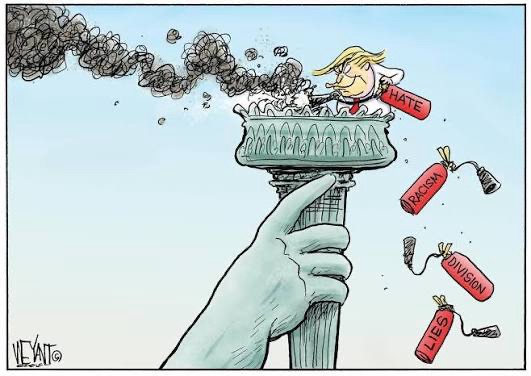
So here we are, watching the GOP’s rerun of “Reagan Theater Presents: The War on the Poor,” now remastered in high definition hypocrisy. Same script, same villains, same smug moralizing about bootstraps—except this time, they’re the ones lighting the fire and then complaining about the smoke.
But don’t worry—they’ll fix it soon. Right after they finish blaming the Democrats, the deep state, the weather, and maybe the ghost of FDR for their own incompetence. Until then, enjoy your government shutdown, America. It’s the only thing this crowd can still manage to keep running.
Somewhere in the golden halls of Mar-a-Lago, between the Diet Coke refills and the well-practiced proclamations of greatness, Delusional Donnie Dumbass (or perhaps Dementia Don, depending on the day’s vibe) seems to be getting polling numbers that only exist in his head—or maybe in a fantasyland where truth checks out for early retirement. Every time the real world reports him hovering around numbers that would make even Richard Nixon blush, Donnie steps up to a microphone and confidently declares that he has “the highest poll ratings of any president in history.”
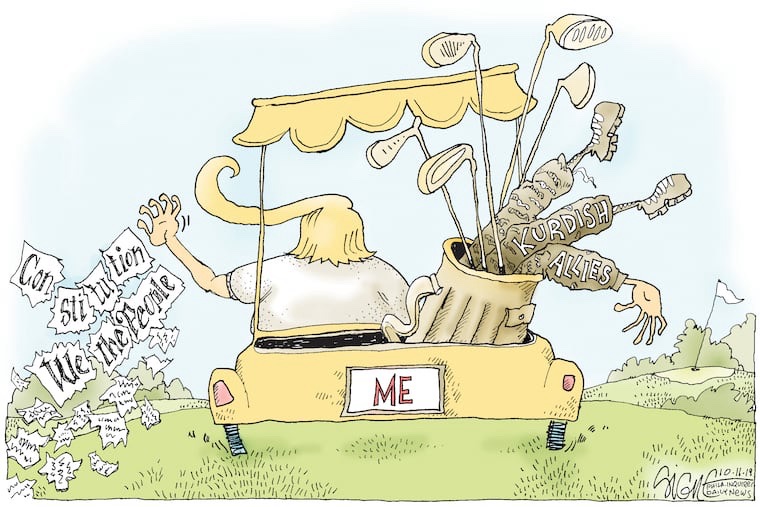
Now, there are two possible explanations for this. One: he’s flat-out lying, which would surprise absolutely no one at this point. Or two: he has fundamentally misunderstood what polls are. Maybe, in that foggy mental golf course of his mind, “poll numbers” are just like golf scores—the lower the better. In that case, the polls showing him down twenty points? Fantastic news! The people love him so much they’re scoring him like a PGA pro. “Look,” he’d probably brag, “everyone else is in the high 50s and 60s—terrible numbers. I’m in the 30s! Maybe even the 20s! Nobody’s ever done that before. Tremendous!”
This would explain a lot: the unbothered smile as his approval craters, the joy with which he recounts his “historic” leads, the way he treats every political loss as a “beautiful win.” It’s as if he’s playing an entirely different game—one where facts are hazards, truth is out of bounds, and reality is just the sand trap you blame for your slice.
So when Donnie Delusion says his poll numbers are the best, maybe he’s right—just not in the way he thinks. In the golf course of his mind, he’s the Tiger Woods of politics: fewer strokes, fewer facts, and one very inflated scorecard of self-delusion.
“Person. Woman. Man. Camera. TV.” – The Einstein of Our Age
There are moments in American history when greatness announces itself with fireworks, marble statues, or stirring speeches. And then there’s Donald J. Trump, who declared his own intellectual supremacy by passing what he insists is the world’s most difficult test: a cognitive exam. Not the SATs, not the LSATs, not even a basic spelling bee — no, no. The very same test your grandmother might take if her doctor suspects early signs of memory loss.
Trump tells this story like it’s his moon landing. “They said, ‘Sir, nobody gets all the questions right,’” he brags. Of course, the questions he’s referring to are not exactly quantum physics. They’re more along the lines of, “What day is it?” “Where are you right now?” and “Can you point to a lion?” The man didn’t so much prove genius as prove he could successfully exist on planet Earth without a medical alert bracelet.
Let’s be clear — a cognitive exam is not an IQ test. It’s not even a pop quiz. It’s a screening tool doctors use to check for cognitive decline, dementia, or brain injury. You don’t just walk into your annual physical and say, “Doc, I’d like to show off my smarts. Hit me with the Montreal Cognitive Assessment.” No, you take that test because something’s off — because you forgot how to get home from the grocery store, or you mistook your wife for the TV remote.
But to Donald, this wasn’t a red flag; it was a golden trophy. In his mind, he hadn’t just passed — he’d aced the Harvard entrance exam, solved Fermat’s Last Theorem, and rewritten Einstein’s relativity on the back of a McDonald’s wrapper. “They couldn’t believe how well I did,” he says. One imagines the poor neurologist nodding politely, whispering to the nurse, “Just smile and give him a sticker.”
What makes this performance art truly remarkable is the man’s utter sincerity. Trump seems to believe that being able to remember five random words in a row — “Person. Woman. Man. Camera. TV.” — is equivalent to writing the Federalist Papers. In fact, he repeated those five words for weeks like they were a sacred mantra, his personal Rosetta Stone of brilliance. The rest of us were left wondering whether he knew that the test was designed to see if someone’s memory was failing, not to confirm they were ready for Mensa membership.
And just when you think the story can’t get more absurd, Trump takes his cognitive conquest on the road — challenging actual members of Congress, like Jazmine Crockett and Alexandria Ocasio-Cortez, to “take the test” because, in his own words, he doesn’t think they’d pass. Why? Because, of course, in Trump’s world, intelligence is directly proportional to skin tone and subservience. The irony is staggering: a man who needed a neurological assessment to prove he knew what a rhinoceros was, now lecturing women of color about mental fitness.
Imagine it — Trump sitting there, Sharpie in hand, smugly daring two accomplished, educated women to name the date and draw a clock face. These are women who’ve written legislation, grilled witnesses, and navigated the political minefield of Washington with more grace and intellect than Trump ever displayed in a rally speech — and yet, because they don’t fit his outdated, misogynistic, and racist idea of “smart,” he’s convinced they’d fail a test meant for post-concussion patients.
It’s the perfect Trumpian paradox: a man who doesn’t read his own briefings, who once suggested nuking hurricanes, and who can’t spell “tap” without adding an extra “e,” calling into question the cognitive ability of women who can actually spell cognitive. His fragile ego is so desperate for validation that he’s turned a medical screening into a political weapon — a test of loyalty, not logic.
The irony, of course, remains: no one takes a cognitive exam unless there’s reason to suspect cognitive issues. It’s not a test for geniuses — it’s a medical precaution. But Trump, master of rebranding, turned it into a badge of honor, a certification of “stable genius.” It’s the equivalent of bragging that you “passed your sobriety test with flying colors” when the reason you were taking it is because you drove into a lamppost.
So here we are, in the year 2025, with a man still bragging about recognizing a giraffe and remembering today’s date — and now daring congresswomen to match him in his field of “expertise.” Perhaps that’s fitting. Trump has always been the magician of mediocrity, turning the mundane into spectacle, the ordinary into self-worship. And while the rest of us might worry if our doctor ever recommends a cognitive assessment, Donald will likely frame his next one — right beside his Time magazine covers — proof, in his mind, that he’s still the sharpest tool in the shed.
Only, of course, the rest of us know that the test wasn’t to see if he was sharp. It was to see if the lights were still on.
And in the grand finale of his delusional highlight reel, we are waiting for Trump to proudly proclaims that his doctor recently gave him another “very tough” test — this one, a flexibility and range of motion test. According to Trump, the doctor looked at him in sheer awe and said, “Sir, you could be an Olympic athlete. You’ve got the flexibility of a gymnast and the arm of a major-league pitcher. You could be in the World Series right now — probably throw a no-hitter.”
It would be a perfect sequel to his cognitive saga — the man who mistook a memory test for a Mensa exam now believes a routine physical stretch means he’s ready for the Olympics. In Trump’s fantasy world, every doctor’s polite small talk becomes a divine proclamation of greatness. Next week, when he’s told his blood pressure is “normal,” expect a press release announcing that he’s achieved perfect human physiology, possibly the first man to outdo Michelangelo’s David.
In the end, Trump’s America doesn’t need facts, science, or reality — just a steady stream of compliments, imagined or otherwise. Because in his mind, every test is an IQ test, every checkup is an Olympic qualifier, and every doctor is a fan begging for an autograph.
ICE, Ice, Maybe — The Fitness Farce of Pete and the Barbie Brigade
Ah, the irony is so thick you could bench-press it. On one end of the government gym, we’ve got Fox News’ very own Pete Hegseth, self-styled warrior of masculinity, puffing his chest and proclaiming the need to toughen up the military. Higher standards! More grit! Less comfort! A return to the days when “pain is weakness leaving the body” was a lifestyle, not a motivational poster.
Meanwhile, down the hall in the frostbitten offices of Homeland Security, Secretary “Ice Barbie” Nome — who seems to have mistaken a national security agency for a runway — is lowering physical standards for ICE agents faster than you can say “photo op.” Agents no longer need to scale walls, chase suspects, or even break a sweat — because, let’s face it, sweating doesn’t look great on camera.
Her qualifications? Let’s just say she’s as prepared to run a federal enforcement agency as a mall kiosk worker is to command NASA. Nome’s main skill seems to be staging photo ops that make her look “tough on crime” while wearing aviators and a fitted jacket. Substance? Optional. Optics? Mandatory. She runs ICE the way reality TV runs a “team challenge”: lots of shouting, questionable wardrobe choices, and zero follow-through.
Now, imagine this perfect storm of absurdity:
Pete wants to build an army of modern Spartans, while Nome is producing a squad of snowflakes with badges. The military’s out there hauling 80-pound packs through the desert, and ICE agents are being applauded for “emotional endurance” and learning how to hydrate responsibly. The country’s defenders are training like warriors — and ICE is filming TikToks.
But here’s where it gets dangerous — not just ridiculous. Lower the bar physically and intellectually, and what you get isn’t compassion; it’s incompetence with a badge. ICE agents, already undertrained in the actual law, are now so out of touch with legal standards that they often can’t distinguish between “undocumented immigrant” and “U.S. citizen with a tan.” The lack of critical thinking, cultural understanding, or even a passing grasp of civil rights law has turned ICE from a law enforcement agency into a nationwide profiling patrol.
They’re not enforcing the law — they’re enforcing a vibe. And that vibe, sadly, is suspicion. Suspicion of anyone with an accent, darker skin, or the audacity to exist while bilingual. Instead of investigating or verifying, ICE agents now seem to operate on the “looks illegal to me” principle — a blend of ignorance and arrogance that would make even a 1980s action movie villain blush.
And speaking of misplaced obsession: Pete’s fixation on “Spartan toughness” might need a quick brush-up in ancient history. The Spartans — those paragons of military discipline he loves to name-drop — were, let’s say, intimately close with their fellow soldiers. In fact, their entire fighting structure was built on the strength of same-sex bonds. The very warriors Pete idolizes would have been summarily banned from his idealized modern army for being too gay, too open, or too human.
That’s the GOP paradox in protein-powder form: praise the Spartans, but purge the soldiers who actually resemble them. Preach about honor and courage — unless that courage involves coming out as transgender or refusing to hide who you are. Hegseth’s version of “military purity” looks less like Sparta and more like a CrossFit cult with a flag fetish.
Meanwhile, Nome keeps choreographing her next “decisive leadership” Instagram reel while her agents bumble through neighborhoods, turning civil rights violations into performance art. Together, Pete and Nome have created the perfect two-act farce: a myth of strength and a theater of cruelty. One worships the idea of warriors; the other produces a glossy imitation of them.
If they ever joined forces, America would get an army of perfectly heterosexual Spartans — none of whom could actually be Spartan — and an ICE force too busy posing to know which laws they’re breaking. It’s fitness without purpose, authority without intellect, and patriotism filtered through Photoshop.
Because in the end, that’s the tragicomic heart of this movement: a worship of image over substance, muscle over mind, and control over compassion. Hegseth and Nome don’t want strength — they want aesthetic. The photo ops are flawless; the policies are disastrous. And while they’re busy flexing for the cameras, the rest of us are left wondering: who’s actually protecting America while the models play soldier?
Taking Back the Words: Why the Liberal Left Must Reclaim Language and Make the Right Defend “Nazi”
Somewhere along the line, the liberal left lost control of the dictionary. Words like woke—which originally meant being aware of social injustice—have been turned into insults. Libtard, a grotesque mashup of “liberal” and “retard,” became a go-to slur for anyone who believes in compassion. And meanwhile, the right has managed to whitewash terms like “nationalist,” “Christian patriot,” and even “America First”—phrases with deeply fascist roots—into something they wear proudly on a red hat. It’s time for progressives to flip the script, take back the words, and make the other side defend the indefensible.
Let’s start with woke. It was never about elitism or smugness. Being woke once meant you were awake to reality—the systemic injustices that too many preferred to sleep through. But as soon as people started using it to call out racism, sexism, and inequality, the right weaponized it. Now, they spit it out like it’s toxic. The left shouldn’t run from the term; it should lean into it. Yes, I’m woke. I believe people should be treated equally. I think children should learn history accurately. I think women should control their bodies. If that’s a bad thing, then maybe the problem isn’t the word—it’s the people who fear it.
And libtard—let’s dismantle that one. It was meant to humiliate, to fuse empathy with weakness, intelligence with stupidity. But what if liberals embraced it, too? “Yes, I’m a libtard,” one might say. “I care about climate change, healthcare, and democracy—sorry if that offends your feelings.” It’s the same energy the LGBTQ+ community used to reclaim queer, transforming a slur into a badge of power. When you own the insult, it loses its sting. It becomes armor.
But here’s where the linguistic war really needs to turn: the right needs to own Nazi. For too long, they’ve managed to deflect, deny, and downplay their creeping authoritarianism. They wave flags that look suspiciously similar to 1930s banners. They idolize strongmen who jail opponents, demonize minorities, and scapegoat the press. They march with torches, shout “blood and soil,” and still somehow insist they’re the patriots. If liberals have to constantly defend words like woke, conservatives should have to defend their flirtation with fascism. You like banning books? Silencing teachers? Demonizing immigrants? Great—defend that. Defend the ideology that history already judged and condemned.
Language is power, and the left has spent too long surrendering it out of politeness. Every time a liberal backs away from a word because it’s been turned into an insult, the right wins another inch of cultural ground. It’s time to reclaim that ground—loudly, unapologetically, and with humor. Because authoritarianism feeds on fear, but it chokes on mockery.
So yes, be woke. Be a libtard. And make the people flirting with fascism explain, in public, why they keep defending Nazi talking points without ever using the word. Let’s turn the tables. Because in the end, whoever controls the language controls the narrative—and it’s long past time for progressives to grab the mic back.
It started, as all great wars do, with a tweet—or maybe twelve. DJ T, the man who never met a mirror he didn’t salute or a critic he didn’t declare an enemy of the state, has taken his lifelong battle against anyone who ever said anything mean about him and expanded it to include the entire population of the United States. That’s right. Every last one of us. From toddlers to teachers, from veterans to vegans—congratulations, America, you’re all part of the resistance now.
At first, it seemed like garden-variety pettiness: the name-calling, the tantrums, the “I alone can fix it” slogans delivered with the subtlety of a foghorn in a library. But then the pettiness metastasized. Suddenly, the man wasn’t just mad at reporters or comedians or the guy who made fun of his hands—he was mad at the country itself. Every flaw became an insult. Every question, an act of treason. Every mirror that didn’t flatter him enough, an accomplice in the great American betrayal.
And so began his war—not of armies, but of ego. A scorched-earth campaign where the earth happened to be… well, ours. He bombed the credibility of institutions, shelled the idea of truth, and carpet-bombed the concept of humility. He even took a wrecking ball—literally—to the White House, turning what was once “The People’s House” into the world’s tackiest metaphor: a gilded ballroom, complete with chandeliers bright enough to blind the ghosts of Lincoln and Roosevelt as they wander, wondering what they did to deserve this afterlife.
Meanwhile, his rallies—those endless, sweaty, self-congratulatory episodes of mass therapy—became his battlefronts. He ranted not against foreign powers or existential threats, but against us: Americans who dared to think, read, question, or worse, laugh. He told his followers that America was a disaster, a hellhole, a disgrace—and somehow, the only way to save it was to make it more like him.
And the saddest part? Some believed it. They mistook cruelty for courage and confusion for conviction. They clapped as he insulted their country, their cities, their neighbors. They didn’t realize they were cheering the general who had declared war on his own army.
Now the White House looks less like a seat of democracy and more like the world’s most dangerous wedding venue. The press briefings have turned into hostage videos. The flag still waves outside, but it feels tired—like it’s seen too much nonsense and would very much like a nap.
The irony, of course, is that DJ T will never win this war. You can’t conquer a people you claim to lead. You can’t love America while loathing Americans. You can’t make a country great while calling it garbage every other sentence. But he’ll keep fighting anyway, shouting into the marble halls, angry at the ghosts, the voters, the journalists, the comedians, the wind.
Because in the end, his true enemy isn’t any of us—it’s the truth.
And that’s one war he’ll never win, no matter how many ballrooms he builds on top of the rubble.
Would you like me to punch this up a little more—more biting sarcasm, darker humor, or more emotional melancholy?
Why Vaccines Work: A Helpful Guide for People Who Somehow Missed Science Class
Okay, class, let’s use our listening ears and big kid brains. Vaccines are like superhero training for your body. When you get a vaccine, your immune system meets a tiny, harmless version of a germ — kind of like a “wanted” poster for the real bad guy. Your immune system studies it, takes notes, maybe doodles a little “never forget this face” sketch, and gets ready to fight the real thing if it ever shows up.
So, when the actual germ comes around yelling, “Hey, I’m here to ruin your week!” your body’s like, “Nice try, loser. I’ve seen your mugshot,” and stops it before it can throw a party in your lungs. That’s why people who are vaccinated don’t get as sick — their bodies are basically bouncers with VIP immune lists.
Now, here’s the really wild part — when lots of people are vaccinated, the germs can’t find anyone to infect. It’s like showing up to a party and realizing the door is locked, the lights are off, and everyone’s gone home to binge-watch Netflix. Scientists call this herd immunity — though it’s less about actual cows and more about protecting everyone, especially the babies, the sick, and the folks who can’t get vaccinated.
But if too many people skip their shots because they “did their own research” on a blog called “MomTruthFreedom.biz,” the germs start spreading again. Suddenly, the disease gets a sequel nobody asked for.
So, to review: vaccines work because your immune system learns to fight smarter, not harder. And the more people vaccinated, the less chance germs have to ruin everyone’s day. It’s science — not sorcery, not politics, not a plot by Big Needle. Just basic, boring biology doing its job.
Now go get your shots, wash your hands, and stop pretending viruses care about your opinions.
Ladies and gentlemen, gather ‘round and behold the rarest creature in the political wilderness: the Marxist Communist Fascist. This beast is said to stalk college campuses, cable news panels, and the fevered imaginations of certain social media commentators. It’s a terrifying chimera — part Lenin, part Mussolini, and entirely nonsense.
Let’s unpack this ideological smoothie. A Marxist believes in the collective ownership of production and the eventual withering away of the state. A Communist takes that Marxist dream to the next level — no private property, no classes, no bosses, no billionaires, no Kardashians selling “luxury minimalism.” Meanwhile, a Fascist believes in total authoritarian control, ultranationalism, and usually worships a strongman leader who thinks democracy is something you use to wipe your boots.
So, calling someone a “Marxist Communist Fascist” is like calling them a vegan carnivore who only eats gluten-free steak. It’s an ideological paradox wrapped in a logical impossibility. Marxists want to abolish the state; fascists are the state. Communists want to dissolve hierarchy; fascists build altars to it. One dreams of equality, the other demands obedience — they’re not sharing a dorm room, let alone a movement.
And yet, in the modern political jungle, the “Marxist Communist Fascist” label gets tossed around like confetti at a conspiracy convention. Someone proposes free school lunches? Must be Marxist Communist Fascism. Someone suggests not jailing journalists? Definitely Marxist Communist Fascism. Someone says words longer than two syllables? Clearly indoctrinated by Karl Mussolini and Benito Marx.
In conclusion, the “Marxist Communist Fascist” exists only in the same place as Bigfoot and honest political discourse — the imagination. But rest assured, whenever you hear someone use the term, you can safely assume one thing: they’ve never read a single page of The Communist Manifesto, Mein Kampf, or, for that matter, a dictionary.










You must be logged in to post a comment.