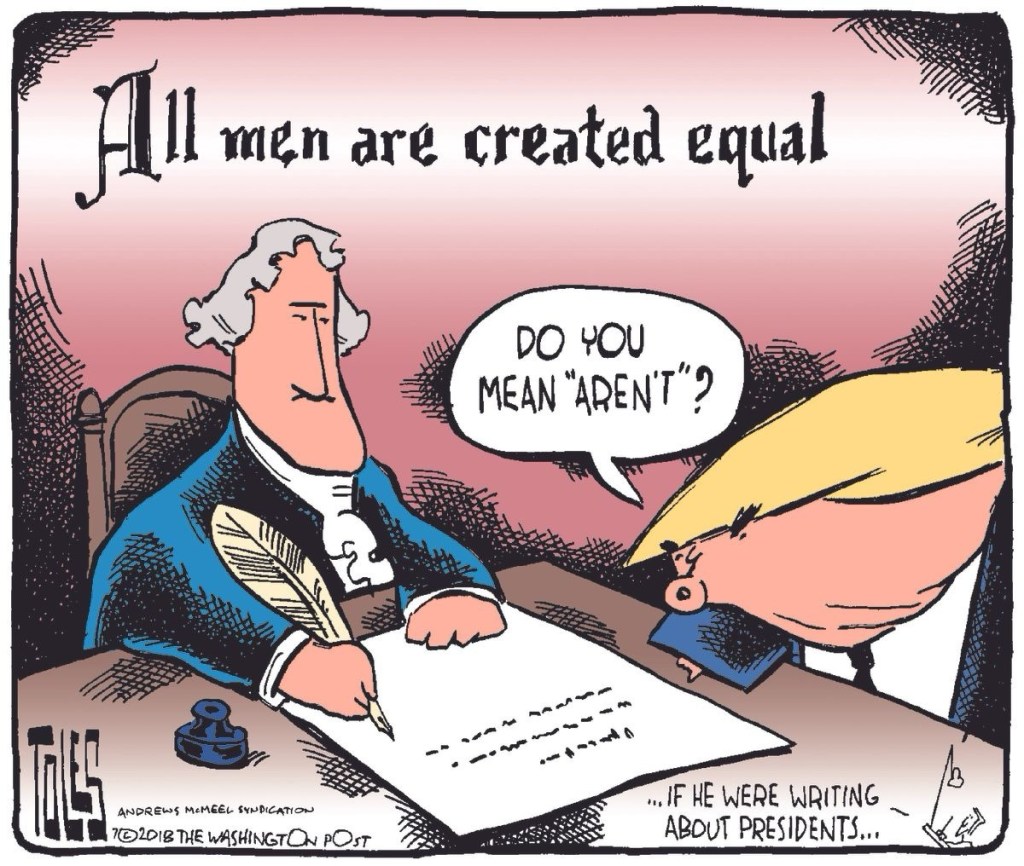
Donny’s (aka Mango Mussolini ) anti-“woke” policies, particularly those aimed at suppressing discussions of race, gender, and systemic inequality, conflict with the foundational American ideal that “all men are created equal.” This principle, rooted in the Declaration of Independence and echoed in the Constitution’s equal protection clause, affirms the inherent dignity and rights of every individual. Yet, Trump’s efforts to ban diversity training, restrict classroom discussions on racism and LGBTQ+ rights, and penalize institutions that promote inclusion directly undermine this ideal.
By framing efforts to address historical and ongoing inequality as divisive or “anti-American,” these policies ignore the lived experiences of marginalized groups. They attempt to erase critical narratives that expose how far the nation still has to go to achieve true equality. Censoring perspectives in education and public policy silences voices that challenge the status quo, reinforcing systems of privilege rather than confronting them.
Moreover, targeting “woke” culture often results in policies that disproportionately harm communities of color, LGBTQ+ individuals, and others already facing discrimination. In doing so, these actions deny the equal treatment and respect the Constitution guarantees. A government truly committed to the idea that all are created equal must support, not suppress, the pursuit of justice and equity for all.
In this world, early humans never formed religions or waged wars. Rather than fearing the unknown, they sought to understand it. From the beginning, early humans revered curiosity and evidence. Tribal leaders were not warriors or shamans but natural philosophers. Fire, the wheel, and agriculture were developed not through accident, but deliberate experimentation. Disputes were resolved through reasoned councils and mutual understanding, emphasizing data over dominance. As knowledge spread, collaboration between early civilizations accelerated discovery instead of conflict. The absence of religious dogma allowed ideas to flow freely, and societies began documenting and sharing their findings in unified systems of learning.
Chapter 2: The Age of Unity
By 1000 BCE, what we’d call “ancient civilizations” had already launched satellites and built sustainable cities. A global language of science had emerged, enabling all cultures to contribute to a collective knowledge base. Cultural expression thrived—art, music, and philosophy developed without borders—but always grounded in logic and a deep respect for nature. Education was universal. Disease was largely eradicated by coordinated global efforts. Rather than building empires, great civilizations formed research coalitions. With no war industry, entire economies were dedicated to exploration, medicine, and technological enhancement.
Chapter 3: The Stellar Renaissance
By the year 0, humanity had colonized the Moon and Mars. Artificial intelligence emerged not as a threat, but as an integrated partner in societal governance and progress. Energy came from fusion and space-based solar arrays. Poverty and hunger were myths of a forgotten past. Individual purpose was driven by contribution to collective advancement rather than survival or conquest. With religion never institutionalized, spirituality existed only as philosophical reflection, grounded in awe for the cosmos rather than divine judgment. Humanity’s sense of morality was based on empathy and shared well-being.
Chapter 4: The Quantum Society
In the 2100s of this timeline, society no longer used money. Resources were managed by planetary councils overseen by superintelligent AIs, guided by transparency and democratic consensus. Cities were self-sustaining, ecological harmony was prioritized, and human augmentation allowed people to live for centuries. Time was invested in research, arts, and personal growth. Even the boundaries of biology blurred as humans began merging consciousness with machines, exploring the possibility of life beyond physical form. With no war and no religious sectarianism, attention turned entirely to understanding consciousness, time, and the origins of the universe.
Chapter 5: The Light Beyond
Now, in the 3000s, humanity is post-biological. Earth has become a living museum and sanctuary, maintained by descendants of humans who chose to remain organic. The rest of consciousness has expanded across galaxies in digital and quantum forms, probing black holes, creating virtual worlds, and initiating contact with other lifeforms. These meetings are not hostile but celebratory—civilizations exchanging knowledge, never weapons. Without the historical detours of war and religious conflict, humanity’s legacy is not one of conquest, but of understanding. And as the universe continues to unfold, so too does the great experiment of a species that chose reason over fear, forever reaching toward the stars.
If the United States had maintained the corporate and high-income tax rates from the Eisenhower administration of the 1950s, the national debt today would likely be significantly lower—potentially by tens of trillions of dollars. During that era, the top marginal income tax rate for individuals exceeded 90%, and corporate taxes accounted for a much larger share of federal revenue—often over 30%, compared to less than 10% today.
Assuming similar economic growth and spending patterns, but with consistently higher revenue from top earners and corporations, the U.S. government would have collected trillions more in revenue over the past seven decades. According to some economic estimates, maintaining those higher tax rates could have generated an additional $30–50 trillion in revenue between 1960 and today. Even after accounting for potential behavioral and economic shifts—such as changes in investment or tax avoidance—conservative models still show a substantial reduction in the federal deficit and accumulated debt.
As of 2025, the U.S. national debt stands at over $34 trillion. If those higher tax rates had remained in place and even half of the estimated additional revenue had been used to offset borrowing, the current national debt could plausibly be closer to $15–20 trillion, or even less. This would have reduced interest payments, lowered fiscal pressures, and provided more room for public investment.
However, it’s important to note that such a scenario assumes political and economic conditions that could have supported such high rates over time, which may not have been sustainable in a modern, globalized economy. Still, the data strongly suggest that maintaining higher tax contributions from the wealthiest individuals and corporations would have dramatically altered the fiscal landscape of the United States.
Oh, thank you, GOP. Truly—thank you for setting the record straight. For too long, we labored under the illusion that phrases like “liberty and justice for all” actually meant everyone. Silly us. But you—brave champions of selective freedom—have heroically reminded us that equality was never really meant to be universal. It’s comforting to know that someone is finally correcting the historical oversight of progress.
We now understand that rights are privileges—distributed on a need-to-be-entitled basis. Women, minorities, immigrants, the LGBTQ+ community—how selfish of them to think they deserved equal treatment under the law. But fear not! With surgical precision, you’ve managed to peel back those pesky layers of progress and return us to a time when power was simpler, whiter, and let’s be honest—more exclusive.
Thank you for teaching us that the Constitution is a buffet—you pick what suits you, and ignore the rest. We applaud your tireless efforts to preserve traditional values: inequality, disenfranchisement, and good old-fashioned control.
Really, it’s so refreshing to watch the arc of history bend—not toward justice—but neatly back into its original, exclusionary mold. Bravo, GOP. Your commitment to historical accuracy is both chilling and inspiring. What would we do without you?
Ah yes, the good old patriarchy—because obviously, nothing says “efficient leadership” like centuries of wars, economic collapse, and fragile egos running the show. We’ve been letting men steer this ship for millennia, and wow, what a job they’ve done. Climate change? Check. Global inequality? Check. Still arguing about whether women deserve rights? Big fat check.
But sure, let’s keep pretending that testosterone-fueled pissing contests are the pinnacle of governance.
Let’s be real: if the world had been run by women all along, we might actually have universal healthcare, functioning schools, and, I don’t know, peace. Matriarchies tend to be more cooperative and community-oriented—crazy, right? Imagine prioritizing education and empathy over nukes and oil.
“But men are natural leaders,” some guy yells from the back while failing to load a dishwasher. Right, buddy. Meanwhile, women have been managing families, careers, emotional labor, and literal childbirth without burning everything to the ground. But no, let’s keep handing the keys to guys who think empathy is a weakness and emotions are “hormonal issues.”
It’s not that men are inherently bad leaders—plenty are great—it’s just that the patriarchal model assumes they must lead, and often at the expense of everyone else. Maybe, just maybe, it’s time we tried something else. A matriarchal system might focus on sustainability, equity, and not destroying everything for profit. Wild concept, huh?
So yeah, maybe the next time we’re picking leaders, we should look for someone who doesn’t measure success in missiles and quarterly profits. If nothing else, let’s at least admit the patriarchy isn’t the flawless masterpiece it claims to be. Honestly, at this point, letting grandmas run the world sounds like our best shot.
This budget isn’t about fiscal responsibility—it’s a bold, unapologetic power grab for the ultra-rich. By extending Trump‑era tax cuts and slashing programs like Medicaid and SNAP, it channels trillions upward. According to the CBO and Yale Budget Lab, families in the bottom 10 percent would lose about $1,600 a year—roughly 3.9 percent of income—while the top 10 percent would see gains of around $12,000 annually (about a 2.3 percent increase) . For the very richest, it’s even more dramatic: the top 1 percent could pocket a windfall north of $32,000 ().
This isn’t just redistribution—it’s raiding. Cuts to Medicaid could leave up to roughly 12 million Americans uninsured by 2034 , while reductions in SNAP threaten food security for millions more . Human Rights Watch warns this wave of austerity could deepen inequality and damage public health, particularly among low‑income and minority communities .
Middle‑class families get crumbs: a modest tax relief of $500–1,000 annually, far from enough to offset inflation or rising costs . In contrast, the bill’s wealthy backers reap windfalls from business deductions, SALT cap expansion, capital gains breaks, and estate‑tax giveaways—all of which overwhelmingly benefit the upper echelons .
Moreover, the long‑term fiscal picture is dire. The CBO projects this bill will add between $2.8–3.3 trillion to the debt by 2034, pushing the debt‑to‑GDP ratio toward dangerous levels and crowding out future investments in health, education, and infrastructure .
In effect, this legislation enshrines a reverse Robin Hood: systematic wealth transfer from the poor and working class up to the ultra‑rich. It risks eroding the foundations of the American dream and consigning the middle class—already squeezed—to stagnation or decline. Unless reversed soon, its consequences will ripple across generations.
Many Americans struggle to distinguish between the Declaration of Independence and the U.S. Constitution. This confusion is common, even among public figures, and highlights a broader issue with civic education. The Declaration of Independence, adopted on July 4, 1776, was essentially a “divorce decree” from Great Britain. It laid out grievances against King George III and asserted the colonies’ right to separate. It is a fiery, revolutionary document focused on breaking political ties, not forming a government.
The Constitution, on the other hand, was adopted over a decade later, in 1787. It serves as the supreme law of the land, establishing the structure, powers, and limits of the federal government. It replaced the Articles of Confederation and is the foundation for American law and governance.
Donald Trump once referred to the Declaration of Independence as a document of “love and unity,” a striking mischaracterization. His comment illustrates the misconception that the Declaration was about building internal harmony rather than severing colonial ties. In reality, the Declaration was born of frustration, conflict, and rebellion. Understanding the distinction between these two founding documents is essential for grasping how the U.S. came to exist and how it is supposed to function. Confusing the two distorts the country’s origin story.
Let’s call it what it is: Florida is turning into a testing ground for fascist cruelty under the direction of. the giggling couch tumor, Ron DeSantis—with Donald Trump’s full ideological blessing. The so-called “migrant relocation” programs and indefinite detentions are not about law enforcement, border security, or community safety. This is about building a modern-day concentration camp system to cage people who haven’t even committed a crime—except daring to seek safety, dignity, and a future in the United States.
Under DeSantis, Florida has created a shadow infrastructure of incarceration: secretive sites, mass detentions without due process, and state-sponsored kidnapping of migrants under false pretenses. These aren’t just policy failures—they are human rights violations. Florida officials are literally flying people across the country under lies, then locking them away like criminals. This isn’t immigration policy; this is authoritarian social control.
And to fund this cruelty? They’re raiding disaster relief money from FEMA. That’s right—while Florida residents brace for the next hurricane, their own governor is siphoning federal emergency funds to bankroll a xenophobic fantasy. This is not just immoral, it’s dangerous. Every dollar stolen from FEMA is a dollar stolen from Floridians whose homes will be underwater tomorrow.
This is a test balloon for a national strategy. Trump and DeSantis are building the blueprint for mass detention of undesirables—no trial, no crime, no justice. It reeks of the ugliest chapters in world history.
We have to stop soft-pedaling this. This is not a “policy disagreement.” It is state-sponsored ethnic cleansing dressed up as border enforcement. It is the dehumanization of the vulnerable to score political points. And if we don’t call it what it is now—a concentration camp system in the making—we will look back and wonder how we let it happen again.
The month of July is named in honor of Julius Caesar, the famed Roman general and statesman. Originally called “Quintilis” (Latin for “fifth month”) in the old Roman calendar, it was renamed “Julius” in 44 BCE following Caesar’s assassination, to commemorate his birth month. Caesar had significantly influenced the Roman calendar itself—replacing the old lunar system with the solar-based Julian calendar, which more accurately aligned with the Earth’s revolutions around the sun. The renaming was a tribute not only to his birth but to his legacy as a reformer and powerful figure in Roman history.
Now imagine, for a moment, how a modern political cult of personality might respond to this kind of historical legacy. If the most fervent supporters of Donald Trump—often referred to (sometimes mockingly) as the “Trump sick offense”—truly understood that July was named to glorify a powerful ruler, they might demand a similar honor for Trump. Perhaps June, the month preceding July, would be renamed “Trumpuary” or simply “Trump.” After all, if Julius Caesar gets a whole month, why not the 45th president, they might argue?
They could even push for his face to be added to Mount Rushmore alongside Washington, Jefferson, Lincoln, and Roosevelt—presidents remembered for nation-building, emancipation, and global leadership. While critics would scoff at the comparison, Trump’s most loyal followers might insist that his impact—be it controversial or not—deserves a permanent, granite-carved tribute. History, they’d say, should reflect the greatness they believe he brought to America.









You must be logged in to post a comment.