Dwain Northey (Gen X)
https://www.cbsnews.com/news/naacp-travel-advisory-florida-says-state-hostile-to-black-americans/
Remember the good old days when there were only travel advisories and or ban for, what some would call, third word countries? Well now because of the vile vitriol of one Governor Ron DeSantis the state of Florida, a vacation destination, has received a travel advisory by the NAACP.
The wannabe future President has made the climate so venomous in Florida the anyone who is a part of any minority group does not feel safe in the state. Black, Brown, LGTBQ+, these are all groups that are under attack in the Sunshine State. The majority Republican legislature and their fearful leader has passed laws that make almost everything a jailable offence and the fact that the state has very loose gun laws and a stand your ground law makes it more dangerous than being a blonde female in central America.
Florida residents are able to carry concealed guns without a permit under a bill signed into law by Republican Gov. Ron DeSantis. The law, which goes into effect on July 1, means that anyone who can legally own a gun in Florida can carry a concealed gun in public without any training or background check. This with their ridiculous stand your ground law, ‘Florida’s “Stand-Your-Ground” law was passed in 2005. The law allows those who feel a reasonable threat of death or bodily injury to “meet force with force” rather than retreat. Similar “Castle Doctrine” laws assert that a person does not need to retreat if their home is attacked.’ Makes it really sketchy to go there.
This in top of the don’t say gay rule and the new trans ruling that just passed.
“Florida lawmakers have no shame. This discriminatory bill is extraordinarily desperate and extreme in a year full of extreme, discriminatory legislation. It is a cruel effort to stigmatize, marginalize and erase the LGBTQ+ community, particularly transgender youth. Let me be clear: gender-affirming care saves lives. Every mainstream American medical and mental health organization – representing millions of providers in the United States – call for age-appropriate, gender-affirming care for transgender and non-binary people.
“These politicians have no place inserting themselves in conversations between doctors, parents, and transgender youth about gender-affirming care. And at the same time that Florida lawmakers crow about protecting parental rights they make an extra-constitutional attempt to strip parents of – you guessed it! – their parental rights. The Human Rights Campaign strongly condemns this bill and will continue to fight for LGBTQ+ youth and their families who deserve better from their elected leaders.”
This law makes it possible for anyone to just accuse someone of gender affirming care to have their child taken from them this would include someone traveling from out of state. This alone justifies a travel ban to the Magic Kingdom for families.
Oh, and I haven’t even mentioned DeSantis holy war with Disney, the largest employer in the state. I really hope the Mouse eats this ass holes lunch.
Well that’s enough bitching, thanks again for suffering though my rant.
-
MAGA deeper dive
Dwain Northey
When Exactly Was “Again”?
Whenever someone asks me what trend I wish would disappear, my answer is simple: MAGA.
Now before anyone immediately reaches for the keyboard to accuse me of hating America, let me stop you. I’m an American. I’m a veteran. I love this country enough to believe it can always become something better. Patriotism isn’t believing your country has never made mistakes. Patriotism is loving it enough to acknowledge its failures and demanding that it live up to the ideals it proudly proclaims.
I have absolutely no problem with the phrase “Make America Great.”
Who wouldn’t want America to be great?
In fact, even Ronald Reagan—whose policies I disagreed with on many fronts—understood the distinction. His campaign message was “Let’s Make America Great.” Whether you supported his policies or not, his slogan was aspirational. It was about striving to improve the nation. It looked forward.
Donald Trump added one word.
Again.
That single word changes everything.
It isn’t just a slogan anymore. It’s a historical claim. The word “again” carries a timestamp. It assumes there was some point in our past when America had already reached greatness and that our mission is simply to return there.
So I ask the same question every time I hear someone proudly proclaim, “Make America Great Again.”
When?
Give me the year.
Not when America was great for people who looked like me.
Not when it was great for wealthy Americans.
Not when it was great for straight white Christian men.
Tell me when America was great for everyone.
When was it great for white men, Black men, brown men, white women, Black women, brown women, Native Americans, Asian Americans, immigrants, LGBTQ Americans, and transgender Americans—all at the same time?
Because if your answer begins with, “Well, it was great for…” followed by one particular group, then you’ve already answered my question.
It wasn’t great for everyone.
Was it when slavery was legal?
When women couldn’t vote?
When Native Americans were forced from their lands?
When Chinese immigrants helped build the railroads while being treated as second-class citizens and later excluded by law?
When Japanese Americans were imprisoned in internment camps?
When Black Americans lived under Jim Crow and were denied the right to vote through intimidation and violence?
When interracial marriage was illegal?
When LGBTQ Americans had to hide who they were to keep their jobs, homes, and families?
When transgender Americans were treated as though they didn’t even deserve to exist?
Exactly which version of America are we trying to return to?
History isn’t a Norman Rockwell painting.
It’s complicated.
America has always been a work in progress.
And that’s actually one of the things I admire most about this country.
Compared to civilizations that have existed for thousands of years, we’re barely 250 years old. In the grand scheme of human history, we’re teenagers. We’re still growing up. We’re still making mistakes. We’re still trying to figure out what it actually means to live up to the ideals we wrote down in 1776 and codified in the Constitution.
Growth is messy.
Our Constitution wasn’t perfect, which is why it has amendments.
Our laws weren’t perfect, which is why generations fought to change them.
Our society wasn’t perfect.
It still isn’t.
That isn’t weakness.
That’s the American experiment.
America’s greatest achievements have never come from trying to recreate the past. They’ve come from expanding the circle of who gets included in the American promise. Abolishing slavery. Expanding voting rights. Civil rights legislation. Marriage equality. Every generation has challenged the previous one to make this country more faithful to its own ideals.
None of that happened because we looked backward.
It happened because we moved forward.
That’s why I can enthusiastically support the idea of making America great. Every patriot should want that. Every veteran who has worn the uniform should want that. Every citizen should want that.
What I cannot support is pretending there was some mythical golden age that worked for everyone.
Nostalgia has a funny way of editing history.
It remembers cheap gas but forgets redlining.
It remembers booming factories but forgets who wasn’t allowed to work in them.
It remembers strong families but forgets the families that had to hide who they loved.
It remembers prosperity while ignoring who was excluded from it.
If your definition of greatness only worked for certain Americans, then it wasn’t greatness.
It was privilege.
As a veteran, I didn’t swear an oath to a political party or to a campaign slogan. I swore an oath to defend the Constitution—a living document designed to be strengthened by each generation. That oath wasn’t about preserving nostalgia. It was about preserving the possibility that tomorrow could be better than yesterday.
So yes, let’s make America great.
Absolutely.
But don’t ask me to make it great again until someone can answer one simple question honestly.
Again… when?
Show me the year.
Show me the decade.
Show me the moment in our 250-year history when America was genuinely great for everyone—not just for those who held the most power.
Until someone can answer that, I’d rather keep working toward an America that has yet to exist than spend my life chasing one that never did.
Because the true promise of America has never been that we were perfect.
It’s that we always had the capacity to become better.
That’s the America worth fighting for.
-
Christian Capitalist
Dwain Northey (Gen X)

Christian Capitalism: The Bible Seems to Have Missed the Memo
I am continually amazed at how people can weld two completely different ideas together, slap a flag on it, put a cross next to it, and declare that they are inseparable. Recently someone confidently informed me, “This is a Christian capitalist country.”
I’m sorry… what?
Those aren’t synonyms. They’re not even naturally compatible philosophies. One is an economic system. The other is a religion centered around the teachings of a first-century Jewish rabbi who spent an awful lot of time warning people about wealth.
Capitalism is built around markets, competition, private ownership, profit, investment, and the accumulation of capital. Whether you think that’s wonderful or terrible is beside the point. That’s what capitalism is.
Christianity, if we’re actually talking about what Jesus taught instead of what modern politics wishes He taught, repeatedly warns about the dangers of wealth becoming an idol.
Jesus didn’t tell the rich young ruler, “Excellent portfolio. Diversify your investments.”
He told him to sell what he owned and give to the poor.
He didn’t praise the money changers in the Temple for providing valuable financial services.
He flipped over their tables.
He didn’t say, “Blessed are the shareholders, for they shall maximize quarterly returns.”
He said, “Blessed are the poor.”
He didn’t tell people to build bigger barns to store more wealth.
He told parables warning against exactly that mindset.
He didn’t preach, “Greed is good.”
He preached generosity.
He preached humility.
He preached caring for widows, orphans, strangers, and the least among us.
And then there’s that famously inconvenient camel-and-the-eye-of-a-needle passage. Christians have spent nearly two thousand years trying to explain that one away because, frankly, it’s uncomfortable. Apparently it’s easier to invent elaborate theological gymnastics than simply admit Jesus was pretty skeptical about wealth becoming the center of one’s life.
None of this means capitalism is inherently evil. It means capitalism is an economic tool. It has strengths. It has weaknesses. It creates innovation, but it also requires regulation because markets don’t possess a conscience.
Christianity, on the other hand, is supposed to be about conscience.
Those are different categories.
You can certainly be a Christian living in a capitalist society. Millions are.
You can believe capitalism is the best economic system currently available while also believing it should be tempered with compassion, charity, and protections for the vulnerable.
But calling capitalism itself “Christian” requires ignoring an astonishing amount of what Christ actually said.
It’s fascinating that many of the loudest voices proclaiming America a “Christian capitalist nation” are often the same people who accuse others of cherry-picking Scripture. Yet they somehow skip over nearly every sermon Jesus gave about wealth, possessions, generosity, and caring for the poor.
It’s almost as if they like the cross as a symbol but find the actual teachings attached to it… economically inconvenient.
If we’re going to invoke Jesus in our political or economic arguments, then we should probably start by reading what He actually said instead of assuming He’d be ringing the opening bell on Wall Street.
Christianity and capitalism are not the same thing.
One asks, “How do we create wealth?”
The other asks, “What do we owe one another?”
Confusing those two questions doesn’t strengthen either philosophy. It simply creates a version of Christianity that seems oddly more comfortable quoting stock prices than the Sermon on the Mount.
Perhaps the greatest irony is this: if Jesus walked into many of today’s churches preaching exactly the words recorded in the Gospels, some of the same people insisting this is a “Christian capitalist country” might accuse Him of sounding suspiciously… socialist.
That should probably give us pause.
-
MAGA
If you could erase one trend from history, what would it be?
The trend that I would like to erase from history is the movement that the current guy in the White House started, which is the make America great again I have no problems with making America a better country but this great again no one I’ve ever talked to that is involved in the Maga movement can tell me where they wanna go back to. What was great when was it great when was a great for everyone and unfortunately, the problem with Maga is more about hate than great. It’s kick out the immigrants kick out anyone who’s not white so I don’t think that mega make America great again is a complete misnomer because no one can tell me at what period in time they wanna go back to when everything was great for everyone.
-
Tariffs Don’t Put Out Fires
Dwain Northey (Gen X)

I have to admit, I must have missed the chapter in economics where tariffs magically extinguish wildfires.
Canada is battling massive forest fires. Smoke drifts thousands of miles across the border, degrading air quality throughout the Midwest and down the East Coast. It’s a reminder that Mother Nature doesn’t stop at customs checkpoints. Smoke doesn’t pause at the border to show a passport. Carbon monoxide doesn’t ask whether you’re a Democrat or a Republican. Air pollution doesn’t care whose flag is flying.
And yet, instead of asking, “How can we help our neighbor contain these fires before they get worse?” the response seems to be, “Maybe we should punish Canada.”
Really?
If your neighbor’s house is on fire, do you hand them a garden hose, or do you send them a bigger bill?
Leadership has always been about recognizing that some problems are bigger than politics. Forest fires don’t respect international boundaries. Neither do hurricanes, pandemics, earthquakes, or volcanic ash. The atmosphere is shared by everyone. That’s why countries have historically cooperated when disasters strike. Today it’s Canada. Tomorrow it could be California, Oregon, Washington, Arizona, or any other state asking the international community for assistance.
Imagine if California were experiencing another catastrophic fire season and Canada announced, “Since your smoke is drifting into British Columbia, we’re imposing tariffs on American goods.” Americans would rightly ask, “Why aren’t you sending firefighters instead?”
That would be the rational response.
The irony is that helping Canada suppress the fires isn’t charity. It’s enlightened self-interest. Every acre extinguished means less smoke crossing into the United States. Every fire contained means fewer pollutants entering the air Americans breathe. Assisting with aircraft, equipment, logistics, or firefighters isn’t simply helping Canada—it’s helping ourselves.
That’s what leadership looks like.
Real leaders recognize that international cooperation isn’t weakness; it’s practical. They understand that not every problem can be solved by economic punishment or political theater. Sometimes the answer is as simple as asking, “What do you need, and how can we help?”
Tariffs don’t extinguish flames.
They don’t lower air pollution.
They don’t improve visibility.
They don’t help people with asthma breathe easier.
They don’t protect crops or wildlife.
They certainly don’t change the direction of the wind.
The smoke will continue drifting wherever atmospheric currents take it, blissfully unaware that someone decided to raise import taxes.
Nature has a remarkable way of exposing the limits of political slogans. You can tariff lumber. You can tariff steel. You can tariff maple syrup.
But you can’t tariff smoke.
You fight smoke by fighting the fire.
Everything else is just political performance while the sky fills with haze.
-
Low T
Dwain Northey (Gen X)
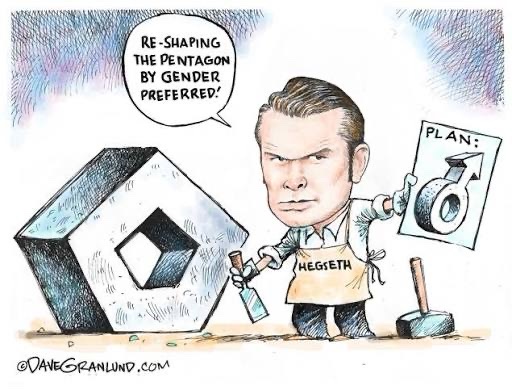
The Masculinity Olympics
For an administration that seems perpetually terrified of anything that might be labeled “woke,” “effeminate,” or “not masculine enough,” they sure spend an astonishing amount of time talking about… men.
Not policy. Not infrastructure. Not healthcare. Men.
Muscular men. Tough men. Young men. High-testosterone men. Men who apparently embody some mythical vision of American masculinity that was forged somewhere between a recruiting poster from 1943 and the cover of a bodybuilding magazine.
It’s almost become government policy.
Every speech seems to include praise for the physical strength, toughness, or appearance of soldiers, athletes, or law enforcement officers. Every cultural complaint somehow circles back to masculinity supposedly being under attack. Every problem in America apparently has the same prescription: more testosterone.
Now enter the Secretary of Defense—or perhaps, given the increasingly hawkish rhetoric, the Secretary of War.
The latest obsession? Testing troops over thirty for low testosterone and aggressively pursuing testosterone replacement therapy wherever it’s deemed appropriate. It’s presented almost as if America’s military readiness hinges not on training, logistics, strategy, or technology, but on everyone’s hormone levels.
You almost expect the next Pentagon budget to include a line item for protein powder and squat racks.
The irony is impossible to ignore.
This is an administration that rails endlessly against LGBTQ Americans, treats discussions of gender identity as existential threats to civilization, and acts as though simply acknowledging diversity is somehow dangerous.
Yet they’re utterly captivated by an incredibly narrow image of masculinity.
Everything becomes about muscles.
Everything becomes about testosterone.
Everything becomes about proving who’s the toughest guy in the room.
It’s as if they believe the Constitution came with a required bench press minimum.
Real strength has never been measured by biceps.
History’s greatest military leaders weren’t remembered because they had the highest testosterone levels. They were remembered because they understood strategy, logistics, diplomacy, discipline, and leadership.
Likewise, great presidents aren’t judged by how “alpha” they appear. They’re judged by whether the country is stronger, safer, and more prosperous after they leave office.
America has never required every citizen—or every soldier—to fit into one cartoonish stereotype of masculinity.
Our military succeeds because it recruits people with different skills, different backgrounds, and different strengths. Intelligence analysts don’t win wars by deadlifting. Cybersecurity experts don’t defend networks with bigger biceps. Pilots don’t fly better because their hormone levels fit some arbitrary ideal.
Competence beats machismo every time.
Perhaps that’s the strangest part of all this.
For a movement constantly accusing everyone else of “identity politics,” they seem remarkably consumed by one particular identity: a highly stylized, exaggerated version of masculinity.
It’s politics as a high school locker room.
The obsession isn’t strength.
It’s the performance of strength.
Because genuinely confident people don’t spend every waking moment trying to convince everyone else how masculine they are.
They simply get the job done.

-
Not really tech
Which outdated technology do you miss the most, and why?
What technology not really technology I miss the most is just basic human conversation and interaction because with cell phones and texting and Snapchat and Instagram. No one knows how to have a conversation anymore. It is like this current generation thinks that it’s something from the Stone Age to actually talk to you so it’s not really technology, but it’s just basic human interaction that I miss.
-
Same Lies in Primetime
Dwain Northey (Gen X)
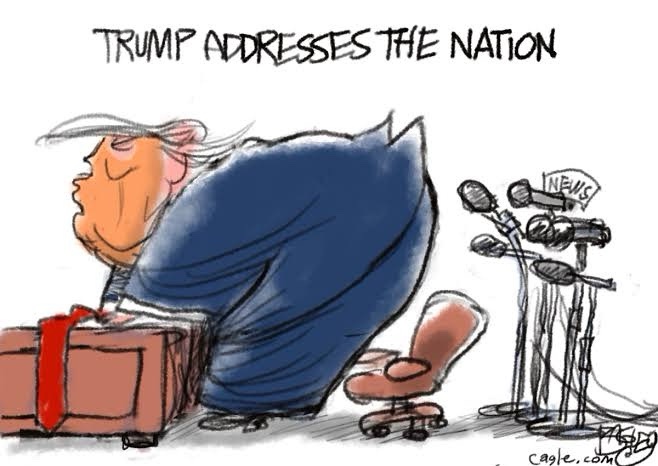
Donald Trump took to the airwaves in prime time once again to relitigate the 2020 election. Once again, we’re told there were shadowy forces, foreign interference, mysterious ballots, and somehow China lurking behind the curtain. Once again, we’re told our elections need to be “cleaned up” because the only election that apparently counts as legitimate is the one where Donald Trump hears the words, “You win.”
Here’s the part that has always fascinated me.
In 2016, Barack Obama was president. Democrats were in the White House. The federal government oversaw the election. Trump won. Miraculously, our voting system worked beautifully. Democracy prevailed. The republic was saved.
Fast forward to 2020.
Donald Trump was president. His administration oversaw the election. His Attorney General was Bill Barr. His Department of Homeland Security was responsible for election security. Republican governors, Republican secretaries of state, Republican election officials, and thousands of local volunteers ran elections across the country.
Trump lost.
Suddenly, the entire system was corrupt.
Then comes 2024.
Joe Biden was president. Democrats were back in the White House. The same basic election infrastructure existed. States still ran their own elections. Paper ballots were still counted. Republican officials still certified Republican counties. Trump won.
And just like that…
Election integrity was back!
So let me see if I’ve got the formula right.
If Democrats are in charge and Trump wins, elections are fair.
If Republicans are in charge and Trump loses, elections are rigged.
If Democrats are in charge and Trump wins again, elections are fair again.
At some point you stop examining the voting machines and start examining the consistency of the argument.
The common denominator isn’t who occupied the White House.
It isn’t who controlled the Department of Justice.
It isn’t who was Secretary of Homeland Security.
It isn’t even which party administered the election.
The only variable that seems to matter is whether Donald Trump won.
Of course, there was one major difference in 2020 that conveniently gets ignored.
We were in the middle of a once-in-a-century pandemic.
COVID-19 changed everything. Polling places had to adapt. States—many of them led by Republican governors and legislatures—expanded absentee and mail-in voting so people didn’t have to risk standing shoulder-to-shoulder in long lines during a public health emergency. Military members had been voting by mail for generations. Seniors had been voting by mail for years. Several states had successfully conducted elections primarily by mail long before COVID ever existed.
The difference in 2020 wasn’t that some sinister foreign power suddenly figured out how to infiltrate thousands of county election offices across America.
The difference was participation.
People were home. They were paying attention. Politics wasn’t background noise anymore; it determined whether schools were open, whether businesses survived, whether family members got sick, and whether loved ones lived or died. Millions of Americans who had never bothered to vote before suddenly had both the time and the motivation to do so. Making voting by mail more accessible meant millions of eligible voters who might otherwise have skipped the election actually cast a ballot.
And apparently, according to Donald Trump, that’s the suspicious part.
Think about that for a moment.
The accusation isn’t really that election officials secretly changed enough votes to alter the outcome. The implication is that because more Americans voted, somehow that itself is evidence of fraud. As if higher voter turnout is inherently suspicious.
That’s a strange argument for someone who constantly says he wants every legal vote counted.
More people voting isn’t proof of a stolen election. It’s proof that more people voted.
Yet the narrative became that because there were millions more mail-in ballots—a system expanded largely because of a global pandemic—the only explanation must be foreign interference, mysterious ballot dumps, China, or some elaborate conspiracy.
Or maybe the simpler explanation is the correct one.
A global pandemic fundamentally changed how Americans voted, not who counted the votes.
Believing every victory proves the system is perfect while every defeat proves the system is corrupt isn’t election integrity.
It’s scoreboard integrity.
We’ve spent nearly six years replaying this movie. Court cases. Audits. Recounts. Republican election officials. Conservative judges. Trump’s own administration. None produced evidence of fraud on the scale required to overturn the election.
Yet here we are again, listening to the same script with a few new villains added to the cast.
It’s almost as if the election system has one incredibly complicated feature built into it:
Sometimes your candidate wins.
Sometimes your candidate loses.
That’s how democracy works.
The theory only works if you begin with the conclusion that Donald Trump couldn’t have legitimately lost. Every fact after that has to be bent until it fits the story.
When he wins, the system is secure.
When he loses, the system is broken.
That’s not a principle.
That’s not evidence.
That’s not election integrity.
That’s simply refusing to accept that in a democracy, sometimes the other guy gets more votes.
-
Excuses
What is the best excuse you have heard lately?
I really don’t believe there’s a good excuse, told my son who is 21 years old. If you have to make up an excuse not to do something then you really just shouldn’t do it. If you’re constantly making up, excuses not to go to work then it’s time to find a new job because you’re spending more energy trying to get out of doing something and just doing it so I haven’t heard a good excuse cause I don’t think excuses are valid. If you have to make a fucking excuse, there’s just no point in doing what you’re making up excuse not to do.
-
International criminal court
Dwain Northey (Gen X)

Before we get started, let me point out one of the oldest traditions in American foreign policy: we absolutely love international law… right up until someone suggests it might apply to us.
For decades, American leaders stood at podiums around the world explaining that no nation should be above international law. We helped build a post-World War II order rooted in the simple idea that there are rules civilized nations follow, especially in war. The Geneva Conventions weren’t written as suggestions. They were written because humanity had already seen what happens when governments convince themselves that military necessity excuses everything.
Now comes Marco Rubio, declaring that the International Criminal Court should be dismantled because it has the audacity to investigate Americans.
Really?
So the problem isn’t whether crimes occurred. The problem is that someone dared ask the question?
That’s an interesting definition of justice.
Apparently the ICC was perfectly acceptable when it investigated African dictators, Serbian war criminals, Russian officials, or anyone else America happened to dislike. Then it was proof that the civilized world could hold tyrants accountable.
But the moment the court looks in our direction?
Suddenly it’s a “rogue court.”
Suddenly it’s “unelected judges.”
Suddenly international law has become an outrageous attack on American sovereignty.
That’s not a legal principle. That’s the diplomatic equivalent of yelling, “The referee is fine until he calls a foul on my team.”
Let’s be honest about what the ICC was created to do.
It wasn’t established after the horrors that culminated in the postwar Geneva Conventions so powerful nations could use it as a club against weaker countries. It exists because the world decided that some crimes are so serious—war crimes, crimes against humanity, genocide—that no nation should simply get to investigate itself and declare, “We checked. We found nothing wrong.”
That principle only works if it applies universally.
Otherwise, it’s not justice.
It’s empire.
The current outrage centers on allegations involving Defense Secretary Pete Hegseth and broader decisions surrounding military operations, as well as inflammatory rhetoric from Donald Trump about striking civilian infrastructure in Iran. Whether any individual ultimately bears criminal responsibility is precisely the kind of question courts are supposed to evaluate based on evidence and law—not political loyalty or cable news ratings.
That’s how justice is supposed to work.
Notice that the ICC doesn’t sentence people because politicians dislike them.
It investigates.
It gathers evidence.
It hears arguments.
It follows legal procedures.
You know—the exact process conservatives usually tell everyone else to respect.
Unless, apparently, the defendant has an American passport or lives at Mar-a-Lago.
Then due process suddenly becomes foreign interference.
This exposes an uncomfortable truth.
For years America projected itself as the indispensable defender of the rules-based international order. We lectured other nations about accountability, human rights, and the rule of law.
Those were admirable ideals.
But ideals mean very little if they’re only intended for other people.
If international law only applies to countries too small to object, then it isn’t international law.
It’s selective enforcement.
And selective enforcement breeds cynicism around the globe.
Donald Trump has long operated under a remarkably simple philosophy: laws exist for everyone else. Whether it’s criminal indictments, civil judgments, constitutional limits, or now international law, every institution that questions him suddenly becomes corrupt, weaponized, illegitimate, or part of some vast conspiracy.
The pattern never changes.
If the court agrees with him, it’s brilliant.
If it doesn’t, abolish the court.
If an election goes his way, democracy works.
If it doesn’t, the election was stolen.
If prosecutors investigate him, dismantle the prosecutors.
If international judges investigate potential war crimes, dismantle the international court.
It’s remarkable consistency, if nothing else.
And now Marco Rubio appears to be extending that philosophy onto the world stage.
Imagine the precedent.
China could dismiss international courts.
Russia could dismiss international courts.
Iran could dismiss international courts.
Israel could dismiss international courts.
America could dismiss international courts.
At that point, why even have international law?
Why have the Geneva Conventions?
Why have treaties?
Why pretend that any rules exist at all?
Because once every nation decides that accountability is only for somebody else, the entire framework collapses.
The irony is impossible to ignore.
America helped champion a world where might wasn’t supposed to make right.
Now some of our leaders seem determined to prove that if you’re powerful enough, accountability is optional.
That’s not American exceptionalism.
That’s just exceptional arrogance.
The real test of believing in the rule of law isn’t whether it applies to your enemies.
It’s whether you’re willing to let it apply to yourself.
Because if your first instinct whenever someone investigates you is to destroy the institution doing the investigating, then you never believed in justice.
You only believed in immunity.
-
Political Placeholder
Dwain Northey (Gen X)

The passing of Lindsey Graham has barely had time to settle into the history books, and we’ve already been treated to one of American democracy’s more bizarre traditions: “Quick! Find somebody with the same last name!”
Apparently, somewhere in the Constitution—probably written in invisible ink between the Third and Fourth Amendments—is a clause that says, “In the event of a vacancy, locate the nearest available relative.”
Now, to be perfectly clear, this isn’t about Lindsey Graham’s sister as an individual. She may be intelligent, capable, and perfectly qualified. That’s beside the point. The problem is that a functioning republic shouldn’t resemble a family business where the owner retires and everyone simply assumes the cousin gets the keys.
We don’t replace Supreme Court justices by asking if they have a sibling who’s free on Tuesdays.
We don’t replace airline pilots by saying, “Well, his brother has flown coach before.”
We don’t replace surgeons by handing the scalpel to a niece because she attended Thanksgiving dinner.
Yet somehow, when it comes to one of the one hundred most powerful legislative seats in the United States, we’re expected to shrug and say, “Sure, close enough.”
This is one of those political traditions that everyone accepts because it’s always been done, not because anyone ever stopped to ask whether it makes any sense.
Governors appoint temporary senators. States have different rules. Congressional vacancies trigger special elections. It’s a patchwork quilt sewn together over two centuries of political compromise, duct tape, and crossed fingers.
The result is that millions of people can suddenly find themselves represented by someone they never voted for.
Sometimes it’s a longtime political ally.
Sometimes it’s a major donor.
Sometimes it’s a former staffer.
Sometimes it’s someone whose primary qualification appears to be sharing DNA with the previous officeholder.
That’s not representative democracy. That’s political inheritance with extra paperwork.
Imagine applying this logic elsewhere.
“Sadly, your dentist retired.”
“Who’s replacing him?”
“His nephew. Never cleaned a tooth in his life, but he has the same Christmas photos.”
Or your airline announces, “Ladies and gentlemen, your captain unexpectedly became unavailable. Fortunately, we’ve located his sister. She once sat in the cockpit during a family vacation.”
Somehow I suspect everyone would suddenly become enthusiastic supporters of merit-based hiring.
The argument, of course, is continuity. Someone has to fill the seat until voters can decide.
Fair enough.
But surely, in a nation of more than 340 million people, we can devise a system that’s a little more democratic than, “Who’s related to the last guy?”
Perhaps require an expedited special election within a fixed number of weeks. Perhaps create a bipartisan interim appointment process with strict qualifications and a prohibition on immediate incumbency advantages. Perhaps limit interim appointees to serving only until the election, preventing them from using the office as a taxpayer-funded campaign headquarters.
Anything that reminds us that these offices belong to the public—not to political families.
Public office was never intended to be hereditary.
America fought an entire revolution because we weren’t particularly fond of inherited political power.
We dumped a bunch of tea into Boston Harbor over the idea that governments derive their legitimacy from the consent of the governed—not from sharing Thanksgiving recipes with the previous officeholder.
And yet, every so often, our political system quietly whispers, “Well… maybe just this once.”
No.
Whether the appointee is a sibling, spouse, child, longtime confidant, or complete stranger isn’t really the issue.
The issue is that citizens deserve representation chosen by citizens.
Not by coincidence.
Not by genealogy.
Not because someone happened to answer the governor’s phone.
If we’re serious about representative government, then vacancies should be filled in ways that maximize representation—not convenience. Democracy is occasionally messy, expensive, and inconvenient. That’s the price of self-government.
It’s still considerably cheaper than pretending political offices are family heirlooms passed down with the fine china.


You must be logged in to post a comment.