Dwain Northey (Gen X)
https://www.cbsnews.com/news/naacp-travel-advisory-florida-says-state-hostile-to-black-americans/
Remember the good old days when there were only travel advisories and or ban for, what some would call, third word countries? Well now because of the vile vitriol of one Governor Ron DeSantis the state of Florida, a vacation destination, has received a travel advisory by the NAACP.
The wannabe future President has made the climate so venomous in Florida the anyone who is a part of any minority group does not feel safe in the state. Black, Brown, LGTBQ+, these are all groups that are under attack in the Sunshine State. The majority Republican legislature and their fearful leader has passed laws that make almost everything a jailable offence and the fact that the state has very loose gun laws and a stand your ground law makes it more dangerous than being a blonde female in central America.
Florida residents are able to carry concealed guns without a permit under a bill signed into law by Republican Gov. Ron DeSantis. The law, which goes into effect on July 1, means that anyone who can legally own a gun in Florida can carry a concealed gun in public without any training or background check. This with their ridiculous stand your ground law, ‘Florida’s “Stand-Your-Ground” law was passed in 2005. The law allows those who feel a reasonable threat of death or bodily injury to “meet force with force” rather than retreat. Similar “Castle Doctrine” laws assert that a person does not need to retreat if their home is attacked.’ Makes it really sketchy to go there.
This in top of the don’t say gay rule and the new trans ruling that just passed.
“Florida lawmakers have no shame. This discriminatory bill is extraordinarily desperate and extreme in a year full of extreme, discriminatory legislation. It is a cruel effort to stigmatize, marginalize and erase the LGBTQ+ community, particularly transgender youth. Let me be clear: gender-affirming care saves lives. Every mainstream American medical and mental health organization – representing millions of providers in the United States – call for age-appropriate, gender-affirming care for transgender and non-binary people.
“These politicians have no place inserting themselves in conversations between doctors, parents, and transgender youth about gender-affirming care. And at the same time that Florida lawmakers crow about protecting parental rights they make an extra-constitutional attempt to strip parents of – you guessed it! – their parental rights. The Human Rights Campaign strongly condemns this bill and will continue to fight for LGBTQ+ youth and their families who deserve better from their elected leaders.”
This law makes it possible for anyone to just accuse someone of gender affirming care to have their child taken from them this would include someone traveling from out of state. This alone justifies a travel ban to the Magic Kingdom for families.
Oh, and I haven’t even mentioned DeSantis holy war with Disney, the largest employer in the state. I really hope the Mouse eats this ass holes lunch.
Well that’s enough bitching, thanks again for suffering though my rant.
-
Driving a Weapon
Dwain Northey (Gen X)
The Most Dangerous Weapon Most People Never Think About
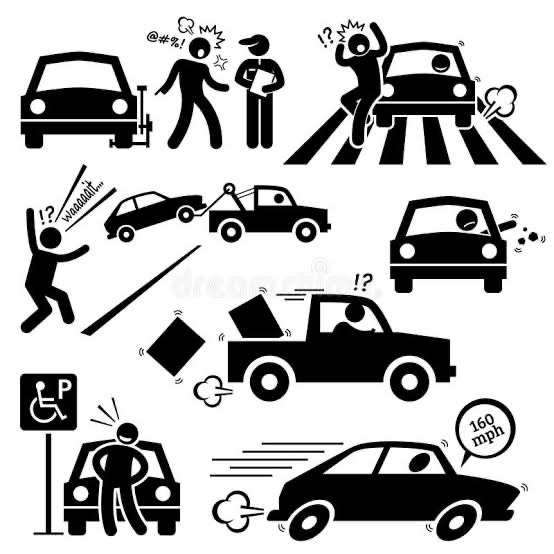
I spend my workday behind the wheel. Hour after hour, mile after mile, I watch what has become a disturbing social experiment in selfishness. Every day I see people scrolling through their phones while driving two tons of steel at freeway speeds. I watch people weaving through traffic without signaling, tailgating until they’re practically in the back seat of the car ahead of them, blowing through red lights because waiting thirty more seconds is apparently too much to ask.
Then there are the people who seem personally offended by a turn signal.
You put your blinker on to merge, and instead of doing what driving etiquette has required for generations, they speed up to close the gap. It’s as if your signal wasn’t a request to merge but a declaration of war. They would rather risk an accident than allow another human being to get one car length ahead of them.
What happened to us?
Somewhere along the way, driving stopped being a shared responsibility and became a competitive sport where everyone believes they’re the only person on the road who matters.
The irony is that these same people rarely stop to consider what they’re actually controlling. A modern automobile isn’t just transportation. It’s a one- to three-ton machine capable of causing catastrophic damage in a fraction of a second. Most drivers don’t think of it that way, but physics certainly does.
A distracted driver staring at a text message isn’t just being rude. They’re operating a deadly piece of machinery while their attention is somewhere else. The laws of momentum don’t care whether you’re checking Instagram or changing the radio station.
Every time we get behind the wheel, we accept an enormous responsibility toward everyone else on the road.
Which brings me to another claim we’ve been hearing over and over.
ICE and the Department of Justice frequently justify shootings by saying an individual “used their vehicle as a weapon” or “drove toward officers,” creating an immediate threat that required deadly force.
If that were the whole story, it would certainly deserve serious consideration. A vehicle can absolutely be used intentionally as a deadly weapon.
But in several widely circulated incidents, publicly available videos recorded by bystanders appear to show a more complicated picture than the official narrative. In some cases, the vehicle seems to be turning away from officers rather than accelerating toward them. In others, gunfire appears to strike through a passenger-side window, raising questions about whether the vehicle was actually moving toward the officer at the moment shots were fired.
Those videos don’t automatically answer every question. A camera captures only one angle, and investigations should examine all available evidence. But they do make one thing clear: official statements deserve scrutiny rather than automatic acceptance.
That is precisely why transparency matters.
If officers routinely claim they were facing an imminent deadly threat from a vehicle, then body-worn cameras should help establish exactly what happened. They protect officers when their actions are justified, and they protect the public when official accounts don’t match reality.
Instead, many of the officers involved in these encounters are not wearing body cameras.
That absence doesn’t prove wrongdoing. But it does leave the public relying on conflicting narratives instead of objective evidence.
Meanwhile, every day on America’s highways, thousands of distracted and aggressive drivers unknowingly create genuine dangers with their vehicles. They aren’t thinking about using a car as a weapon, but their reckless behavior puts lives at risk nonetheless.
It’s a strange contradiction.
We tolerate astonishingly reckless behavior on our roads every single day, often dismissing it as “just traffic.” Yet in some law enforcement encounters, the mere movement of a steering wheel is later described as an intentional deadly assault—even when publicly available video raises legitimate questions about that characterization.
Whether you’re an ordinary commuter or a federal officer, facts matter.
A vehicle is capable of being a deadly weapon. That reality should make every driver more responsible and every use-of-force investigation more careful—not less.
Because when two tons of steel are involved, assumptions can be just as dangerous as reckless driving.
-
Nature versus nurture
Do you think we’re shaped more by our experiences or by who we are?
Psychologist have had this debate forever, whether you are predetermined to have problems or if your environment causes them honestly, it’s a little of both your born was certain inherent attributes or things but absolutely your experiences from a young child to adulthood will sharpen or Dillon those responses if you’re an abuse child then most likely you’re gonna be an abusive adult and if you’re someone that was raised via caring nurturing parent then you’re gonna have those attributes you know so the nature versus nature versus nurture argument it’s gonna continue forever and ever.
-
Rebrand
Dwain Northey (Gen X)

Maybe It’s Time to Stop Calling Ourselves Democratic Socialists and Start Calling Ourselves FDR Democrats
Republicans have spent the better part of a century turning the word socialist into a political boogeyman. Never mind that most of the people using the term couldn’t define socialism if their lives depended on it. To many voters, the word has been conditioned to trigger the same response as “communist,” “Marxist,” or whatever scary label happens to be trending that week.
Politics isn’t just about policy. It’s about language. And Democrats have been losing the language war for decades.
So maybe it’s time to stop arguing over labels that have already been poisoned and start reclaiming one that Americans already respect.
Call ourselves FDR Democrats.
Think about it. Franklin Delano Roosevelt remains one of the most consequential presidents in American history. He inherited an economy in freefall, restored confidence in the banking system, put millions of Americans to work through public projects, created Social Security, strengthened labor rights, and laid the foundation for the American middle class. Whether someone agrees with every New Deal program or not, few can honestly deny that Roosevelt fundamentally reshaped America during one of its darkest moments.
Imagine someone asking, “What’s an FDR Democrat?”
That’s an easy answer.
“We believe government should work for ordinary Americans. We believe workers deserve a fair wage. We believe retirees earned Social Security. We believe infrastructure creates jobs. We believe investing in people makes the country stronger.”
An FDR Democrat also believes in something that has somehow become controversial despite being one of the pillars of America’s most prosperous era: progressive taxation.
That doesn’t mean punishing success. It means recognizing that those who have benefited the most from America’s economy have a greater capacity—and a greater responsibility—to help sustain the country that made that success possible.
During Roosevelt’s presidency and for decades afterward, the wealthiest Americans and the largest corporations paid significantly higher tax rates than they do today. Yet those same decades produced the strongest middle class in our nation’s history, unprecedented economic growth, expanding homeownership, and an explosion of American manufacturing. Asking those at the very top to contribute more did not destroy capitalism. If anything, it strengthened it by giving ordinary Americans the purchasing power to become the engine of the economy.
An FDR Democrat believes that a nurse should not pay a higher effective tax rate than a billionaire whose wealth is largely derived from investments. An FDR Democrat believes multinational corporations that benefit from America’s infrastructure, educated workforce, legal system, and consumer market should help pay to maintain those advantages instead of spending billions finding loopholes to avoid taxes altogether.
It’s a simple principle: those with the broadest shoulders should carry a little more of the load. Not because they’ve done something wrong, but because they’ve done extraordinarily well in a system that all Americans helped build.
Notice something about all of this?
There’s no need to utter the word socialism at all.
Even politicians routinely branded as “socialists” by conservatives often advocate policies that fit comfortably within the New Deal tradition. Bernie Sanders, while an Independent, frequently champions expanding Social Security, strengthening labor protections, and using government to improve economic security—ideas with clear parallels to Roosevelt’s philosophy. New York City Mayor Zohran Mamdani has been labeled a democratic socialist, yet many of the policies he advocates—strengthening public services, investing in infrastructure, expanding affordable housing, and using government to improve the lives of working people—fit comfortably within what I would call the FDR Democratic tradition. Former President Joe Biden’s major legislative accomplishments—from rebuilding infrastructure to encouraging domestic manufacturing and investing in clean energy—reflected the same belief that government should help build prosperity from the ground up instead of simply hoping it trickles down from the top.
That sounds far more like Roosevelt than revolutionary socialism.
The same philosophy stretches beyond Franklin Roosevelt himself. Theodore Roosevelt, though a Republican of his era, challenged monopolies, fought corporate abuses, protected consumers, and believed concentrated economic power threatened democracy. Wisconsin Governor “Fighting Bob” La Follette championed progressive reforms that strengthened democracy and curbed corporate influence. Different parties, different eras, but the same underlying belief: government exists to serve the public before serving concentrated wealth.
The point isn’t to recreate the 1930s.
The point is to reclaim the tradition that built America’s strongest middle class.
One of Roosevelt’s greatest strengths was that he wasn’t governing to maximize quarterly earnings reports. He understood that corporations are essential to the economy, but they are not the economy. Workers are. Families are. Consumers are. Small businesses are. A healthy nation requires healthy people, not simply healthy stock prices.
An FDR Democrat believes government exists to serve the people, not merely those with the largest lobbying budgets. It believes elected representatives should listen first to the citizens who sent them to Washington, not the corporations writing campaign checks. It believes prosperity grows from the bottom up and the middle out—not from hoping that enough wealth trickles down from the top.
Some will immediately scream, “That’s socialism!”
Fine.
Then ask them a few simple questions.
Do you support Social Security?
Do you like national parks?
Do you appreciate rural electrification?
Do you drive on publicly funded highways?
Do you expect clean drinking water?
Because none of those things appeared by magic. They came from a government that decided some investments benefit the entire nation and cannot simply be left to the marketplace.
The irony is almost painful. Many of the same people who recoil at the word socialism fiercely defend programs born from the very philosophy they claim to oppose.
Democrats have spent years trying to explain that nuance. Maybe that’s the wrong strategy.
Maybe the better strategy is to remind Americans of a president they already know.
An FDR Democrat isn’t asking government to control every aspect of life. An FDR Democrat believes government should create the conditions where ordinary Americans—not just the wealthiest corporations—have the opportunity to succeed. It believes those who have benefited the most from our economy should contribute a little more to preserve the opportunities that made their success possible. It believes that democracy works best when government answers to voters instead of corporate boardrooms.
That isn’t socialism.
That isn’t class warfare.
It’s citizenship.
Maybe that’s the brand Democrats should embrace.
Not because it’s new.
Because it’s one of the most successful American ideas we’ve ever had.
-
Dog
If you had to be an animal for a week, which one would you be and why?
If I had to be an animal for a week, I’d wanna be my dog. He just gets to sleep and play and eat and poop. Do nothing be so nice to not have to think about anything for an entire week and somebody else take care of it.
-
Meeting in the middle
Dwain Northey (Gen X)

One of the phrases that has completely lost its meaning in American politics is, “We just need to meet in the middle.”
Really?
The middle of what?
Because what Republicans often call “the middle” isn’t halfway between two competing ideas. It’s halfway between where they started and where they want to end up. Somehow, the compromise always seems to involve Democrats giving up half of what they’re trying to protect while Republicans give up half of what they’re trying to dismantle.
That’s not compromise. That’s negotiating the speed of the demolition.
Take Social Security.
The political left isn’t proposing some radical socialist experiment. The solution has been discussed for decades: raise or eliminate the payroll tax cap so higher earners continue paying into the same system that has successfully kept millions of seniors out of poverty for nearly ninety years. Keep it public. Keep the guarantee. Make the math work.
Republicans, meanwhile, routinely float ideas ranging from privatization to raising the retirement age to reducing benefits. Their preferred “reforms” often involve handing retirement savings to Wall Street, private equity firms, investment banks, or financial managers who would happily collect fees while assuming little of the actual risk.
So where exactly is the “middle”?
Half public and half privatized?
Half guaranteed and half subject to the stock market?
That’s like saying the middle ground between owning your house and selling it is letting someone else collect your mortgage payments.
The destination is still the same.
This pattern repeats itself over and over.
Healthcare? The left argues healthcare should remain accessible and affordable. The right says privatize more of it. The “middle” somehow becomes giving private insurers even more influence.
Education? The left wants to strengthen public schools. The right wants vouchers and privatization. The compromise somehow becomes slowly starving public education while expanding private alternatives.
Environmental policy? Scientists say reduce emissions. Republicans say drill more. The “middle” becomes drilling a little less while still ignoring the science.
Notice a pattern?
The compromise always moves in one direction.
Imagine two people standing on opposite sides of a football field. One walks fifty yards toward the center while the other walks five. Then the second person complains that the first refuses to compromise because they won’t walk the remaining forty-five yards.
That’s what today’s “meet in the middle” often sounds like.
Compromise is supposed to mean both sides surrender something while preserving the underlying goal. It isn’t supposed to mean one side abandons its principles while the other simply slows down long enough to call it bipartisanship.
As a Gen Xer, I grew up believing compromise meant nobody got everything they wanted. Today, it too often means one side gets eighty percent of what it wanted and then congratulates itself for being reasonable because it didn’t demand the remaining twenty percent.
If preserving Social Security means raising the income cap so the wealthiest Americans contribute more to the system they’ve benefited from, that’s a policy debate worth having.
If the alternative is turning one of America’s most successful social insurance programs into another revenue stream for financial institutions, don’t tell me the middle is somewhere between guaranteed retirement security and gambling your future on quarterly earnings reports.
That’s not the middle.
That’s just taking a detour on the road to privatization.
Words matter. “Compromise” means both sides move. “Middle” means halfway. When one side keeps dragging the center toward its own position and then declares that wherever it stopped is the new middle, that’s not moderation.
It’s marketing.
And after hearing it for decades, some of us are simply tired of pretending otherwise.
-
Future technology
What’s a piece of technology you’re convinced will exist in 20 years?
 I think that a lot of the technology that we currently have we will still have it will just be more advanced. AI will get better. We obviously still have cell phones. They’ll be more satellites in the world, but the one technology that I hope that we work on in advance to a greater degree is water desalinization because that’s one thing that we definitely need. The oceans aren’t going away, but if we can desalinate and purify water so that it’s more potful for consumption that will help and if it can be done with green energy that would be even better so that rain out at the end of the desalinization process through solar or geothermal heat won’t cause more climate change.
-
Books?
Which book have you read more than any other?
I know a lot of people are gonna put on this post that the book they’ve read the most is the Bible, which I find insane because most people have never read the whole thing I have but it’s not my favorite book. I did my thesis paper in College in English literature on Moby Dick which I’ve read probably five or six times. I’ve read the great Gatsby a couple times I like the classics. I’ve read a couple Stephen King novels a few times. I will admit that I did read the Harry Potter series more than once, but I’m a reader so I wouldn’t say that there’s a favorite book but the one I’ve spent the most time with my nose in is Moby Dick.
-
Liberal media?
Dwain Northey (Gen X)

For nearly seventy years, American conservatives have used the phrase “liberal media” as though it were a self-evident insult. It’s become one of those political slogans that gets repeated so often people stop asking what it actually means.
Maybe it’s time we did.
Traditional journalism was never supposed to tell us what to think. It was supposed to tell us what happened, verify it with evidence, confirm it with multiple sources, and separate fact from rumor. That’s not liberalism. That’s journalism.
Somewhere along the way, conservatives began equating reality itself with liberalism. If reporting is based on documented evidence, official records, scientific research, court filings, or observable facts, and those facts happen to contradict conservative narratives, suddenly the problem isn’t the narrative—it’s the media.
Think about that for a moment.
If facts consistently have a liberal bias, perhaps the issue isn’t the facts.
For decades, journalists like Walter Cronkite became trusted not because they were activists, but because they painstakingly verified what they reported. Cronkite wasn’t famous for telling America what he wished were true. He was famous for ending each broadcast with the simple phrase, “And that’s the way it is.”
That wasn’t an opinion.
It was a mission statement.
Today’s media landscape has largely abandoned that distinction. We now have entire networks whose business model revolves around commentary disguised as news. Panels of pundits speculate endlessly, personalities tell audiences what they should feel, and evidence often becomes secondary to outrage.
Opinion has become entertainment.
Entertainment has become news.
And news has become whatever confirms someone’s existing beliefs.
Ironically, the media conservatives often dismiss as “left-wing” generally spends enormous amounts of time citing documents, interviewing experts, linking to source material, and issuing corrections when mistakes are made. Is it perfect? Of course not. Journalists make mistakes because journalists are human.
But there is a profound difference between making an error and intentionally constructing a narrative regardless of the evidence.
Conservatives have spent generations attacking the very idea that facts should be the foundation of reporting. Instead, they increasingly reward media that begins with a conclusion and then searches for evidence to support it. That isn’t journalism.
That’s marketing.
Or propaganda.
There’s nothing inherently liberal about believing that climate data should come from climatologists, medical information should come from physicians, election results should come from certified counts, or court cases should be reported using actual court documents.
That’s simply respecting evidence.
If that makes someone a liberal in today’s political vocabulary, then perhaps we’ve reached a strange place where believing verifiable facts has become a partisan identity.
The irony is almost impossible to ignore.
What many conservatives have spent seventy years calling “liberal media” is often nothing more than journalism doing exactly what journalism was always intended to do: gather evidence, verify facts, correct mistakes, and report reality whether people like it or not.
Reality isn’t liberal.
Reality simply exists.
Facts don’t vote.
Facts don’t care about political parties.
Facts don’t change because they make us uncomfortable.
And perhaps the greatest compliment modern journalism can receive is being accused of bias simply because it refuses to abandon the evidence.
As Walter Cronkite reminded America every evening, the goal was never to tell us what we wanted to hear.
It was simply to tell us the truth.
And that’s the way it is.
-
 Lindsey’s gone is Mitch far behind
Dwain Northey (Gen X)

The Republican Party suddenly finds itself facing a political problem that has nothing to do with polling, fundraising, or campaign strategy. It is confronting something every political party eventually must: the reality that time catches everyone.
With the reported passing of Senator Lindsey Graham and the continuing uncertainty surrounding Senator Mitch McConnell’s health and political future, Republicans are entering unfamiliar territory. Even if they retain a Senate majority today, that majority has become noticeably thinner, and every vacancy, retirement, or prolonged absence magnifies the influence of every remaining senator.
In a chamber where a single vote can determine whether legislation advances, judicial nominees are confirmed, or a budget passes, arithmetic matters more than ideology. A three-seat cushion feels comfortable until it becomes a one-seat cushion. Then every illness, every resignation, and every special election becomes national news.
The challenge extends well beyond the current Congress. Republicans now have to ask what their Senate map looks like heading into the 2026 midterms. Do they spend valuable resources defending seats they assumed were secure? Do they recruit new candidates capable of replacing decades-long incumbents? Or do they continue relying on personalities who have dominated the party for years while hoping the transition takes care of itself?
Leadership transitions are never simple. Mitch McConnell has shaped Senate Republican strategy for nearly two decades. Whether one admired his tactics or opposed them, few would argue that he wasn’t extraordinarily effective at counting votes and keeping his conference together. Replacing institutional knowledge accumulated over decades isn’t as simple as holding a leadership election.
Lindsey Graham occupied a different role. He often served as one of the party’s most visible communicators on national security, judicial appointments, and foreign policy. His absence leaves another gap—not just in committee assignments but in the public face of Senate Republicans.
Democrats have faced similar moments. Parties inevitably lose senior members through retirement, defeat, or death. The question is whether they have spent enough time cultivating the next generation of leadership before the transition becomes unavoidable.
The Republican Party has increasingly become identified with one dominant figure at the top and a relatively small circle of long-serving senators around him. That concentration of experience creates stability—until it doesn’t. When several pillars begin disappearing at roughly the same time, succession suddenly becomes the central issue.
Looking toward 2026, Republicans may discover that maintaining a majority is only part of the challenge. They must also convince voters that the party has a deep bench capable of governing for the next decade rather than simply preserving the last one.
Political parties often spend so much time preparing for the next election that they forget to prepare for the next generation. Demographics, health, and time don’t consult polling averages before making their decisions.
The Senate’s balance of power may not change overnight, but its center of gravity already has. And that could make 2026 less about partisan ideology and more about who is ready to inherit the responsibility of governing when an era comes to an end.
-
Aren’t we all?
Are you a lifelong learner?
If you’re asking the question as a traditional learner sitting in classrooms, I would say I’m a learner. I do continue to take classes. I do have a college degree and I’d like to read, but I always refer back to what my dad told my son years ago, cause my dad went back to school and my son said you and my dad are weird every time you’re bored you pick up a book or you go back to school and my dad told my son very frankly that boy the day you stop learning is the day they start throwing dirt on your face.


You must be logged in to post a comment.