Dwain Northey (Gen X)
https://www.cbsnews.com/news/naacp-travel-advisory-florida-says-state-hostile-to-black-americans/
Remember the good old days when there were only travel advisories and or ban for, what some would call, third word countries? Well now because of the vile vitriol of one Governor Ron DeSantis the state of Florida, a vacation destination, has received a travel advisory by the NAACP.
The wannabe future President has made the climate so venomous in Florida the anyone who is a part of any minority group does not feel safe in the state. Black, Brown, LGTBQ+, these are all groups that are under attack in the Sunshine State. The majority Republican legislature and their fearful leader has passed laws that make almost everything a jailable offence and the fact that the state has very loose gun laws and a stand your ground law makes it more dangerous than being a blonde female in central America.
Florida residents are able to carry concealed guns without a permit under a bill signed into law by Republican Gov. Ron DeSantis. The law, which goes into effect on July 1, means that anyone who can legally own a gun in Florida can carry a concealed gun in public without any training or background check. This with their ridiculous stand your ground law, ‘Florida’s “Stand-Your-Ground” law was passed in 2005. The law allows those who feel a reasonable threat of death or bodily injury to “meet force with force” rather than retreat. Similar “Castle Doctrine” laws assert that a person does not need to retreat if their home is attacked.’ Makes it really sketchy to go there.
This in top of the don’t say gay rule and the new trans ruling that just passed.
“Florida lawmakers have no shame. This discriminatory bill is extraordinarily desperate and extreme in a year full of extreme, discriminatory legislation. It is a cruel effort to stigmatize, marginalize and erase the LGBTQ+ community, particularly transgender youth. Let me be clear: gender-affirming care saves lives. Every mainstream American medical and mental health organization – representing millions of providers in the United States – call for age-appropriate, gender-affirming care for transgender and non-binary people.
“These politicians have no place inserting themselves in conversations between doctors, parents, and transgender youth about gender-affirming care. And at the same time that Florida lawmakers crow about protecting parental rights they make an extra-constitutional attempt to strip parents of – you guessed it! – their parental rights. The Human Rights Campaign strongly condemns this bill and will continue to fight for LGBTQ+ youth and their families who deserve better from their elected leaders.”
This law makes it possible for anyone to just accuse someone of gender affirming care to have their child taken from them this would include someone traveling from out of state. This alone justifies a travel ban to the Magic Kingdom for families.
Oh, and I haven’t even mentioned DeSantis holy war with Disney, the largest employer in the state. I really hope the Mouse eats this ass holes lunch.
Well that’s enough bitching, thanks again for suffering though my rant.
-
Donald Trump, Independence Day, and the War He Imagined
Dwain Northey (Gen X)

There is an old saying that when you find yourself in a hole, the first thing you should do is stop digging. Donald Trump apparently heard that advice and responded by ordering a larger shovel.
We now find ourselves watching another chapter in an unnecessary and constitutionally questionable military adventure with Iran, a conflict that seems to have been launched without a clear endgame and with goals that appear remarkably similar to what was available before the first shot was fired.
That is the part that should make everyone pause. The demands being made today are, in many cases, the same demands that could have been pursued through diplomacy a hundred days ago. After all the threats, chest-thumping, airstrikes, press conferences, and declarations of strength, we seem to have arrived right back where we started.
At some point you have to wonder if Iran is sitting across the table trying not to laugh.
The situation increasingly resembles a businessman setting fire to his own office and then demanding praise because he found a bucket of water.
The problem is that Donald Trump has always viewed himself as the hero of every movie playing inside his head. Somewhere in that imagination, dramatic music is swelling. Fighter jets are roaring overhead. Advisors are looking nervous. The world is hanging by a thread, and only one man can save it.
Unfortunately, reality is not a Hollywood screenplay.
Trump appears to see himself as the president from Independence Day, standing before humanity, delivering the inspirational speech that unites the world against an existential threat. In his mind, he is both the president and the action hero. He’s the commander-in-chief, the ace pilot, the strategist, and probably the guy who gets the girl before the credits roll.
The problem is that Independence Day involved giant alien spaceships attacking Earth. Reality involves complicated geopolitics, alliances, economic consequences, military casualties, and the inconvenient fact that other countries are not obligated to participate in your fantasy.
History is filled with leaders who convinced themselves that they alone could bend events to their will. History is also filled with examples of how badly that tends to end.
What makes this episode particularly bizarre is that the administration continues to present every development as evidence of success, even when success increasingly resembles returning to the exact position that existed before the conflict began. It’s like crashing your car into a tree and demanding applause because you’ve successfully located the road again.
Meanwhile, Americans are left paying the bill, military families are left carrying the burden, and the rest of the world is left trying to determine whether this is a coherent strategy or simply another season of reality television masquerading as foreign policy.
The fantasy remains unchanged. Trump still imagines himself soaring through the skies, saving civilization while grateful crowds cheer below. But the real world has a nasty habit of refusing to follow the script.
The aliens aren’t coming. Will Smith isn’t flying cover. The soundtrack isn’t swelling. And no amount of wishful thinking can transform a self-created crisis into a heroic rescue mission.
In the end, the greatest obstacle to Donald Trump’s Independence Day fantasy may be the simple fact that reality keeps showing up and ruining the movie.
-
Learning to Let Go
Dwain Northey (Gen X)

Thirty years ago today, in a small civil ceremony in Bowie, Maryland, I married the person I believed I would spend the rest of my life with.
There was no grand cathedral, no elaborate production, no television cameras, and no audience beyond a handful of people who mattered. Just two people standing in front of a judge, making promises that seemed permanent. At the time, I never imagined I would one day be sitting here, three decades later, staring at a photograph from that day and wondering how a future that seemed so certain could disappear.
The strange thing about memories is that they don’t age the way people do.
The people in that photograph are frozen in time. They don’t know what is coming. They don’t know about the years ahead, the victories and failures, the laughter and arguments, the moments that would bring them closer together and the moments that would eventually drive them apart. They are still standing there, smiling, believing they have solved the mystery of life.
I envy them sometimes.
Thirteen years ago, she decided that the life we had built together was no longer the life she wanted. That is not a criticism. It is simply a fact. People change. Priorities change. Dreams change. Sometimes two people who once walked the same path discover they are heading in different directions.
Since then, she has built a new life. She remarried years ago. She has two more children. By every outward measure, she moved forward. The story continued.
Meanwhile, every year when this date rolls around, I find myself returning to that photograph and asking the same question I have asked countless times before:
What happened?
The frustrating part is that after all these years, I still don’t have an answer.
There was no single dramatic moment that explains everything. No smoking gun. No revelation that suddenly makes the ending make sense. Life is rarely that neat. Relationships are not mathematical equations where you can plug in the variables and arrive at a definitive solution.
Instead, there are fragments. Conversations half remembered. Mistakes made by both people. Opportunities missed. Small cracks that seemed insignificant at the time but eventually became impossible to ignore.
And yet none of those fragments fully answers the question.
For a long time, I thought if I just analyzed the past carefully enough, I would eventually discover the missing piece. There would be a moment of clarity when everything suddenly fit together.
That moment never came.
What I am slowly beginning to understand is that maybe the answer is not hidden somewhere in the past waiting to be discovered. Maybe there isn’t an answer that would satisfy me even if I found it.
Maybe some chapters of our lives end without providing the closure we desperately want.
That is a difficult lesson for me because I have always believed problems can be solved. Questions can be answered. Mysteries can be unraveled.
But relationships are different.
Sometimes people leave.
Sometimes love changes shape.
Sometimes two people tell each other forever and genuinely mean it at the time, only to discover later that forever turned out to be much shorter than they expected.
The hardest part is not losing the marriage. The hardest part is letting go of the search for an explanation.
Because as long as I keep asking what happened, some part of me is still standing in that courtroom thirty years ago, refusing to leave. Some part of me is still trying to rewrite a story whose ending was decided long ago.
The photograph cannot answer my questions.
Neither can the years.
Neither can she.
The answer I have been chasing for thirteen years may simply not exist.
And perhaps that is where letting go begins.
Not with forgetting.
Not with pretending those years never mattered.
Not with denying that I still feel sadness when I look at that picture.
Letting go means accepting that some of the most important events in our lives will never fully make sense.
It means honoring the memories without becoming trapped inside them.
It means recognizing that the young man standing in that photograph was not foolish for believing in forever. He was hopeful. He was in love. He was doing the best he could with the future he imagined.
I don’t need to judge him.
I don’t need to rescue him.
I don’t need to solve the mystery for him.
Maybe after thirty years, the lesson is not figuring out what happened.
Maybe the lesson is accepting that it happened.
And then allowing myself, finally, to keep walking forward.
-
Russia: Superpower or Historical Accident?
Dwain Northey (Gen X)

History is full of strange “what if” questions. What if Napoleon had won at Waterloo? What if the South had won the Civil War? What if someone had told the passengers of the Titanic that maybe an iceberg at full speed wasn’t a great idea?
One of my favorites is this: What if Russia had never played the role it did in World War I and World War II? Would it be the global power everyone treats it as today, or would it simply be another large country most people couldn’t find on a map?
Before the twentieth century, Russia was certainly big. It had a lot of land. It had a lot of people. It had a lot of winters. What it didn’t have was the kind of global influence we associate with great powers today. It was ruled by Czars who often seemed more interested in maintaining absolute power than modernizing the country. Industrialization lagged behind Western Europe. Political institutions were archaic. The economy was largely agricultural. In many ways, Russia was less a modern power than a giant empire held together by geography and force.
Then came World War I.
Russia entered the conflict as one of Europe’s major empires, but the war exposed just how fragile the country really was. Millions of soldiers were thrown into battle with inadequate equipment, poor leadership, and staggering casualties. The war ultimately helped bring down the Romanov dynasty and paved the way for the Bolshevik Revolution. Russia didn’t emerge from World War I stronger. It emerged transformed.
Then came World War II, where the Soviet Union paid a price that is almost impossible to comprehend today. Entire cities were destroyed. Tens of millions died. The Eastern Front became history’s largest and bloodiest meat grinder. Soviet leaders demonstrated a willingness to absorb losses that would have broken virtually any other nation on Earth. Whether one sees that as resilience, brutality, or some combination of both, it undeniably altered the course of the war.
At the same time, Franklin Roosevelt made the strategic decision that defeating Nazi Germany required cooperation with the Soviet Union. The alliance between the United States, Britain, and the USSR was never based on friendship. It was based on necessity. Yet that alliance had enormous consequences. By war’s end, the Soviet Union occupied much of Eastern Europe and emerged as one of two global superpowers.
The Cold War cemented that status. For nearly half a century, the world was organized around the rivalry between Washington and Moscow. Nuclear arsenals, proxy wars, espionage, and ideological competition gave the Soviet Union influence far beyond what its economy alone might have justified.
Which brings us to today.
Modern Russia still occupies an enormous amount of territory. It possesses vast natural resources and one of the world’s largest nuclear arsenals. Yet economically, it struggles to match countries that occupy a fraction of its landmass. Its economy is frequently compared to those of medium-sized European nations despite spanning eleven time zones.
This raises an uncomfortable question. If Russia had never emerged from World War II as one of the victorious powers and if the Cold War had never elevated it into superpower status, would the world view it much differently than it views other large but economically middling countries?
The answer may be yes.
Much of Russia’s modern influence rests on foundations built during the twentieth century. Its permanent seat on the United Nations Security Council, its nuclear arsenal, its military prestige, and much of its geopolitical relevance stem directly from the outcome of World War II and the Cold War that followed.
Without those events, Russia might still be large. It might still be resource-rich. It might still be important regionally. But it is difficult to imagine it commanding the same level of global attention.
In a sense, Russia’s story demonstrates that geography alone does not create power. Land helps. Resources help. Population helps. But historical circumstances matter just as much. The Soviet Union’s sacrifices during World War II and the geopolitical realities that followed transformed Russia from a struggling empire into one of the defining powers of the modern age.
Whether that status can be maintained in the twenty-first century is another question entirely.
Because eventually every nation discovers that memories of past victories can only carry you so far. At some point, significance has to come from what you are now, not simply what your grandparents accomplished eighty years ago.
-
Reflecting Pools for People Who Don’t Understand Reflection
Dwain Northey (Gen X)

It should surprise absolutely no one that a cut-rate hotel owner would decide to paint a reflecting pool bright blue and somehow believe it would improve the reflection. This is the same level of thinking that gives us gold-plated toilets, giant names on buildings, and the belief that every problem can be solved by making it louder.
A reflecting pool exists for one purpose: reflection. The clue is literally in the name.
The entire concept is based on creating a calm, mirror-like surface that captures the sky, surrounding architecture, trees, or whatever happens to be around it. That’s why reflecting pools traditionally have dark or neutral bottoms. They are designed to disappear visually so your eye focuses on the reflected image rather than what’s underneath the water.
Paint the bottom bright blue, however, and congratulations—you’ve created a swimming pool.
That’s it. You haven’t enhanced the reflection. You’ve made the water announce its presence. Instead of seeing the sky mirrored on the surface, your eye now notices the giant blue object sitting underneath it. It’s the aquatic equivalent of hanging a neon sign in front of a window and wondering why you can’t see outside.
Light isn’t complicated. Water reflects light at the surface. The color beneath the water affects what your eyes perceive. A darker, neutral bottom tends to disappear. A bright blue bottom screams, “LOOK AT ME!” and competes with the reflection.
Nobody looks at a hotel pool and says, “Wow, what a magnificent reflecting pool.” They look at it and think about sunscreen, screaming children, and whether the swim-up bar is open.
The irony is that some of the most beautiful reflections in the world come from places that almost vanish into the background. Quiet lakes. Calm ponds. Infinity pools with neutral gray or dark bottoms that blend into the horizon. The whole point is to remove distractions.
But that requires understanding that not everything has to be painted a brighter color to work better.
Then again, we’re talking about the design philosophy that brought us casinos that look like wedding cakes, penthouses decorated like Roman emperors won the lottery, and buildings where subtlety was declared an enemy of the state.
So no, nobody should be surprised.
A reflecting pool painted blue is exactly the kind of idea that sounds brilliant if your entire understanding of architecture comes from staring out the window of a budget hotel and thinking, “You know what this needs? More blue.”
The pool reflects the world above it. The color underneath should be almost invisible. That’s how reflection works.
Of course, understanding reflection requires someone to grasp the concept that the world doesn’t revolve around whatever color paint happened to be on sale this week.
-
Land mines
Dwain Northey (Gen X)

The GOP’s Favorite Trick: Plant the Land Mine, Leave Office, Blame the Next Guy
One of the more impressive skills in modern politics isn’t governing, budgeting, or solving problems. It’s the ability to create a disaster, put a timer on it, leave town, and then come back later to complain about the explosion.
If politics were a cartoon, Republicans would be Wile E. Coyote carefully placing sticks of dynamite under a bridge, lighting the fuse, and then sprinting over the state line before it blows. Two years later, when the bridge collapses, they’re standing in front of a camera screaming, “Look what the Democrats did!”
It’s become a recurring theme. Pass a tax cut that creates a future budget hole. Delay the painful spending cuts until after the next election. Slash funding for programs but stagger the implementation. Set regulations to expire years down the road. Then, when the consequences finally arrive, odds are somebody else is sitting in the governor’s mansion, Congress, or the White House.
The beauty of the strategy—if you’re a political consultant with no conscience—is that most voters don’t follow legislation the way sports fans follow statistics. People remember who was in office when the bill came due, not who signed the paperwork years earlier.
It’s like selling your house after removing half the support beams and then calling the new owner an idiot when the roof caves in eighteen months later.
The public gets treated like goldfish. Every election cycle starts with a collective case of amnesia. Nobody asks who lit the fuse. Everyone just stares at the smoking crater and blames whoever happens to be holding the keys at that particular moment.
What’s remarkable is how predictable it all is. We can practically see some of the political land mines sitting there today. Policies passed this year that won’t fully take effect until 2027. Budget gimmicks that look wonderful on campaign brochures but become ugly realities once the promotional period ends. Programs designed to produce applause now and headaches later.
The strategy isn’t even particularly sophisticated anymore. The timer is visible. The wires are hanging out. The giant ACME logo is stamped on the side of the bomb.
Yet somehow, when it finally detonates, we’ll still hear the same speech.
“Can you believe what the Democrats have done?”
Never mind who built it.
Never mind who planted it.
Never mind who lit the fuse.
The only thing that matters is who happened to be standing nearby when it exploded.
And if history is any guide, plenty of voters will nod along and forget that the people now demanding credit for identifying the crater are the same people who dug the hole in the first place.
American politics increasingly resembles a game where one party spends years planting traps and then acts shocked when somebody falls into them. The truly impressive part isn’t that politicians keep trying it.
It’s that it keeps working.
-
Behind the curtain
Dwain Northey (Gen X)

If you’re looking for a blog with a clear mission statement, a carefully curated niche, or a predictable publishing schedule, you’ve probably taken a wrong turn somewhere on the internet.
This isn’t one of those blogs.
The name Esoteric Mandarins was chosen for a reason. First, it sounds vaguely intellectual, which helps disguise the fact that half the time I’m writing while annoyed about something. Second, because nobody—including me—ever really knows where my mind is going next.
One day I might be ranting about politics. The next day I could be questioning religion. Then I might wander into sports, climate change, economics, history, technology, music, or the strange social experiment we all seem to be participating in without our consent.
Sometimes all in the same essay.
My brain doesn’t travel in straight lines. It takes scenic routes through back alleys, side streets, and occasionally drives directly through the guardrail. A discussion about baseball might somehow end with observations about late-stage capitalism. An article about climate change could detour into 1980s childhood memories. A political essay might suddenly become a meditation on why adults voluntarily pay hundreds of dollars to sit in traffic on the way to a football game.
Welcome to Generation X thinking.
We are the generation raised largely unsupervised. We drank from garden hoses. We rode bicycles until the streetlights came on. We learned that life wasn’t fair long before it became a social media hashtag. We grew up watching institutions tell us one thing and reality tell us another. As a result, many of us developed a healthy skepticism toward authority, marketing, politicians, corporations, experts, celebrities, and pretty much anyone who insists they have all the answers.
Especially anyone who insists they have all the answers.
That skepticism fuels this blog.
I don’t write because I think I possess some hidden wisdom. I write because I find the world endlessly fascinating, occasionally absurd, and frequently deserving of a sarcastic raised eyebrow.
Some days the target is politicians. They make it easy.
Other days it’s billionaires trying to convince us they’re saving humanity while selling us subscriptions.
Sometimes it’s organized religion.
Sometimes it’s organized sports.
Sometimes it’s organized anything.
And sometimes it’s just the bizarre contradictions of modern life, where humanity can land a spacecraft on another world but still can’t figure out how to merge properly in traffic.
The common thread isn’t politics or religion or culture. The common thread is curiosity mixed with irritation. Something catches my attention, rattles around in my head for a while, and eventually escapes as an essay.
That’s what Esoteric Mandarins really is: a guided tour through the random corners of a Gen X mind.
There will be sarcasm.
There will be tangents.
There will be observations that make perfect sense and observations that may have arrived after taking three wrong turns and a shortcut through a conspiracy theory convention.
But every post starts the same way: something in the world made me stop and think, “Well, that’s weird.”
And from there, all bets are off.
So welcome aboard.
The destination is unknown.
The route is unplanned.
The driver is mildly annoyed.
And the radio is playing something from the 1980s.
-
Were We Smarter Before the Internet?
Dwain Northey (Gen X)
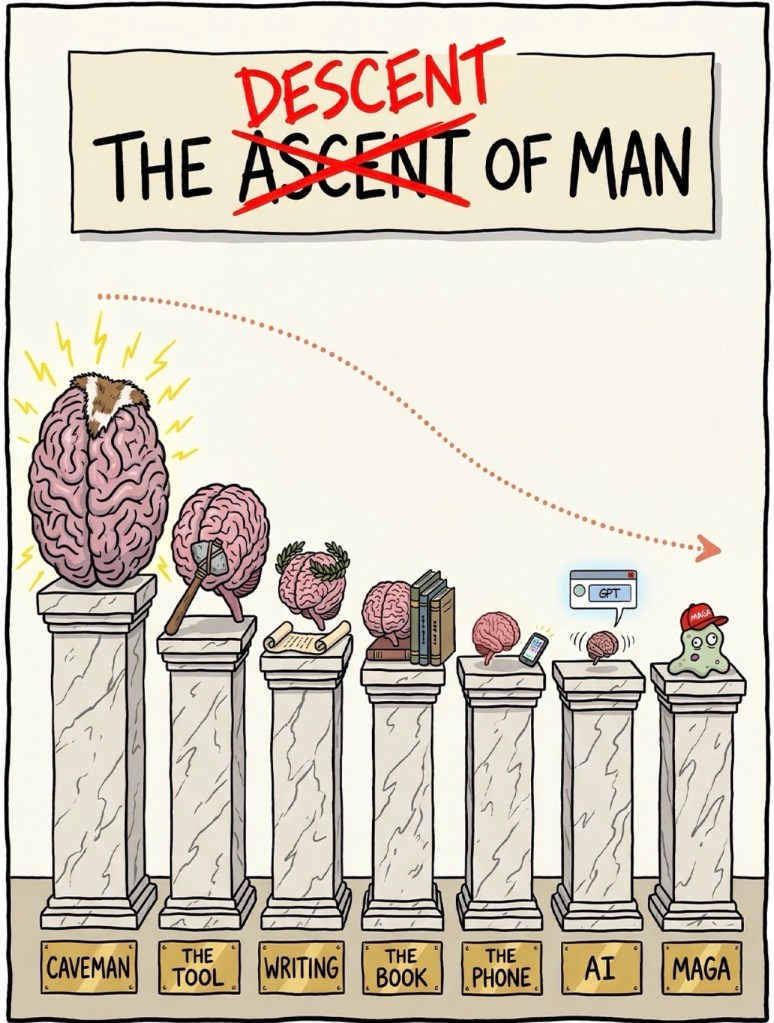
Maybe I’m not the only one scratching my head, but it really feels like over the last fifty years humanity has somehow managed to get dumber.
Now, before anyone fires up their keyboard and writes a 37-tweet thread explaining why I’m wrong, hear me out.
The Internet was supposed to be one of mankind’s greatest achievements. Every book, every scientific paper, every historical document, every piece of knowledge ever assembled sitting in your pocket twenty-four hours a day. The sum total of human understanding available with a few taps of a screen.
And somehow we used it to argue about whether the Earth is flat.
It’s like giving a starving man the keys to the world’s largest library and watching him spend eight hours looking at cat videos and conspiracy theories about how pigeons are government surveillance drones.
The technology itself isn’t the problem. The Internet is amazing. The problem is that mankind clearly wasn’t ready for it. We handed every village idiot a global broadcasting platform and then acted surprised when the village idiot started attracting followers.
Which brings us to MAGA.
In theory, “Make America Great Again” sounds perfectly reasonable. Who wouldn’t want their country to be great? It’s a slogan that works because it’s simple, optimistic, and vague enough that everyone can project their own fantasy onto it.
In reality? It’s been about as relaxing as giving a toddler three energy drinks and the launch codes.
What started as a political movement somehow evolved into a loyalty test, a religion, a reality television show, and a never-ending family argument all rolled into one. Facts became optional. Expertise became suspicious. Outrage became a hobby.
The truly remarkable thing is that we have more access to information than any generation in human history, yet people seem more determined than ever to ignore it.
Maybe that’s the lesson. Technology doesn’t automatically make people smarter. It just gives them faster ways to be wrong.
And if that’s true, then perhaps the Internet wasn’t humanity’s greatest invention.
Maybe it was the world’s largest IQ test.
And we’re still waiting for the results.
-
GarageBand to AI
Dwain Northey (Gen X)

Every generation seems convinced that the generation after them has ruined music. Our grandparents thought rock and roll was noise. Our parents thought rap wasn’t music. Today’s teenagers probably think anything recorded before 2010 belongs in a museum. But there is a legitimate question buried beneath the usual generational grumbling: where does new music come from now, and what happens when artificial intelligence starts making it?
Back in the 1960s, the path to stardom was surprisingly simple, at least in theory. A handful of kids got together in a garage, a basement, or a friend’s living room. They learned three chords, played local dances, and hoped somebody noticed. The Beatles weren’t created by a marketing department. They were a scrappy group of young musicians grinding away in clubs in Liverpool and Hamburg before anyone outside their hometown knew their names. The Rolling Stones followed a similar route, building a reputation through relentless live performances.
The beauty of that era was that nobody knew what would work. Record executives were often guessing. Radio stations were gambling. Bands were experimenting. Sometimes the result was genius. Sometimes it was terrible. But it was undeniably human.
By the 1970s, the scene became more professional. Stadium rock arrived. Record labels poured serious money into artists. Bands still emerged from garages and clubs, but there was now a larger machine waiting to package and promote them. Success still depended on talent, but increasingly it also depended on having the right label, the right producer, and the right timing.
Then came the 1980s, when MTV changed everything.
Suddenly, being a great musician wasn’t enough. You had to look good on television. A catchy song was important, but so was a memorable video. Some artists thrived in this environment. Others disappeared despite being excellent musicians because they didn’t fit the visual expectations of the era.
The joke was that musicians had become actors who occasionally sang.
Yet even during the MTV years, authentic garage-band stories still emerged. Countless bands rehearsed in suburban garages hoping for their big break. Most never got one, but the dream remained alive.
The 1990s may have been the last great era of the traditional discovery story. Bands like Nirvana didn’t emerge from a television talent competition. They came from local scenes. They played small clubs. They developed their sound organically. Nobody designed Kurt Cobain in a corporate boardroom. In fact, much of grunge was practically a rebellion against the polished, manufactured image culture that MTV had helped create.
Then the internet arrived.
At first, this seemed like a golden age for creativity. Suddenly anyone could upload music. You no longer needed a record deal. You didn’t need a manager. You didn’t need a studio. In theory, talent could finally rise based solely on merit.
Instead, we got something nobody anticipated: infinite choice.
When there were only a few radio stations, everybody listened to the same songs. Today there are millions of tracks available instantly. The barrier to entry disappeared, but so did the shared experience. It’s easier than ever to create music and harder than ever to be noticed.
This is where talent competitions entered the picture.
Shows like The Voice, American Idol, and America’s Got Talent became modern talent scouts. Instead of discovering musicians in clubs, producers discovered them on television. The focus shifted from building a band over years to finding a compelling backstory and a powerful voice.
There’s nothing inherently wrong with that. Some genuinely talented artists emerged from these shows. But many viewers noticed that something felt different. The contestants often arrived as finished products. They didn’t spend years developing a unique sound with bandmates in a garage. They were selected because they could perform well immediately.
And now we arrive at artificial intelligence.
For the first time in history, we’re approaching a moment where songs can be generated by software. Lyrics can be written by algorithms. Melodies can be composed by machines. Voices can be synthesized. Entire albums can be created without a traditional musician ever picking up an instrument.
That possibility excites some people and terrifies others.
The optimistic view is that AI becomes another tool, like a guitar, synthesizer, or recording studio. Creative people will use it to explore ideas they couldn’t reach before. Just as drum machines didn’t eliminate drummers, AI won’t eliminate musicians.
The pessimistic view is harder to dismiss. Record companies have always searched for cheaper ways to produce content. If software can generate endless songs that are “good enough,” what incentive remains to invest in young artists spending years perfecting their craft?
Perhaps that fear explains why so many people feel creativity is disappearing.
But maybe creativity hasn’t vanished. Maybe it’s just harder to see.
The Beatles were competing against a few hundred notable acts. Today’s musicians compete against millions of creators, social media influencers, podcasts, video games, streaming services, and now AI-generated content. The signal is buried under mountains of noise.
The garage band still exists. Somewhere right now a group of teenagers is making terrible music in a garage. That’s how it starts. One day they might create something brilliant. The difference is that instead of competing with the local bands across town, they’re competing with the entire internet.
The real challenge of the AI era may not be creating music. Creating music has never been easier.
The challenge is creating something human enough that people care.
Because no matter how sophisticated the algorithm becomes, there is still something magical about knowing that a song came from a kid sitting in a garage, trying to turn a feeling into a melody. Technology can imitate that process. Whether it can truly replace it remains the biggest question facing music’s future.
Maybe creativity isn’t dying at all.
Maybe it’s simply fighting for attention in a world where everyone—and now everything—can make a song.
-
Campaign season
Dwain Northey (Gen X)

The Most Honest Campaign Sign Never Made
It’s campaign season again here in Phoenix, which means every major intersection looks like a yard-sale explosion of political signs. Governor, legislature, city council, dog catcher—if there’s an office available, somebody’s smiling awkwardly from a corrugated plastic rectangle asking for my vote.
And every year I notice the same thing.
The Republican signs always say something like “Fiscal Conservative,” “Protecting Taxpayers,” or “Conservative Leadership.” The Democrat signs usually talk about education, healthcare, opportunity, or some variation of “working for Arizona families.”
What I never see is a sign that simply tells me what the candidate actually plans to do.
You know, honesty in advertising.
Imagine driving down the street and seeing a sign that says:
“Current state budget is balanced and functioning fine. Vote for me and we’re going to screw with it.”
At least I’d appreciate the honesty.
Because that’s what always puzzles me about political campaigns. If the economy is doing reasonably well, the roads aren’t collapsing, schools are still open, and the state somehow managed to balance the books, why is every challenger acting like they’ve discovered a five-alarm fire?
If you’re running against the current administration, your campaign slogan is basically, “Everything they’re doing is terrible.”
Really?
Everything?
The budget’s balanced. The lights are on. The checks aren’t bouncing. The state hasn’t sunk into the Gulf of California.
Yet every candidate shows up claiming they’re going to “fix” things.
Fix what exactly?
Because if I hire a mechanic and my car is running perfectly, I get nervous when he starts talking about all the parts he wants to replace.
Politics often feels the same way.
Candidates never say, “You know what? My opponent actually got a few things right. I’d mostly leave those alone and just improve a couple areas.”
Oh no.
That kind of honesty would apparently violate some sacred law of campaigning.
Instead, every election is presented as if civilization itself hangs in the balance.
Vote for me or the state will collapse.
Vote for the other guy and democracy ends.
Vote for her and taxes will consume the Earth.
Vote for him and public services will disappear.
It’s always the end of the world. Every single election. Somehow we’ve been living through the final battle between good and evil every two years for my entire adult life.
And yet somehow we keep waking up the next morning.
The reality is that governments are often like homeowners associations. Most of the time the truly successful ones are the boring ones. The garbage gets collected. The bills get paid. The roads get repaired occasionally. Nobody notices because things are functioning.
But politicians can’t campaign on boredom.
Nobody’s putting up signs that say:
“State Government: Adequately Managed Since 2022.”
Or:
“Vote for Me. I Promise Not to Break Anything.”
Which is a shame because I’d probably vote for that person.
The older I get, the more suspicious I become of people who arrive loudly announcing that everything is broken and only they possess the magical wisdom to fix it.
Sometimes I want a candidate to stand at a podium and say:
“Honestly, things are okay. Not perfect, but okay. I’d like to improve a few things, leave the rest alone, and avoid creating new problems.”
I’d probably fall out of my chair from shock.
Until then, I’ll continue driving through Phoenix during campaign season, staring at all those signs and wondering why nobody has the courage to print the most honest slogan in politics:
“Vote for Me. I’m About to Change a Bunch of Stuff That Was Working Fine.”
-
June 1, Summer is here
Dwain Northey (Gen X)

Summer Vacation Then and Now
What strikes me about summer vacation today isn’t that kids get bored. Kids have always gotten bored. That’s practically part of the job description of being a kid.
What has changed is what happens before they get bored.
Back in the 1970s and 1980s, summer wasn’t something your parents organized. Summer was something you and your friends invented.
After breakfast, you’d head outside and see who was around.
Maybe you’d end up at the community pool. Maybe you’d find a pickup basketball game. Maybe somebody brought a bat and ball to an empty lot and suddenly you had a sandlot baseball game. Maybe you’d ride your bike halfway across town for no reason whatsoever.
The point wasn’t the activity. The point was the friends.
We weren’t looking for curated experiences. We were looking for people.
And when we got old enough, we started picking up little jobs. Mowing lawns. Pulling weeds. Delivering newspapers. Washing cars. Whatever the neighborhood would pay us to do.
Not because we were building résumés.
Because we wanted money.
Money meant roller skating. Money meant pizza. Money meant arcade games. Money meant movies. The work wasn’t the point. The freedom was.
Today’s kids seem to live in a completely different universe.
The community pools still exist. The basketball courts still exist. The baseball fields still exist.
But many kids experience them as scheduled activities rather than gathering places.
They’ll go to the pool for a couple of weeks.
Then they’re bored.
They’ll play a sport for a while.
Then they’re bored.
They’ll spend hours on Xbox, PlayStation, YouTube, TikTok, or whatever platform is currently consuming childhood.
Then they’re bored.
What fascinates me is that modern kids have access to more entertainment than any generation in human history.
If you told twelve-year-old me that one day I could have every movie ever made, every song ever recorded, thousands of video games, and instant communication with my friends all sitting in my pocket, I would have assumed boredom had been permanently cured.
Instead, it turns out boredom is undefeated.
Maybe part of the difference is that our generation had to create our own fun. We spent entire afternoons figuring out what to do. The search was part of the adventure.
Now entertainment arrives prepackaged, professionally produced, and instantly available.
And when everything is available all the time, somehow nothing feels special for very long.
So by the first week of July, just as surely as fireworks and sunburns, you’ll hear it.
The kid who has a gaming system worth hundreds of dollars.
The kid with streaming services.
The kid with a smartphone.
The kid with air conditioning, Wi-Fi, and enough entertainment options to keep a medieval king occupied for a thousand years.
Will stand in the middle of the living room and announce:
“I’m bored.”
And every Gen Xer within earshot will have the same thought.
“There’s a basketball court, a swimming pool, a bicycle in the garage, and half a dozen friends within a mile of this house. How exactly did you manage to run out of things to do?”
Some mysteries may never be solved.


You must be logged in to post a comment.