Dwain Northey (Gen X)
https://www.cbsnews.com/news/naacp-travel-advisory-florida-says-state-hostile-to-black-americans/
Remember the good old days when there were only travel advisories and or ban for, what some would call, third word countries? Well now because of the vile vitriol of one Governor Ron DeSantis the state of Florida, a vacation destination, has received a travel advisory by the NAACP.
The wannabe future President has made the climate so venomous in Florida the anyone who is a part of any minority group does not feel safe in the state. Black, Brown, LGTBQ+, these are all groups that are under attack in the Sunshine State. The majority Republican legislature and their fearful leader has passed laws that make almost everything a jailable offence and the fact that the state has very loose gun laws and a stand your ground law makes it more dangerous than being a blonde female in central America.
Florida residents are able to carry concealed guns without a permit under a bill signed into law by Republican Gov. Ron DeSantis. The law, which goes into effect on July 1, means that anyone who can legally own a gun in Florida can carry a concealed gun in public without any training or background check. This with their ridiculous stand your ground law, ‘Florida’s “Stand-Your-Ground” law was passed in 2005. The law allows those who feel a reasonable threat of death or bodily injury to “meet force with force” rather than retreat. Similar “Castle Doctrine” laws assert that a person does not need to retreat if their home is attacked.’ Makes it really sketchy to go there.
This in top of the don’t say gay rule and the new trans ruling that just passed.
“Florida lawmakers have no shame. This discriminatory bill is extraordinarily desperate and extreme in a year full of extreme, discriminatory legislation. It is a cruel effort to stigmatize, marginalize and erase the LGBTQ+ community, particularly transgender youth. Let me be clear: gender-affirming care saves lives. Every mainstream American medical and mental health organization – representing millions of providers in the United States – call for age-appropriate, gender-affirming care for transgender and non-binary people.
“These politicians have no place inserting themselves in conversations between doctors, parents, and transgender youth about gender-affirming care. And at the same time that Florida lawmakers crow about protecting parental rights they make an extra-constitutional attempt to strip parents of – you guessed it! – their parental rights. The Human Rights Campaign strongly condemns this bill and will continue to fight for LGBTQ+ youth and their families who deserve better from their elected leaders.”
This law makes it possible for anyone to just accuse someone of gender affirming care to have their child taken from them this would include someone traveling from out of state. This alone justifies a travel ban to the Magic Kingdom for families.
Oh, and I haven’t even mentioned DeSantis holy war with Disney, the largest employer in the state. I really hope the Mouse eats this ass holes lunch.
Well that’s enough bitching, thanks again for suffering though my rant.
-
Fix What You Broke
Dwain Northey (Gen X)

It’s midterm election season again, which is an interesting name for something that is still, in fact, an election. I suppose calling it a midterm makes it sound like we’re taking a break from democracy to check our progress, like a teacher handing out a report card halfway through the semester. Except instead of grades, we get campaign ads, attack commercials, and politicians promising to fix the exact problems they’ve been in charge of creating.
And nowhere is this more entertaining than Texas.
Take Greg Abbott. The man has been governor of Texas since 2015. That’s going on twelve years of executive authority by the time the next election rolls around. Twelve years. Long enough for a child to enter kindergarten, graduate high school, and develop a strong opinion about whether the state’s government is doing a good job.
And yet here we are, listening to Abbott campaign on the promise that he’s going to fix things.
Fix what?
That’s the part I’m having trouble with.
Texas has had Republican leadership in the governor’s mansion for decades. The state legislature has been controlled by Republicans for decades. The House and Senate have had plenty of time to pass the policies they wanted, fund the programs they supported, and address the problems they claimed were important.
This isn’t a situation where the opposition party has been secretly running the state from a basement somewhere. Republicans have been in charge. They have controlled the agenda, the budgets, the appointments, and the direction of state government.
So when the governor stands up and says, “I’m going to fix Texas,” I have to wonder whether he’s talking about the same Texas he’s been governing.
Because if the state is broken, who exactly has been holding the wrench?
And if everything is going great, as politicians always seem to tell us when they’re defending their record, then what needs fixing?
Apparently, the answer is whatever the next campaign commercial says needs fixing.
This is the political equivalent of a contractor showing up at your house after twelve years, looking at the leaking roof, and saying, “Don’t worry. I’ve got a plan.”
You might reasonably ask why the roof is still leaking.
He might explain that the previous contractor was difficult, the weather was unpredictable, and the tools were expensive. He might point out that the roof would have been worse if he hadn’t been there.
And then he’d ask you to hire him again.
That’s the part of politics that continues to amaze me. We have somehow accepted the idea that the person in charge of a problem is the best person to solve it, even when the problem has been sitting there for years.
Not because they have demonstrated that they can solve it, but because they have demonstrated that they can talk about solving it.
And voters seem willing to believe that the next four years will be different from the last twelve, even when the person making that promise has been in the same office the entire time.
Maybe that’s the real meaning of a midterm election. It’s not halfway through a term of office. It’s halfway through the voters’ attention span.
We forget who was responsible. We forget who controlled the legislature. We forget which party had the votes. We forget which policies were passed and which ones were blocked. Then somebody puts up a new campaign sign, says “fixing Texas,” and suddenly we’re all supposed to believe the past twelve years were just a rough draft.
I’m not saying voters have to vote against Republicans. I’m saying voters should at least make them explain their record.
If you’ve been in power for twelve years and the state is still facing the same problems you promised to solve when you first took office, maybe the question isn’t whether you need more time.
Maybe the question is whether you’ve earned it.
And if your answer is that you need another term to fix what’s broken, I have one simple question:
Fix what?
Because if you broke it, you should probably start there.
-
Saturday morning cartoons
Who is your favorite cartoon character?

I was a kid in the 70s. I still remember Saturday morning the Bugs Bunny roadrunner hour that was always the way you start your weekend.
-
September 11
Dwain Northey (Gen X)

Will September 11 Just Become a Number?
Every September 11, we say the same thing:
Never forget.
And I understand why.
For those of us who lived through September 11, 2001, it isn’t really history. It’s memory. We remember where we were. We remember the confusion. We remember the television coverage. We remember the towers falling. We remember the Pentagon. We remember the field in Pennsylvania. We remember the sudden realization that the world we thought we understood had changed before breakfast.
But this year, something else occurred to me.
Something that made me feel very, very old.
The generation being born today is roughly as far removed from September 11, 2001, as my generation was from December 7, 1941.
Think about that for a second.
As a Gen X kid, World War II felt like ancient history. It was black-and-white photographs, grainy newsreels, stories from grandparents, old military uniforms hanging in closets, and movies where everybody somehow had the same square jaw.
Pearl Harbor was something that happened before my parents were even adults.
It was history.
Not memory.
And now September 11 is becoming that same kind of distance for an entire generation.
That’s a little difficult for those of us who remember it to wrap our heads around.
Because I can remember September 11.
And eventually there will be adults walking around who weren’t merely too young to remember it.
They won’t have existed yet.
That’s the part that gets me.
My son is Gen Z. If you say “December 7,” there’s a good chance you’re going to get a blank stare.
December 7, 1941.
Pearl Harbor.
The date that pulled the United States into World War II.
For his generation, it is already possible for that date to exist primarily as a number.
And then there is another date.
November 22, 1963.
You can say the date and get another blank stare.
John F. Kennedy.
Assassination.
For people my age, that date still carries weight. For younger generations, it is increasingly something they learn because a history teacher tells them it happened.
That’s how history works.
The people who experienced an event eventually disappear.
The people who remember the people who experienced it eventually disappear.
And eventually all that’s left is the date.
December 7.
November 22.
June 6.
August 6.
August 9.
Numbers that once represented moments that changed the world.
So what happens to September 11?
Will it eventually become just another number?
Will a teacher someday say, “On September 11, 2001, terrorists attacked the United States,” and a room full of teenagers will dutifully write it down before moving on to the next chapter?
Will there be some kid in 2076 who knows that 9/11 happened but has absolutely no emotional connection to it?
Will September 11 become something like December 7 is today?
Or will it become something different?
Because I wonder if September 11 has an advantage that Pearl Harbor never had.
We named it.
We turned it into something more than a date.
9/11.
Not September 11.
Nine-eleven.
A number that became a noun.
A number that became a verb.
A number that became an entire era.
We don’t simply say that something happened on September 11, 2001.
We say 9/11 happened.
And everybody who was alive knows what that means.
It changed airport security.
It changed immigration debates.
It changed American foreign policy.
It changed the military.
It changed the way we looked at skyscrapers.
It changed the way we looked at airplanes.
It changed the way we looked at strangers.
It changed the way we looked at the word “terrorism.”
It changed the way an entire generation understood the idea that America was somehow protected by oceans and geography.
It even changed our vocabulary.
Before September 11, “homeland security” wasn’t part of everyday American conversation.
Afterward, it was everywhere.
That’s a remarkable amount of cultural weight for four numbers.
But eventually, even that weight will fade.
Not because people don’t care.
Because that’s what time does.
There will be no one left who remembers watching the second tower fall in real time.
No one left who remembers the skies being strangely empty because commercial aviation had been grounded.
No one left who remembers the smoke.
No one left who remembers wondering whether another attack was coming.
No one left who remembers calling somebody just to make sure they were alive.
No one left who can say:
“I remember where I was.”
And perhaps that is the real meaning behind “Never Forget.”
It doesn’t mean we can prevent history from becoming history.
We can’t.
It means that while we are still here, we have a responsibility to tell the story.
Not just the story of the buildings.
Not just the story of terrorism.
Not just the story of war.
The story of the people.
The firefighters.
The police officers.
The paramedics.
The office workers.
The passengers.
The people who ran toward the danger while everybody else was running away from it.
The people who made phone calls they knew might be their last.
The people who waited for someone who never came home.
Because someday, September 11 will belong to history.
That’s inevitable.
And maybe someday a kid will hear “9/11” and think of it the same way my generation heard “Pearl Harbor.”
A date.
An event.
A chapter in a textbook.
Something that happened a long time ago.
And honestly, I hope they never understand it the way we did.
I hope they never have to.
Because the goal of remembering history isn’t to keep the pain alive forever.
It’s to keep the lessons alive long enough that we don’t have to repeat it.
So tomorrow, September 11 will come around again.
For some people, it will be a memorial.
For some, a painful anniversary.
For some, a day of service.
For others, simply another Thursday.
But for those of us who remember, it will still be 9/11.
And perhaps that is the strange thing about getting older.
You eventually realize that some of the things you thought would always be living memory are slowly becoming history.
December 7 became Pearl Harbor.
November 22 became Kennedy.
And one day, September 11 will become just another entry in a history book.
I just hope that before it becomes merely a number, we have taught the next generation why those numbers mattered.
Because history isn’t really about remembering dates.
It’s about remembering what happened to the people behind them.
-
Money woes
How does your mindset affect your financial success?
That’s kind of a topic that would be in a book about projecting your thoughts or manifesting and yes, your mindset does affect everything and a positive or negative attitude can affect your financial situation. You could have someone that wins a lottery, but doesn’t have a mindset to hold onto money so they don’t so yes you’re your mindset or your attitude or your feelings toward money or relationships or whatever may be can affect it and it’s one of those things that there’s 1000 books wrote about manifesting.
-
Blame Game
Dwain Northey (Gen X)

And Suddenly, It Was All the Democrats’ Fault
I’m really looking forward to November.
Or January.
Whenever the political calendar finally gets around to changing the wallpaper in Washington, I suspect we’re going to witness one of the greatest disappearing acts in modern American politics.
Because if Democrats take control of the House and Senate, suddenly — magically — Republicans are going to rediscover the national debt.
Remember the deficit?
That thing we were apparently not supposed to worry about yesterday?
Oh, they’re going to worry about it.
A lot.
Suddenly every Republican talking head on television will become deeply concerned about fiscal responsibility. We’ll hear about reckless spending. We’ll hear about how Democrats inherited an economy that was supposedly humming along beautifully and immediately drove it into a ditch.
There will be charts.
There will be ominous music.
There will be someone on Fox News pointing at a red line going upward while explaining that Democrats have “destroyed the economy.”
And somewhere, somebody will say:
“We had a plan.”
Of course they did.
It was apparently a fantastic plan.
Everything was working.
The economy was perfect.
The deficit was under control.
The national debt was apparently just taking a little nap.
The oil reserves were going to be overflowing.
Manufacturing was coming back.
Inflation was defeated.
The tariffs were brilliant.
The tax cuts were going to pay for themselves.
And apparently America was about twelve minutes away from achieving financial independence from mathematics itself.
Then Democrats got elected.
And ruined everything.
Because that is the beautiful simplicity of partisan accounting.
When your party is in charge, everything good is evidence of your policies.
When your party is out of power, everything bad is evidence of theirs.
It’s like political quantum physics.
The economy can simultaneously be fantastic when your guy is president and absolutely catastrophic when the other guy becomes president — without changing anything except the party affiliation of the person standing behind the podium.
And the national debt?
Well, that one is particularly entertaining.
CBO’s February 2026 projections already had the federal government running a $1.9 trillion deficit for fiscal year 2026, with debt held by the public projected to reach 120% of GDP by 2036.
And CBO’s more recent numbers estimated the deficit had already reached $1.8 trillion through the first ten months of fiscal 2026.
So when the political winds change, don’t be surprised when the people who spent years telling us not to worry suddenly discover that deficits are, in fact, a problem.
It’s not that the numbers changed.
The political ownership of the numbers changed.
And then comes 2028.
Oh, 2028 is going to be spectacular.
If the economy is struggling, we’ll hear that Democrats broke it.
Not the tariffs.
Not the cumulative fiscal decisions.
Not the interest payments.
Not the policies that helped create the deficit.
Not the fact that America’s fiscal problems have been building for decades under presidents and Congresses from both parties.
Nope.
It’ll be:
“Look what the Democrats did.”
Because apparently the American economy has the institutional memory of a goldfish.
The Republican administration can spend years making decisions, Republicans can spend years controlling Congress, Republicans can spend years defending those decisions — and then, once Democrats take over, the economic scoreboard apparently resets to zero.
Suddenly everything before the inauguration is ancient history.
It’s the political equivalent of spilling milk on the kitchen floor and blaming the guy who moved into the house three months later.
And here’s the really depressing part:
It works.
Not because everybody is stupid.
Because people are busy.
People have jobs.
Bills.
Kids.
Mortgages.
Car payments.
Medical expenses.
They don’t have time to spend their evenings reading Congressional Budget Office reports and tracing fiscal policy through ten-year budget windows.
So somebody on television gives them a simple explanation:
“Democrats caused this.”
And for millions of people, that’s enough.
Never mind that CBO’s own analysis shows federal deficits are the product of multiple interacting factors — spending, revenues, interest costs, economic conditions and policy changes — rather than some magical switch that gets flipped when one party walks through the White House door.
And tariffs aren’t some imaginary footnote either. CBO’s August 2026 update said changes in trade policy through July were projected to make deficits $0.9 trillion larger over 2027–2036 compared with its February baseline.
But nuance doesn’t fit particularly well on cable news.
“The deficit is complicated and reflects decades of bipartisan fiscal decisions” doesn’t make a very good chyron.
“DEMOCRATS DESTROY ECONOMY” fits beautifully across the bottom of the screen.
And that’s the part that frustrates me most.
We’re old enough to remember when political arguments were at least occasionally about what somebody actually planned to do.
Now we’ve turned government into a perpetual blame relay.
Nobody wants to carry the baton.
Everybody just wants to explain why they didn’t drop it.
The deficit is somebody else’s fault.
Inflation is somebody else’s fault.
The economy is somebody else’s fault.
The debt is somebody else’s fault.
And when the next election comes around, we’re apparently expected to forget everything that happened before the last election.
Maybe someday we’ll stop treating the federal budget like a football game where the objective isn’t to win, but to make sure the other team gets blamed for the score.
Until then, enjoy the show.
Because sometime after the next election, the same people who told us everything was going great will discover that everything is terrible.
And the reason will be remarkably convenient:
The Democrats did it.
Again.
Because apparently Washington has discovered the ultimate economic principle:
If you’re in charge, you get the credit.
If you’re out of charge, you get the blame.
And if you’re really good at politics, you get both.
-
Remember the age of responsibility?
Dwain Northey (Gen X)

The Orange Vest of Responsibility
School starting back up this year hit me with one of those Gen X flashbacks that you don’t see coming.
It wasn’t the smell of freshly sharpened pencils. It wasn’t the sound of the school bus. It wasn’t even the sight of kids walking around with backpacks that cost more than my first car.
It was the crossing guards.
There they were, standing at elementary schools, junior highs, even high schools, making sure children safely crossed the street.
And I thought, Wait a minute… when the hell did we decide kids needed adults to do this?
Because when I was in elementary school in the 1970s, you didn’t necessarily need an adult to make sure you crossed the street. You needed a fifth or sixth grader.
That’s right.
Fifth graders.
We were apparently considered mature enough to be entrusted with the lives of smaller children while simultaneously being considered immature enough that we probably shouldn’t be trusted with a pair of scissors.
Somewhere around fifth grade, you could get handed an orange crossing-guard vest and suddenly you had a job.
No badge.
No certification.
No reflective stop sign on a giant stick.
Hell, half the time you didn’t even have a stop sign.
You just stood there, stuck your hand out into traffic and apparently that was enough.
“STOP!”
And remarkably, people stopped.
There you were, eleven years old, holding your hand up to a two-ton automobile like some miniature traffic cop with absolutely no authority whatsoever.
And nobody questioned it.
Your parents didn’t demand to know the qualifications of the crossing guard.
There wasn’t a committee meeting.
There wasn’t a background check.
There wasn’t a laminated handbook explaining your responsibilities.
There was just:
“You’re a fifth grader now. Here’s an orange vest. Make sure those first graders don’t get run over.”
And apparently, we did.
But crossing children wasn’t even the weirdest part.
We were given responsibility for ourselves.
We walked to school.
We walked home.
We went outside.
We disappeared for hours.
We rode bikes without helmets.
We drank water from garden hoses.
We were expected to know where we were supposed to be and when we were supposed to be home.
And somewhere along the way, we apparently decided that childhood needed to become a fully supervised corporate internship.
Today, we have adults standing outside schools making sure teenagers cross the street safely.
Teenagers.
These are people who are old enough to drive a car, hold a job, enlist in the military, and, depending on the state, vote.
But apparently crossing 25 feet of asphalt requires adult supervision.
I’m not saying children shouldn’t be protected. Obviously they should.
And I’m not saying there aren’t legitimate reasons for having professional crossing guards. Traffic is different. Roads are busier. Cars are bigger. Distracted driving is a real thing.
But there’s something else we’ve lost along the way.
Responsibility.
We used to give children responsibility as a way of teaching them how to become adults.
You weren’t expected to magically become responsible at eighteen.
You practiced.
You were given something to do.
You were trusted with something.
You learned that somebody smaller than you was counting on you.
You learned that if you screwed up, there were consequences.
And maybe that’s the part that sticks with me.
We didn’t have a lot of supervision, but we had expectations.
You didn’t need somebody standing over you every second because somebody had already told you what was expected.
You took care of the little kids.
You watched your siblings.
You walked home.
You had chores.
You figured things out.
And if you came home with a scraped knee, your parents probably didn’t call a lawyer.
They got you a Band-Aid.
Maybe some hydrogen peroxide that felt like Satan himself had been poured into the wound.
Then they told you to quit whining.
We were given freedom before we were given adulthood.
And perhaps that’s the difference.
Today’s kids are often protected from every possible risk, while we were often expected to learn how to navigate those risks ourselves.
Neither extreme is necessarily perfect.
But sometimes I wonder if, in our effort to keep children safe, we’ve forgotten that learning responsibility requires actually being responsible for something.
Because when I look at those crossing guards today, I can’t help but think about that orange vest.
Some fifth grader in the 1970s would put it on, walk out to the curb, hold up his hand and think:
“Well, I guess I’m in charge now.”
And somehow, for an entire generation, that was pretty much how adulthood began.
Not with a ceremony.
Not with an app.
Not with a permission slip.
Just somebody handing you an orange vest and saying:
“Don’t let those kids get hit by a car.”
And you didn’t.
Because you were a kid.
But for that ten minutes every morning, somebody trusted you to be an adult.
-
One more Reason
Dwain Northey (Gen X)

Nine Justices, Thirteen Circuits, and One Hell of a Bottleneck
Well, here we are again.
Chief Justice John Roberts basically looked at the White House ballroom case and said, in the judicial equivalent of “Yeah, this probably isn’t legal, but apparently this is what we’re doing,” and then watched the Supreme Court’s majority allow construction to continue anyway.

To be fair, the Court didn’t actually declare the ballroom legal. The majority’s ruling was about whether the preservation group challenging the project had sufficient standing to bring the case. Roberts, joined by the Court’s three liberal justices, dissented and wrote that the construction was “likely unlawful,” pointing specifically to Congress’s authority over federal property. (Justia Law)
And that distinction matters.
But here’s the problem: when the Supreme Court says something is probably unlawful and then the practical result is, “Well, go ahead and keep building it,” ordinary Americans are understandably left wondering what the hell the word “law” is supposed to accomplish.
This is precisely why I keep coming back to something we’ve discussed a hundred times:
Nine justices are not enough.
We have thirteen federal judicial circuits and nine Supreme Court justices. That means the highest court in the land is operating with fewer members than there are appellate circuits whose decisions it is ultimately supposed to review.
That made a certain amount of sense when the country was considerably smaller, the legal system was considerably smaller, and we weren’t trying to govern a nation of more than 300 million people with institutions designed for a vastly different America.

Congress has the constitutional authority to structure the Supreme Court, and the Constitution itself doesn’t specify that the Court must have nine justices. Congress has changed the Court’s size repeatedly throughout American history. (Congress.gov)
So maybe it’s time to stop treating nine like it was handed down from Mount Sinai on stone tablets.
Make it thirteen.
One justice for each federal circuit.
That doesn’t magically solve every problem. It doesn’t make justices more objective. It doesn’t eliminate ideological disagreements. And it certainly doesn’t guarantee that the Court will suddenly start making decisions everybody likes.
But it could reduce the absurdity of having an institution with enormous power concentrated in nine people whose appointments can shape American law for generations.
And while we’re fixing things, let’s talk about the other elephant sitting in the courtroom:
Lifetime appointments.
I’m not talking about removing judges because we don’t like their decisions. That’s exactly the kind of political nonsense judicial independence is supposed to protect us from.
I’m talking about a reasonable term of service on the Supreme Court.
Eighteen years.

That isn’t some crazy number pulled out of a hat. Eighteen-year Supreme Court terms have been proposed in Congress, with a system designed to stagger appointments so that presidents would ordinarily make two appointments during a four-year term. Under such proposals, justices could continue serving in the federal judiciary after their Supreme Court service ended. (Congress.gov)
In other words, you’re not firing the judge. You’re changing the job assignment.
Serve eighteen years on the Supreme Court. Then go back to the federal appellate bench or another appropriate judicial role.
You still have judicial independence.
You still have experienced judges.
You still have people who have spent decades learning constitutional law.
What you don’t have is a system where one presidential election can effectively determine the ideological composition of the Supreme Court for the next thirty or forty years.
Because that’s where the system gets ridiculous.
We have turned Supreme Court appointments into political nuclear warfare because everybody knows that one vacancy can determine the direction of constitutional law for a generation.
And then we act surprised when politicians behave like the fate of Western civilization depends on getting their person into that chair.
Remember Merrick Garland?
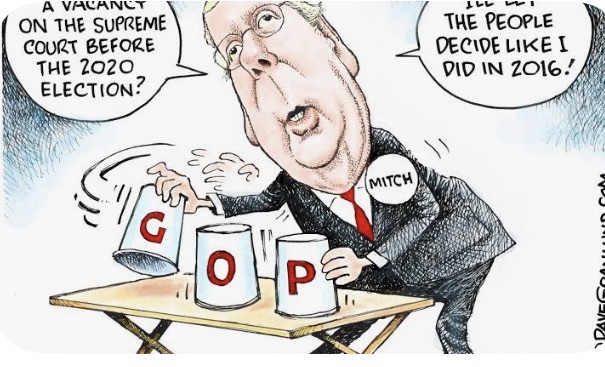
In 2016, Senate Majority Leader Mitch McConnell refused to hold hearings on President Obama’s Supreme Court nominee, arguing that voters should have a voice in selecting the next justice. Garland’s nomination sat there for 237 days without a hearing. Four years later, McConnell’s Senate moved forward with Amy Coney Barrett’s nomination just 46 days before the presidential election. (Senate Judiciary Committee)
That’s not a system.
That’s a game of political chicken played with lifetime judicial appointments.
And here’s the funny part: everybody pretends they’re defending some sacred constitutional principle when what they’re really defending is who gets to pick the next lifetime player on the Supreme Court.
If we had eighteen-year terms with regular, staggered appointments, the stakes would change dramatically.
You wouldn’t have a 39-year-old justice potentially sitting until they’re 89.
You wouldn’t have presidents gambling on vacancies.
You wouldn’t have senators deciding that the Constitution means one thing when their party occupies the White House and something entirely different when the other party does.
And perhaps most importantly, we wouldn’t be asking nine human beings to carry the constitutional weight of an entire nation indefinitely.
The Supreme Court is supposed to be one branch of government, not the final resting place of American political consequences.
And maybe that’s the bigger lesson from this ridiculous ballroom episode.
The problem isn’t just the ballroom.
The problem is a political system that has increasingly turned every institutional decision into a battle over who has enough power to get around whom.
Congress says one thing.
The president says another.
The courts get dragged into it.
The Supreme Court says, essentially, “We aren’t necessarily deciding whether this is legal, but we’re not stopping it right now.”
And everybody walks away pretending that’s somehow a satisfying resolution.
It isn’t.
We shouldn’t want a Supreme Court that belongs to Republicans.
We shouldn’t want a Supreme Court that belongs to Democrats.
We should want a Supreme Court that belongs to the Constitution and the American people.
And if that requires expanding the Court to thirteen justices, establishing regular eighteen-year terms, staggering appointments, and allowing experienced justices to continue serving elsewhere in the federal judiciary, then maybe it’s time to stop pretending that institutional reform is some radical assault on democracy.
Maybe the radical idea is continuing to operate a twenty-first-century democracy with an eighteenth-century political architecture and then acting shocked when the damn thing creaks.
Because nine people shouldn’t be able to become the constitutional equivalent of a permanent homeowners’ association for America.
And neither should one president.
And neither should one Senate leader.
And neither should one political party.
The voters should get a meaningful say in the direction of the country through elections.
The president should nominate.
The Senate should advise and consent.
The courts should interpret the law.
Congress should make the laws and exercise its constitutional authority.
And nobody should get to rewrite the rules halfway through the game because suddenly the political math isn’t working in their favor.
If we’re going to have a government of the people, then perhaps we should stop designing it around the people who happen to hold power today.
Because today eventually becomes yesterday.
And that’s when the people who changed the rules discover the oldest rule in politics:
Eventually, somebody else gets to use the rules you created.
-
Pet Questions
If your pet could talk, what would be the first thing it says?

The look on Petey’s face is always where you been?
-
Regretted reading?
Have you ever regretted reading a book — which one and why?
This is a very high school ask juvenile question. I’ve never read anything I regretted reading. I didn’t like it when I read it, but I didn’t regret picking it up.
-
Lonewolf fallacy
Dwain Northey (Gen X)

The Self-Made Man Was Never Self-Made
And here’s the other part of this generational shift that I find particularly interesting: Millennials and Gen Z don’t seem nearly as willing to swallow the mythology of the self-made billionaire.
And frankly, I think that’s a good thing.
Because we have spent decades being sold this fairy tale that Jeff Bezos, Elon Musk, Mark Zuckerberg and Bill Gates simply woke up one morning, believed in themselves, worked harder than everybody else and magically became billionaires.
And then there’s Donald Trump, who somehow became the patron saint of the self-made man despite being born into considerable wealth and receiving substantial help from his family.
But apparently the official American biography of a billionaire is:
“I believed in myself.”
Roll credits.
The problem is that believing in yourself doesn’t explain the private school, the inherited money, the family connections, the investors, the employees, the government infrastructure, the public education system, the courts, the roads, the internet, the universities, the scientists, the engineers, the customers, the workers or the millions of other people whose labor and participation made that success possible.
That’s not to say these people didn’t work hard.
They did.
That’s not to say they weren’t intelligent, ambitious or extraordinarily driven.
Some of them clearly were.
But working hard and doing it alone are two completely different things.
And I think that’s the veil Millennials and Gen Z are beginning to pull back.
They’re looking at the billionaire class and asking a very uncomfortable question:
“Self-made compared to what?”
Because if you’re handed a significant head start and then win the race, you can certainly say you ran the race.
But don’t stand at the finish line pretending you built the track, manufactured your shoes, invented gravity and personally carried everyone else across the finish line.
That’s mythology.
And mythology matters because it becomes policy.
If we convince ourselves that every billionaire is simply the result of extraordinary individual effort, then the logical conclusion becomes that everyone who isn’t wealthy simply didn’t try hard enough.
And that’s where the whole thing falls apart.
Because millions of people work their asses off every single day and will never accumulate even a microscopic fraction of the wealth possessed by these people.
The difference isn’t necessarily work ethic.
Sometimes it’s opportunity.
Sometimes it’s timing.
Sometimes it’s education.
Sometimes it’s family.
Sometimes it’s connections.
Sometimes it’s luck.
Sometimes it’s being born into exactly the right circumstances.
And almost always, it’s some combination of those things.
That’s what makes the younger generation’s growing emphasis on community so interesting.
They’re beginning to understand something that the rugged-individualism crowd desperately doesn’t want them to understand:
Nobody gets anywhere entirely by themselves.
Not the billionaire.
Not the politician.
Not the CEO.
Not the astronaut.
Not the soldier.
Not the artist.
Not even Rocky fucking Balboa.
Rocky had Mickey.
He had Apollo.
He had Adrian.
He had Paulie.
Apparently even Rocky needed a support system.
Yet somehow we built an entire political and economic mythology around the idea that needing other people means you’re weak.
And Millennials and Gen Z seem to be looking at that mythology and saying:
“Yeah… we’re not buying it anymore.”
They’re seeing the machinery behind the curtain.
They’re recognizing that society isn’t a collection of rugged individuals who occasionally bump into each other at Walmart.
It’s a web.
Your success affects me.
My success affects you.
The teacher educating your kid is part of your life.
The person stocking the grocery store is part of your life.
The truck driver bringing your food across the country is part of your life.
The nurse taking care of you when you’re sick is part of your life.
The engineer maintaining the infrastructure you depend upon is part of your life.
The person picking up your garbage is part of your life.
You don’t have to know their names for their work to be essential to your existence.
That’s community.
And maybe that’s the real generational rebellion happening right now.
It’s not simply, “We don’t want your capitalism.”
It’s more fundamental:
“We don’t believe your mythology.”
They aren’t necessarily impressed by somebody standing on a stage telling them they became wealthy because they were smarter, tougher and more determined than everyone else.
They’re asking what was underneath that success.
Who helped?
Who funded it?
Who built it?
Who worked for it?
Who paid for the infrastructure?
Who created the technology?
Who took the risks?
Who provided the education?
Who got lucky?
And perhaps most importantly:
Who didn’t get those opportunities?
That’s a much more complicated conversation than “work hard and you too can become a billionaire.”
But complicated doesn’t mean wrong.
It means we’re finally talking about reality instead of the bedtime story.
And as a Gen Xer, I have to admit there’s something humbling about watching younger generations question something that some people in my generation accepted as gospel.
We were raised on the idea that the individual was everything.
They seem increasingly interested in the idea that the individual exists within a community.
And maybe that’s the correction we needed.
Because believing you can accomplish something yourself is empowering.
Believing that you accomplished everything yourself is delusional.
There is a difference.
You can be proud of what you built without pretending nobody helped you build it.
You can celebrate ambition without worshipping wealth.
You can admire achievement without turning successful people into superheroes.
And you can believe in personal responsibility while acknowledging that nobody gets to choose the circumstances into which they’re born.
Maybe Millennials and Gen Z aren’t becoming weaker.
Maybe they’re becoming harder to bullshit.
And honestly?
After decades of being told that every billionaire is a rugged individual who personally pulled himself out of the primordial ooze by his bootstraps, I’m perfectly happy to see somebody finally ask:
“Wait a minute… who the hell gave him the boots?”


You must be logged in to post a comment.