Category: Uncategorized
-
Dwain Northey (Gen X)
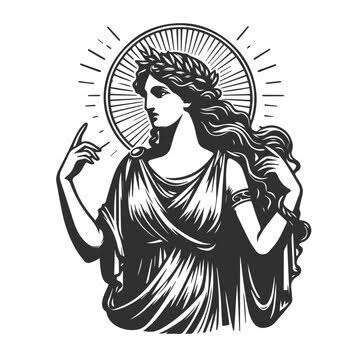
What If the Gods Had Been Goddesses?
Imagine, just for a moment, that history had taken a completely different turn.
Imagine that when the ancient Greeks looked toward Mount Olympus, the most powerful figures weren’t Zeus, Poseidon, and Hades, but goddesses representing love, knowledge, wisdom, intuition, creation, and perhaps even mercy. Imagine that the supreme divine authority wasn’t embodied primarily in the thunderbolt, the trident, and the underworld, but in the ideas of understanding, relationship, learning, and preservation.
Now go one step further.
Imagine that Genesis had placed Eve—not Adam—at the center of humanity’s creation story. Eve was made in the image of God. Eve was the first human being. Eve was the archetype from which humanity understood itself.
Imagine that the great stories of the Bible had followed the same pattern. Noah was Noah, but she was a woman. Moses was Moses, but she was a woman. Abraham was Abraham, but she was a woman. The prophets were women. The apostles were women. And Jesus—the central figure of Christianity—was a woman.
Not because men had been eliminated. Not because women had become the oppressors and men the oppressed.
Simply because, at some foundational point in human history, civilization had decided that the feminine was not secondary.
What kind of world might that have produced?
Of course, this is a thought experiment, not a claim that women are inherently peaceful and men are inherently violent. History doesn’t permit anything nearly that simple. Women have participated in wars, supported authoritarian regimes, and committed terrible acts. Men have been extraordinary teachers, caregivers, philosophers, pacifists, and advocates for peace.
But there is something fascinating about asking what happens when the default archetypes of power change.
Because mythology matters.
Religion matters.
The stories a civilization tells about its gods and heroes become part of the psychological architecture of that civilization. They teach us what greatness looks like.
And look at some of the ancient world’s most powerful male archetypes.
Zeus throws lightning.
Poseidon commands the seas.
Ares represents war.
Kings conquer.
Heroes slay monsters.
Empires expand.
The language of power becomes remarkably physical: territory, domination, conquest, victory.
Now imagine that the civilization’s highest divine archetypes were instead centered around knowledge, love, intuition, fertility, healing, creation, and preservation.
What would children learn when they were taught what greatness meant?
Perhaps greatness wouldn’t necessarily mean defeating someone.
Perhaps it would mean understanding something.
Perhaps wisdom would be considered more impressive than conquest.
Perhaps the greatest person in the room would be the person who could prevent a war rather than the person who could win one.
And that distinction is enormous.
Human civilization has spent thousands of years constructing an almost absurd equation between masculinity and power. The warrior became the hero. The conqueror became the king. The general became the statue in the square.
We built monuments to men on horseback.
We named ships after battles.
We named cities after emperors.
We celebrated borders expanding as though geography itself were keeping score.
And then we wondered why humanity kept going to war.
What if our oldest stories had taught us something different?
What if the ultimate act of heroism wasn’t killing Goliath but convincing Goliath that nobody needed to die?
What if Moses’ greatest accomplishment wasn’t leading people out of Egypt through divine intervention, but creating a society where nobody had to become Pharaoh?
What if the great biblical moral authority wasn’t a male prophet descending from a mountain with commandments, but a woman whose defining characteristic was her ability to understand the human consequences of those commandments?
And what if Jesus had been a woman?
That one change alone would have been an earthquake beneath Western civilization.
Imagine Christianity developing around the image of a female savior whose defining teachings emphasized compassion, forgiveness, humility, love of one’s enemy, care for the poor, and rejection of worldly power.
Imagine generations of children being told that God had chosen a woman to embody divine love.
Suddenly, the sentence “God created humanity in God’s image” would have carried a very different psychological implication.
Women wouldn’t merely have been created by God.
They would have been one of the civilization’s most powerful symbols of God.
And that could have changed everything.
Or perhaps it wouldn’t have.
That’s the uncomfortable part of the thought experiment.
Because changing the gender of the characters doesn’t necessarily change the human beings writing the story.
A patriarchal society could still turn a female deity into an excuse for patriarchal behavior. A woman could still become a tyrant. A female monarch could still wage war. A female religious institution could still accumulate wealth and power.
Humans are remarkably talented at taking beautiful ideas and finding ways to weaponize them.
But perhaps the deeper question isn’t whether women would have magically eliminated war.
It’s whether civilization might have developed a different definition of power.
Consider the difference between domination and influence.
Domination says:
“I have power because you cannot stop me.”
Influence says:
“I have power because you trust me.”
Those are radically different forms of authority.
And perhaps a civilization whose foundational mythology emphasized love, knowledge, intuition, and preservation might have placed greater cultural value on the second.
Maybe the hero wouldn’t be the strongest person.
Maybe it would be the wisest.
Maybe the leader wouldn’t be the person who could make everyone obey.
Maybe it would be the person who could make everyone cooperate.
Maybe intelligence wouldn’t be measured by how effectively someone defeats an opponent, but by how effectively they prevent opponents from becoming enemies in the first place.
And perhaps that would have affected warfare itself.
Wars are rarely started by ordinary people sitting around a table saying, “You know what sounds wonderful? Let’s send our children to die.”
Wars are generally constructed through leadership, ideology, nationalism, fear, resources, territory, revenge, and the glorification of sacrifice.
And someone has to convince millions of people that killing strangers is necessary.
Imagine if the cultural mythology surrounding leadership had made that persuasion more difficult.
Imagine if the most revered leader in history wasn’t remembered for conquering twelve nations but for preventing twelve wars.
Imagine if the greatest monument in every capital wasn’t a general on horseback but a mother embracing the mothers of former enemies.
Imagine if history books devoted entire chapters to treaties that prevented bloodshed rather than merely battles that produced winners.
Maybe we’d still have wars.
Probably.
But perhaps fewer of them.
Or perhaps they would look different.
And there’s another fascinating possibility.
A more matriarchal civilization wouldn’t necessarily have been a world where women ruled men.
The real revolution would be eliminating the assumption that one gender must rule the other at all.
Instead of replacing patriarchy with matriarchy, perhaps humanity could have developed something closer to partnership.
The masculine and feminine would not represent opposing political factions. They would represent complementary dimensions of humanity.
Strength without compassion becomes brutality.
Compassion without strength can become helplessness.
Knowledge without empathy becomes cold calculation.
Intuition without knowledge can become superstition.
Perhaps the ideal civilization would have recognized that humans need all of these things.
And maybe that is the greatest flaw in the way we’ve traditionally constructed our myths.
We’ve often treated power as though it were a scarce resource.
Someone must dominate.
Someone must submit.
Someone must win.
Someone must lose.
But what if power was never supposed to be the ability to stand above everyone else?
What if power was the ability to lift everyone else up?
That’s the civilization I keep imagining when I run this thought experiment to its logical conclusion.
Not a world where women become the new tyrants.
Not a world where men are relegated to some historical apology.
A world where the feminine principles traditionally dismissed as weakness—empathy, intuition, nurturing, cooperation, emotional intelligence, preservation—are recognized as forms of intelligence and power rather than deviations from it.
Because perhaps humanity’s greatest historical mistake wasn’t choosing men over women.
Perhaps it was choosing domination over cooperation.
And maybe that distinction matters more than gender.
We have spent thousands of years worshiping thunderbolts.
Perhaps it was time we tried worshiping wisdom.
We’ve built civilizations around conquest and then congratulated ourselves for becoming civilized.
Maybe civilization begins when winning stops being the highest human achievement.
Maybe the greatest revolution imaginable isn’t putting a woman on a throne.
Maybe it’s finally realizing that the throne itself was never the point.
-
What’s a moment when you realized you were officially an adult?
At 59 their days I still don’t feel like an adult other than when every single responsibility is on me that’s when it hits or win climbing the step ladder seems like it’s a bridge too far adulting kind of sucks.
-
Which is the best restaurant in your city?
I couldn’t tell you what’s the best restaurant in my city because as a divorced single guy that hasn’t dated in more than a decade I don’t eat out. I prefer to just cook at home.
-
Which is the best restaurant in your city?
I couldn’t tell you what’s the best restaurant in my city because as a divorced single guy that hasn’t dated in more than a decade I don’t eat out. I prefer to just cook at home.
-
Which is the best restaurant in your city?
I couldn’t tell you what’s the best restaurant in my city because as a divorced single guy that hasn’t dated in more than a decade I don’t eat out. I prefer to just cook at home.
-
Which is the best restaurant in your city?
I couldn’t tell you what’s the best restaurant in my city because as a divorced single guy that hasn’t dated in more than a decade I don’t eat out. I prefer to just cook at home.
-
Dwain Northey (Gen X)

There is something profoundly strange about human beings and our relationship with isolation.
Throughout history, people have voluntarily removed themselves from society in the pursuit of peace. Monks retreat into monasteries. Buddhist practitioners may take vows of silence. Hermits disappear into mountains, deserts, forests, or caves because they believe the noise of the world is an obstacle to understanding themselves. For some people, solitude isn’t punishment at all. It is the destination.
And then we have another form of isolation: solitary confinement.
Human-rights organizations and prison-reform advocates have long argued that prolonged solitary confinement can constitute cruel, inhuman, or degrading treatment. That can initially seem almost absurdly counterintuitive to someone who genuinely enjoys being alone.
If I can spend an entire Saturday perfectly happy without speaking to another human being, why would putting somebody alone in a room be considered psychologically harmful?
Because, as it turns out, being alone and being isolated are two very different psychological experiences.
The monk chose the mountain.
The prisoner was sent to the cell.
That distinction may be enormous.
When you choose solitude, being alone can feel like freedom. When solitude is imposed upon you, it can feel like abandonment, punishment and helplessness. One says, I am choosing to be here. The other says, Someone has decided that I deserve to be here.
And perhaps that loss of agency is one of the most important pieces of the puzzle.
Imagine that I decide tomorrow that I want to spend three days alone in my house. I have books. I have television. I have music. I have a refrigerator full of food. I can open the door and walk outside whenever I want. I can call somebody. I can take a shower. I can sit in a chair and stare at the ceiling for six hours if that’s what I feel like doing.
That’s solitude.
Now take away my ability to leave.
Take away meaningful human interaction.
Take away normal sensory stimulation.
Give me a small room with almost nothing to do, tell me that I will remain there for an indefinite period and make somebody else the person who decides when I am allowed to return to society.
That’s not simply being alone.
That’s deprivation of autonomy.
And human beings apparently need autonomy almost as much as they need companionship.
This is where the apparent contradiction begins to make sense.
A monk taking a vow of silence isn’t necessarily experiencing the absence of human contact as deprivation. The silence itself is the practice. The monk has chosen it, understands its purpose and presumably has a framework for interpreting the experience.
The prisoner in solitary confinement doesn’t have that luxury.
The silence isn’t enlightenment.
It’s punishment.
And the difference between those two experiences may be enormous.
There is another psychological component that fascinates me: stimulation.
Our brains aren’t designed to sit inside an empty sensory environment indefinitely. We need things to process. Conversation provides stimulation. Reading provides stimulation. Movement provides stimulation. Nature provides stimulation. Music provides stimulation. Even the irritating guy in the next cubicle provides stimulation.
Take enough of that away and the brain doesn’t necessarily just become peaceful.
Sometimes it starts creating its own stimulation.
That’s where reports of hallucinations, distorted perceptions, anxiety, paranoia, obsessive thinking and other psychological symptoms associated with prolonged isolation become particularly disturbing.
And suddenly the old idea that “if you enjoy being alone, solitary confinement shouldn’t bother you” falls apart.
Because enjoying solitude generally means having the ability to end the solitude.
That’s the part I think is easy to overlook.
I can enjoy being alone because somewhere in the back of my mind is the knowledge that I don’t have to be alone.
I can call someone.
I can walk outside.
I can go get coffee.
I can turn on the television.
I can get in my car.
I can walk into a crowded room and immediately regret it.
That last option matters too.
Freedom includes the freedom to choose solitude and the freedom to choose company.
Solitary confinement removes the second choice.
And perhaps that’s why it can be psychologically devastating even to people who ordinarily prefer their own company.
There’s a profound difference between saying, I don’t need anybody right now, and being told, Nobody is available to you.
The first is independence.
The second is deprivation.
Maybe that’s the real paradox of isolation.
We don’t necessarily need constant human contact. Some of us would go completely insane if that were the requirement. There are people who genuinely need substantial amounts of solitude to recharge, think, create or simply escape the exhausting theater of everyday human interaction.
But that doesn’t mean human connection is optional.
Perhaps what the human brain really needs isn’t a certain number of people around it at all times.
Perhaps it needs choice.
The choice to be alone.
The choice not to be alone.
The knowledge that another human being is available if you need one.
And maybe that’s why someone can spend an entire day happily alone while another person can psychologically unravel in a cell.
The difference isn’t necessarily how much they like people.
It’s whether the solitude belongs to them.
That’s a surprisingly profound distinction.
Because the moment solitude becomes something you cannot escape, it stops being solitude in the psychological sense.
It becomes confinement.
And perhaps that’s why the phrase “cruel and unusual punishment” begins to make considerably more sense.
The cruelty isn’t simply that you’re alone.
It’s that someone else controls your aloneness.
-
Dwain Northey (Gen X)

Well, folks, I believe we have finally arrived.
The Golden Age has officially begun, just as promised by our geriatric Commander in Chief and his increasingly elaborate traveling entourage of sycophants, billionaires, foreign dignitaries, and people apparently carrying very expensive gift bags.
Forget economic indicators. Forget wages. Forget whether the average American can afford groceries, rent, healthcare, or the increasingly ambitious concept of owning a home.
We have jets.
Apparently, nothing says America First quite like other countries handing the American president aircraft worth untold fortunes. And because apparently airplanes weren’t sufficiently ostentatious, we can add diamond-encrusted jewelry and other spectacular gifts to the growing collection of things being bestowed upon the man who promised to restore American greatness.
And honestly, what could possibly be more American than a president being showered with luxury while millions of Americans are being told to tighten their belts?
That is, after all, the fundamental philosophy of the modern Republican economic miracle: the rich get richer, the poor get poorer, and everyone is encouraged to applaud the falling champagne bottle.
Welcome back to Reagan-era trickle-down economics, folks.
Except somebody forgot to mention that when you stand underneath the top of the economic pyramid waiting for the wealth to trickle down, you may want to bring an umbrella.
Or perhaps a hazmat suit.
Because the wealth isn’t exactly trickling.
It appears to be pooling at the top.
Meanwhile, the White House itself looks like it’s been through a particularly aggressive episode of Extreme Makeover: Presidential Edition. Everything is rumbling, construction is everywhere, and somewhere in the middle of all this imperial remodeling sits a reflecting pool that looks less like a symbol of American grandeur and more like the swimming pool behind a Motel 6 that has recently lost a fight with chlorine.
But don’t worry.
It’s the Golden Age.
Look at the gold!
Never mind that the infrastructure is crumbling.
Never mind that healthcare costs are climbing.
Never mind that ordinary people are watching their purchasing power evaporate while the wealthiest Americans continue accumulating fortunes large enough to require their own gravitational fields.
Never mind all that.
There is gold.
And apparently that’s the metric now.
Then we have the Oval Office itself.
There is so much gilded décor, gold trim, glitter, ornamentation and unapologetic opulence packed into that room that I genuinely suspect Marie Antoinette would walk through the doors, look around, and say, “Dude, this is a little much.”
And this is the woman historically associated with the whole “Let them eat cake” thing.
Imagine being so extravagantly ostentatious that Marie Antoinette would be embarrassed for you.
That’s not merely excessive.
That’s achieving a level of conspicuous consumption that would make the French aristocracy whisper, “Perhaps we should tone it down.”
The Oval Office increasingly looks less like the workplace of the President of the United States and more like the lobby of a casino owned by a man who just discovered gold leaf.
And somewhere in the middle of all this gilded magnificence, we’re supposed to believe this represents the greatness of America.
No.
It represents the greatness of wealth concentrated in the hands of people who have somehow convinced everyone else that their wealth is evidence of everybody else’s success.
It’s economic astrology.
“Your billionaire is entering a favorable tax position this quarter, so good news! You may experience a slight reduction in your standard of living.”
And naturally, we’re told this is capitalism at its finest.
The same people who spent years screaming about socialism somehow have no problem with government resources, political favors, tax advantages, tariffs, bailouts, and spectacular gifts flowing upward.
Because apparently socialism is when you get something.
Capitalism is when they get everything.
And if you’re particularly lucky, perhaps a tiny golden droplet will eventually trickle down your leg.
Which brings us to the most appropriate description of this entire magnificent economic renaissance:
If this is a Golden Age, then apparently we’re talking about golden showers.
The wealthy are getting showered with gold.
The powerful are getting showered with gifts.
The president is getting showered with luxury.
And the rest of us are standing underneath wondering why the trickle-down economics we’ve been promised for forty years still hasn’t reached the fucking ground.
But hey, at least the reflecting pool is there.
Well…
Technically it’s there.
It just looks like Motel 6 drained the pool, forgot to refill it, and then Washington decided to make it a metaphor.
So congratulations, America.
The Golden Age has arrived.
The rich are golden.
The gifts are golden.
The jets are golden.
The jewels are golden.
The Oval Office is so fucking gilded that Marie Antoinette herself might walk in and mutter, “Perhaps the peasants have a point.”
And if you’re an ordinary American wondering why none of that gold seems to be improving your life, don’t be so negative.
That’s just because you’re standing on the wrong end of the trickle.
Welcome to the Golden Age.
Bring a towel.
And maybe some cake.
-
If you had a time machine and could send just one message to your past self, what would it say?
If I had the opportunity to go back and tell myself something, I’d probably just say stick to one thing and get good at it. I’ve been in a lot of different professions or job opportunities but get frustrated very quickly and never stick anything so I would probably give myself the advice to stick to something.
 Esoteric Meandering Shouting Into the Void
You must be logged in to post a comment.